
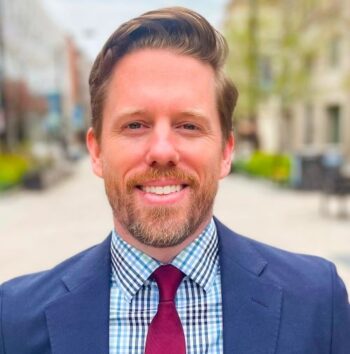
I recently sat down with Eleanor Goldfield at Project Censored to talk about the immigration enforcement landscape in 2026. Project Censored is a media research and advocacy organization that has been tracking underreported and censored news stories since 1976, and their radio show on Pacifica Radio is one of the best places to hear substantive conversations about stories that don’t get adequate coverage in mainstream outlets.
Our conversation covered a lot of ground, from detention deaths to the 287G program to what’s happening in immigration courts. But I want to highlight two ideas from the interview that I think are essential for understanding this moment.
The first is about how we think about the border itself. As a political geographer, I’ve come to believe that one of the most important shifts we can make is moving away from thinking about what the border is and toward thinking about what the border does. As I told Eleanor in our conversation:
Instead of thinking about what a border is, we ask what does a border do? How does the state use the border as a mechanism for accomplishing other things?
The U.S. government has long treated the border as a space where the Constitution doesn’t fully apply. That’s a strange idea if you think about it. You’re inside the United States, but the government says: you’re close to a border, so we’re going to treat this as a zone of exception where laws don’t function the way you think they function. It’s like an event horizon of a black hole where the normal rules start to break down.
This framing matters because once you see the border as a practice rather than a place, you start to understand how that practice spreads. The border isn’t just the Rio Grande or a checkpoint in San Diego. It’s a set of policies, technologies, and legal exceptions that can be deployed anywhere. And that’s exactly what we’re seeing when people talk about the expansion of aggressive immigration enforcement in places like Chicago, Minneapolis, and Los Angeles. People at the border have long raised the alarm about these practices but haven’t felt like they’ve been taken seriously—and we all pay the price when we normalize these things.
Once you normalize that, then there’s policy creep. So you say, okay, well, if the Constitution doesn’t apply at the border, does it apply 10 feet from the border? Well, it shouldn’t apply 10 feet from the border either, because you’re pretty close. And then what about a mile? What about 10 miles? What about a hundred miles? And so what happens is the border gives states, in certain circumstances, the ability to exploit borders to create these kinds of practices and industries.
This brings me to the second idea I want to emphasize: the border as a testing ground. The exceptional legal space of the border zone has become a sandbox where the state experiments with surveillance, force, and the erosion of rights, and then exports those tools and techniques elsewhere.
The border is a testing ground. It’s a sandbox for civil rights violations and state violence where it practices those things, normalizes them, gets good at them, and then moves them… You go to a place because of all of these exceptions built into the use of force and law enforcement. And so our law enforcement learns all of these exceptional practices in this kind of zone of legal exception and then incorporates them back into U.S. policing in a very different context.
This is why what happens at the border doesn’t stay at the border. The technologies, the legal frameworks, the normalized practices of operating in a “zone of exception” inevitably migrate inward. When ICE conducts operations in Portland, Minneapolis, or Columbus, they bring with them an entire apparatus that was developed and refined in spaces where constitutional protections were already weakened. Understanding this dynamic helps explain why the current moment feels different, why enforcement has become so aggressive so quickly. The infrastructure, both physical and legal, was already in place. It just needed to be deployed more broadly and the Trump administration gave immigration enforcement agencies and officers to do exactly that.
All of this background is crucial context for why we’ve seen the recent level of violence in Minneapolis, including the killing of two U.S. citizens—Alex Pretti and Renee Good—and why we’ve seen so many deaths in detention downplayed by the administration.
The full conversation goes much deeper into detention conditions, the 287(g) program that turns local police into immigration officers, the fundamental problems with immigration courts, and what communities can do to respond. I hope you’ll give it a listen.
The homepage for the podcast is available on the Project Censored website or you can listen on Apple Podcasts at the link below. Thank you to Project Censored and Eleanor for having me on.