
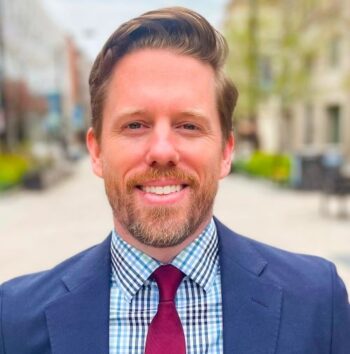
Yesterday I sat down with Doug MacMillan from The Washington Post for a conversation about his reporting on ICE detention. It was one of the most illuminating conversations I’ve had in a while, and I’m grateful Doug made time for it.
Doug came to this beat as a business reporter, not an immigration reporter, and that’s a huge part of what makes his work so valuable. As he said, he “follows the money.” And when you follow the money through ICE’s detention system, you end up in some very revealing places. His reporting over the past year has broken open stories about deaths at Camp East Montana (the highest concentration of detained deaths), the corporate players profiting from human confinement and the growth of ankle monitors, and, most recently, a plan to convert industrial warehouses across the country into massive detention facilities.
That warehouse story is where we spent a lot of our time. The scale of what’s being planned is hard to overstate and represents what I believe is a qualitative shift—not merely quantitative growth—in the Detention Industrial Complex. ICE has already purchased at least eight buildings for close to $700 million, and a document that Elliott Spagat shared in the comments from the New Hampshire government pegged the total projected cost at $38.3 billion. These facilities are former Amazon-style fulfilment centres, empty shells near highways and airports and other logistical hubs, that are being retrofitted to hold seven to ten thousand people each. Doug described it as “detention reengineering,” a deliberate effort to redesign how the United States detains people, modelled explicitly on Amazon’s logistics network. The first facility, near Hagerstown, Maryland, is supposed to open by April. Since I live in Maryland, I can tell you that people are definitely organising against it locally.
To follow more local reporting on immigration, I encourage you to read the excellent work over at Project Salt Box.
Doug and I also talked about deaths in detention and what it means that ICE had its deadliest year on record. Doug’s reporting on the death of Geraldo Lunas Campos at Camp East Montana, which the El Paso County Medical Examiner ruled a homicide, was a significant thread in our conversation. So was the broader question of how we even measure whether the system is becoming more dangerous when the administration has been putting out numbers that, as both Andrew Free #DetentionKills and I have found independently, appear to be off by a factor of a hundred.
After my conversation with Doug, I learned that a seventh person died in ICE custody. Read more here:
One of the things I appreciated most about the conversation was Doug’s candor about the challenges of reporting on a system designed to be opaque. ICE facilities are closed to journalists. Cameras can’t get inside and detainees are difficult to reach. Doug talked about the importance of finding documentary evidence, 911 calls, surveillance footage, government inspection reports, and about the reporters and local organizations doing creative work to get around those barriers. He also talked about something that stuck with me, which is the empathy gap that closed facilities create. When the public can’t see what’s happening inside, it becomes much harder to care. That’s why reporters like Doug are so important and why I encourage everyone to read his work at The Washington Post.
The audience asked great questions about community pushback, local tax implications, staffing challenges, and whether the shift to government-owned facilities might actually open the door to more transparency through public records. Doug pointed out that in places like Social Circle, Georgia, a town of four thousand people being asked to absorb a facility designed for ten thousand, residents who voted for Trump are saying they didn’t vote for this. Republican elected officials are starting to push back carefully, too. Some deals have already been canceled because building owners faced local pressure. Whether that strategy holds long term is another question.
I want to thank Doug for his generosity with his time and his openness about his reporting process. His work is essential reading right now. If you’re not already following what he’s doing at The Washington Post, I’d encourage you to start. And if you or your organization have tips or leads related to detention, Doug put his email in the chat and is genuinely interested in hearing from people on the ground