
 On February 3, 2026, senior Shiromani Akali Dal (SAD) leader Bikram Singh Majithia walked out of Nabha Central Jail, more than seven months after his arrest in a high-profile disproportionate assets case involving alleged laundering of ₹540 crore. His release follows the Supreme Court granting him bail, a decision that has ignited fresh political debate, deepened fault lines in Punjab’s political landscape, and reshaped the dynamics among key parties—especially as the 2027 Punjab Assembly elections approach.
The Shiromani Akali Dal is hailing Majithia’s release as a political victory and vindication. Upon leaving jail, he was welcomed enthusiastically by party workers and supporters. In statements to the media, Majithia charged the Aam Aadmi Party (AAP)-led state government, accusing it of using investigative agencies to pursue political vendettas and even alleging threats to his life while in custody—claims that the government denies.
For the SAD leadership, Majithia’s return to public life is more than just a personal relief; it reintroduces a key face and strategist into the party’s campaign ahead of the 2027 elections. Majithia has challenged the ruling dispensation to address governance issues, promising to intensify opposition against the AAP on matters of law and order, drug policy, economy, and administrative accountability.
This moment also underscores SAD’s broader narrative of resistance against what it terms “political misuse of state machinery”—a theme likely to resonate among its voter base, particularly rural and Sikh constituencies where trust in state institutions is often closely tied to perceptions of fairness and justice.
For the Aam Aadmi Party government in Punjab, Majithia’s release presents both a legal and political challenge. The AAP leaders, including Punjab Finance Minister Harpal Singh Cheema, have reminded the public that bail is not acquittal; the disproportionate assets case and an ongoing trial will continue. The government has suggested that it may even seek a review of the Supreme Court’s bail decision while defending the original investigation as based on substantial material rather than political motive.
The timing of the release, close to election cycles, complicates matters: it allows Majithia the platform to question the AAP’s governance record and potentially influence public perception—especially on issues where the party already faces criticism, such as industry stagnation and unemployment (points Majithia has publicly highlighted in the past).
The Supreme Court’s decision to grant bail after 224 days in custody—and to reject certain restrictive conditions proposed by the state—has legal as well as political resonance. The court’s protection of Majithia’s constitutional rights to residence and free speech reinforces a critical check on state power, something both opposition parties and civil liberties advocates have noted.For the SAD, this legal outcome is a symbolic defeat of what it labels political prosecution, strengthening its claim that the judiciary remains an independent safeguard amidst intense inter-party rivalry.
A significant subplot has been the public support extended by religious figures, such as the head of Radha Soami Satsang Beas (Dera Beas), who visited Majithia in jail and described the allegations as false. This intervention became controversial, triggering criticism from the AAP for prejudging the judicial process. Such dynamics reveal how religion and politics often interweave in Punjab’s public discourse, shaping voter sentiments beyond pure party line-ups.
SAD gains a mobilizing leader: His speeches and campaign mobilization efforts can energize the party cadre and voters disillusioned with the status quo.AAP faces messaging challenges: Defending its actions without appearing authoritarian will be key as it tries to maintain narrative control.Congress and Other Parties: While currently less central in the Majithia-AAP contest, they might capitalize on emerging fissures within voter blocs dissatisfied with both major players.
Majithia’s bolstered political stature could rekindle debates on Punjab’s governance, drug trade, corruption, and federal–state relations—issues that have dominated the state’s political conversations for years.
In summary: Majithia’s release is not just a legal occurrence—it is a political inflection point in Punjab. It reinforces the deepening polarization between the SAD and the ruling AAP, shapes public narratives ahead of elections, and underscores how judicial outcomes can pivotally influence political momentum in states with highly competitive political landscapes.
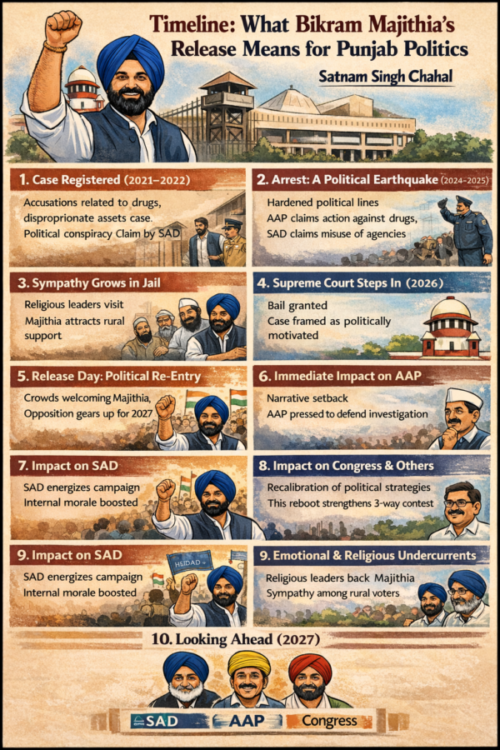
Timeline: What Bikram Majithia’s Release Means for Punjab Politics
1. The Beginning: Case Registered (2021–2022)
The political story began when the Punjab Police registered a high-profile case against Bikram Singh Majithia under the NDPS Act, accusing him of links with drug networks. Even though the Akali Dal called it a political conspiracy, the Aam Aadmi Party and Congress used the allegations to corner both Majithia and the SAD leadership. This period marked the beginning of a long, heated narrative war in Punjab politics. For many voters, Majithia became a symbol of elite political battles rather than ground-level governance.
2. Arrest and Political Earthquake (2024–2025)
Majithia’s arrest triggered a major political storm. The AAP government presented it as proof of their commitment to ending the drug menace. The SAD, on the other hand, declared it a misuse of agencies and an attempt to silence opposition voices. His arrest hardened political lines—supporters saw him as a victim of vendetta, while critics viewed it as accountability. Punjab politics became sharply polarized, with little room for centrist opinion.
3. Life Inside Jail & Growing Sympathy
During his stay in jail, Majithia’s position subtly shifted. Instead of being seen only as a political heavyweight, he began attracting sympathy from sectors of the Sikh electorate and rural clusters who felt the state government was indulging in selective targeting. Visits by religious leaders, political allies, and his consistent message of “politically motivated case” created a narrative of resilience, which the SAD quietly capitalized on.
4. The Supreme Court Step-In (2026)
The turning point came when the Supreme Court examined the evidence and granted him bail. The court noted inconsistencies, flaws in the investigation, and the absence of concrete links in several allegations. This legal relief reshaped the political battlefield—SAD termed it vindication; AAP maintained that bail is not acquittal. But the perception among voters was clear: Majithia had survived a major political assault.
5. Release Day: A Political Re-Entry
When Majithia finally walked out of Nabha Jail, it was nothing short of a political show of strength. SAD cadres flooded the streets, supporters danced, slogans echoed across villages, and Majithia spoke of fighting back against what he called tyrannical governance. His release was not just a personal return—it was the revival of SAD’s confidence ahead of the crucial 2027 elections.
6. Immediate Impact on AAP
For the ruling AAP, Majithia’s release is a setback. Their anti-drug, anti-corruption narrative takes a hit. They now face an aggressive opposition leader who can mobilize cadres, strike emotional chords, and question AAP’s credibility. AAP must now defend its investigation while maintaining its governance image—a delicate balancing act.
7. Impact on SAD
Majithia’s return acts as a booster shot for a struggling SAD. He is one of their strongest orators, strategists, and mass-connect leaders. With him back in the field, SAD’s campaign machinery becomes more energized. Internally too, his presence strengthens party unity and discipline.
8. Impact on Congress and Other Parties
While Congress benefits indirectly from the AAP–SAD fight, Majithia’s release forces them to recalculate strategies. With SAD rising again and AAP under pressure, Congress has to redefine its own narrative to stay relevant. Smaller parties, including BSP and independents, also adjust their alliances and campaign messaging accordingly.
9. Emotional and Religious Undercurrents
Punjab politics is rarely just political—it is emotional, religious, and identity-driven. Majithia’s release, especially after support from certain religious figures, adds a moral layer to his public image. Many rural voters see this as a fight between powerful political forces and an individual who stood firm.
10. Looking Ahead to 2027
Majithia’s release reshapes the 2027 battlefield:
SAD regains its aggressive voice.
AAP faces a rejuvenated opposition.
Congress must find relevance again.
Voters now see a three-way contest, not a one-sided race.