
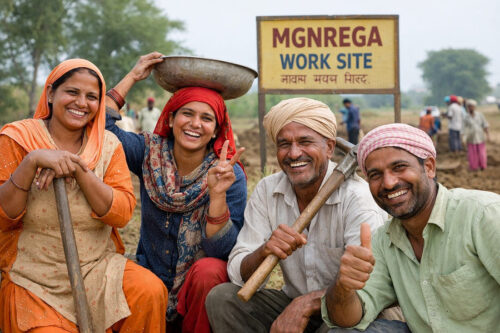
 MGNREGA traces its origins to the National Rural Employment Guarantee Act, 2005, enacted by the UPA government to provide a statutory right to 100 days of wage employment to rural households willing to perform unskilled manual work. In 2009, it was renamed after Mahatma Gandhi to underline its moral and ideological commitment to rural dignity and livelihood security. Over two decades, it evolved into one of the world’s largest public works programmes — yet also one of the most emotionally insulated from scrutiny.
Over time, MGNREGA became less a public policy subject to evaluation and more an article of faith. Questioning its design or outcomes was quickly branded “anti-poor”. This moral shield allowed serious flaws to persist, uncorrected and unchallenged. The government’s move to replace it with the VB-G RAM G Bill, 2025 — raising guaranteed employment from 100 to 125 days, introducing Centre–state cost sharing, and pausing work during peak agricultural seasons — has forced an overdue reckoning. MGNREGA had outlived its original design, harming the rural economy it claimed to protect while breeding inefficiency and corruption.
From Employment Guarantee to Institutionalised Leakage
The scheme’s single biggest structural defect was 100 per cent central funding of wages. When states paid nothing, they owned nothing — and were accountable for nothing. Panchayats could demand work with minimal scrutiny; states could abdicate responsibility; and the Centre continued writing cheques with little ground-level control.
The outcome was predictable and well documented:
· Ghost workers and recycled job cards
· Muster rolls inflated with fictitious labour
· Works that existed only on paper
· Machines disguised as manual labour
· Assets that added little durable productive value
This was not accidental slippage. It was the logical outcome of a system with no financial stake for states and weak accountability for outcomes.
Punjab illustrates this clearly. Verification drives between 2022 and 2025 detected over 4,900 bogus job cards, uncovering wages siphoned to the dead, collusion between supervisors and contractors, and fictitious works. Suspensions and recoveries followed — but only after systemic leakage had already occurred.
How MGNREGA Distorted the Farm Labour Market
One of MGNREGA’s most damaging — and least discussed — effects was its distortion of agricultural labour.
By operating year-round and often generating easy wages with weak supervision, the scheme:
· Pulled labour away during sowing and harvesting
· Artificially tightened rural labour markets
· Pushed up wage volatility
· Hurt small and marginal farmers the most
In Punjab’s farming belt, cultivators repeatedly reported labour shortages during critical agricultural windows, delayed operations, rising costs and forced mechanisation. A programme meant to support rural livelihoods ended up undermining agriculture — the backbone of rural employment.
The proposed 60-day pause during peak agricultural seasons is therefore not anti-worker; it is pro-rural economy. Farm labour must first serve farming.
Old Scheme vs New Scheme: What Has Really Changed
The proposed VB-G RAM G framework is not merely a renaming exercise. It attempts to correct multiple structural weaknesses that plagued MGNREGA for two decades.
Why These Changes Matter
Perhaps the most critical reform is the introduction of biometric authentication for worker attendance. Under MGNREGA, ghost beneficiaries flourished because verification happened after wages were paid, if at all. Manual muster rolls were easy to inflate, recycle or fabricate. Biometric attendance shifts control to the front end, eliminating fake workers before money leaves the system.
Equally important is the shift from an open-ended demand-driven model to normative allocation. The earlier framework functioned like a blank cheque, vulnerable to political pressure and inflated demand. Planned allocation introduces fiscal realism, prioritisation and asset quality.
The Centre–state cost-sharing model is another structural correction. When states paid nothing, inefficiency flourished. When states pay, they scrutinise. Financial participation forces planning discipline, improves monitoring, and aligns incentives with outcomes.
The 60-day agricultural pause corrects a long-ignored distortion. Employment guarantees cannot undermine farming — the primary rural livelihood. Aligning public works with agricultural cycles strengthens, rather than sabotages, the rural economy.
Finally, sharper rules on asset durability, machine use, social audits and unemployment allowance enforcement signal a shift from headline-driven welfare to outcome-driven governance.
Why the Opposition Is Opposing It
Opposition parties have mounted strong resistance, arguing that the overhaul dilutes the original legal right to work. Priyanka Gandhi Vadra has accused the Centre of attempting to expand control while shrinking responsibilities and funding, warning that cost-sharing could burden states and weaken worker entitlements. Congress leaders have also demanded that the Bill be referred to a parliamentary committee, raising concerns over implementation, wage adequacy and centralisation.
A major plank of opposition has been the removal of Mahatma Gandhi’s name, portrayed as disrespectful, ideologically motivated and administratively wasteful. Critics argue that renaming the scheme erodes its moral foundation and legacy.
The Name Debate: Unnecessary, but Not the Core Issue
The change of name was unnecessary and avoidable. It has added political heat without policy value and distracted attention from substantive reform. Retaining Gandhi’s name while reforming the scheme could have preserved consensus and reduced polarisation.
Yet symbolism should not obscure substance. Most changes proposed — more workdays, stronger oversight, state accountability, alignment with agriculture and improved asset quality — are corrections long overdue.
Reform Must Not Be Held Hostage to Symbolism
Even if the name is changed, the reforms should not be opposed. MGNREGA’s weaknesses — leakage, poor asset creation and labour distortions — are widely acknowledged. A scheme guaranteeing 125 days instead of 100, with greater state involvement and accountability, and stricter monitoring, is objectively an improvement if implemented honestly.
Mahatma Gandhi believed in the dignity of labour, integrity in public life and moral accountability. He would not have defended a failing system merely because it carried his name. He would have insisted on transparency, honesty and effectiveness — even if that meant shedding symbolism to preserve substance