
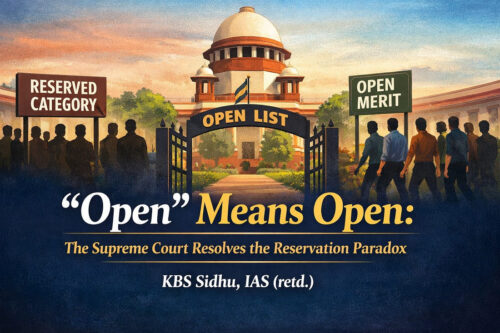
 On 19 December 2025, a Division Bench of the Supreme Court comprising Justice Dipankar Datta and Justice Augustine George Masih delivered a judgment that deserves attention well beyond the narrow world of service law. The Apex Court’s detailed 45-page judgment became available only today (4 January 2026). It addresses a question that ordinary applicants, parents, and hiring authorities have argued over for years: if a candidate belongs to a reserved category but scores high enough to clear the open/unreserved cut-off, should that candidate be counted in the open list—or forced to remain within the reserved stream simply because they applied under it?
That may sound like a technical dispute about list-making. In practice, it has often decided who gets to proceed to the next stage of a recruitment, and who is shut out for good. It has also fed a particularly corrosive public suspicion: that the system can end up admitting a lower-scoring “general” candidate while excluding a higher-scoring reserved-category candidate, not because reservation demands it, but because the administration has mistakenly treated the “open” category as a closed compartment.
The Court has now put the matter in plain constitutional English: “open” means open. An open (unreserved/general) vacancy is not a quota earmarked for any social group. It is a merit pool available to all candidates, regardless of caste or class, so long as the candidate has met the open standard without availing substantive relaxations that alter comparability.
The real-world anomaly behind the case
The case arose from recruitment to Junior Judicial Assistant/Clerk Grade-II posts in the Rajasthan High Court and allied institutions. The selection had two stages: a written test of 300 marks followed by a computer typewriting test of 100 marks, with final merit to be drawn on the aggregate. The recruitment notice fixed minimum qualifying marks (50% for general, 45% for certain categories, 40% for SC/ST/PwD) and provided that candidates securing the minimum marks would be shortlisted up to five times the number of vacancies, on a category-wise basis, for the typing test.

Then came the twist that is becoming increasingly common in competitive examinations: cut-offs for several reserved categories rose above the cut-off for the general/open category. Candidates from reserved categories who scored more than the general cut-off still failed to reach the even higher cut-off within their own category, because competition in that reserved pool was intense. The recruiting authority treated the open list as if it were meant only for “general category” candidates, and it shortlisted reserved candidates only within their own category lists. The consequence was stark: a candidate could outscore many open-category candidates and still be excluded from the next stage because their reserved category cut-off happened to be higher.
This is not a theoretical unfairness. In any multi-stage process, shortlisting is a gatekeeping event: if you are excluded there, you do not get to compete further, even if you could have earned an open seat on merit. The High Court held that this practice violated equality and directed a reworking of the lists. The Supreme Court has now upheld that approach.
The first principle the Court insists upon: the open category is not a “general category quota”
The Court’s key move is to refuse a linguistic—and constitutional—distortion that has crept into public conversation. We casually say “general seats” to mean “seats for the general category”. But constitutionally, unreserved seats are not “for” the general category. They are for everyone, filled on merit.
Once that is accepted, the consequence becomes unavoidable. If a reserved-category candidate clears the open cut-off on the same standard, that candidate cannot be barred from open vacancies merely because they belong to a reserved group. Doing so would convert the open list into a kind of communal reservation for the socially dominant—precisely what the Constitution’s equality code does not permit. Reservation is meant to ensure representation for groups historically excluded, but it does not authorise the State to erect an identity-based wall around open posts.
The Court’s reasoning implicitly speaks to a deeper point that rarely gets stated honestly: the Indian reservation system was never designed as two hermetically sealed streams—one for “general”, one for “reserved”. It was designed as one common competitive field (open seats), with an additional safety net (reserved seats) so that representation is not choked by historic disadvantage. The error occurs when administrations treat the open field as closed.
Why “you applied under reservation” cannot become a trap
A long-standing administrative reflex has been to say: “You declared your category, therefore you must remain in that category list.” That logic sounds tidy. It is also deeply flawed.
Candidates declare their category for many reasons: because the form requires it, because documentation is needed for eligibility, because the recruiting authority must compute vertical and horizontal reservations, and because candidates are entitled to be considered for reserved vacancies where applicable. None of that can mean the candidate has waived their right to be considered for open vacancies if they meet the open standard.
If the State treats the act of declaring one’s category as a permanent confinement to a quota lane, it pushes the system towards a perverse incentive: conceal identity to be treated as “open”. That is not equality; it is administrative coercion by paperwork. The Court’s approach restores the obvious: a citizen does not become less eligible for an unreserved post merely because the citizen belongs to a community for whom reservation exists.
The “double benefit” slogan—and why it misfires
The most politically potent objection to placing meritorious reserved-category candidates in the open list is the claim of “double benefit”: they can compete for open seats and also have reserved seats available.
The Court rejects this as a misunderstanding. The core distinction is between (a) selection because reservation lowered the standard for you, and (b) selection because you met the open standard on merit. When a candidate meets the open cut-off without substantive relaxations, the candidate’s success is not a “reservation benefit” at all; it is the ordinary product of open competition. To call that a “double benefit” is to treat the candidate’s very identity as a disqualifying advantage.
There is also an important practical point here. If meritorious reserved candidates are counted against reserved seats instead of open seats, the system can perversely reduce the ability of reservation to help those who actually need it. Putting meritorious candidates into open seats frees reserved seats for candidates who fall short of open thresholds but are nonetheless eligible within their category. In other words, the Court’s approach is not an attack on reservation; it is an attempt to make the mechanism work as intended.
The real limiter: competing on the “same standard” and the role of substantive relaxations
The Court’s rule is not absolute in the naïve sense that “any reserved candidate scoring above the open cut-off can claim an open seat in every situation”. The judgment is anchored to a common-sense constitutional limiter: did the candidate compete on the same standard as open-category competitors?
This is where public debate often becomes sloppy. Many people assume that any reserved-category presence in open seats must be the product of quota. That is frequently untrue. But the reverse is also possible: if a candidate has availed substantive relaxations—age relaxation, additional attempts, relaxed eligibility, reduced qualifying marks, extended zone of consideration—then the candidate may not be comparable with those who had to satisfy stricter conditions to even enter the field.
The Court recognises that recruitment rules and executive instructions sometimes expressly bar movement into unreserved seats when relaxed standards have been applied. That is not the controversy this case turned on. Here, the Court recorded that the petitioning candidates were not shown to have availed any such concession or relaxation; and no rule or instruction was shown that barred treating them as open candidates once it became clear that they had outperformed the open-category cut-off.
This distinction is crucial for keeping the judgment intellectually honest. It prevents a simplistic reading that would provoke needless backlash. The Court is not saying “reservation gives you open seats regardless of relaxations”. The Court is saying “if you have met the open benchmark on merit, you cannot be excluded from open vacancies merely because of your social category”.
Not “migration” as a favour, but merit as a right
Service law has often used the language of “migration” as if reserved candidates are being allowed to “move” to the open category by some administrative indulgence. The Court dismantles that symbolism. Where a candidate outperforms open-category candidates and appears high on the merit list at a meaningful stage, the Court treats the outcome as a merit-based adjustment—indeed, it uses the phrase that this situation involves a “merit-induced shift”, and that calling it “migration” can obscure what is really happening.
This matters because “migration” invites moralising: as though a candidate is taking something that belongs to someone else. A merit-based adjustment is the opposite: it is recognition that unreserved posts are meant for the most meritorious candidates on the applicable standard, without caste filters. If the system denies that recognition, it tells a candidate: you must “pay a price for your merit” because of who you are. That is not merely unfair; it is constitutionally inverted.
Why the timing matters: shortlisting is not a harmless administrative step
One of the judgment’s most practical contributions lies in its treatment of shortlisting. Authorities often argue that category adjustments can be done at the final stage, and that interim shortlisting can be done category-wise. That might be defensible where the first stage is purely a screening test and the marks do not carry forward.
But in this recruitment, the written test constituted 75% of the total marks, and therefore was not a disposable filter. Excluding a meritorious candidate at that stage, on the basis of a compartmentalised list, could permanently deprive the candidate of open-category consideration. The Court’s approach implies an important operational rule: whenever a stage is meaningfully determinative, the open-category principle cannot be postponed as a ceremonial correction at the end.
This is also why the Court was unpersuaded by reliance on older precedents that dealt with preliminary examinations and “migration” occurring only after final results. Those cases were built around different selection architectures. The present decision is tailored to modern recruitment realities, where early-stage decisions can be outcome-determinative.
Estoppel: participation does not sanctify illegality
The recruiting authority also raised an argument familiar to anyone who has followed recruitment litigation: candidates participated in the process, therefore they are estopped from challenging it later.
The Court rejects this as well, drawing a line that is both doctrinally settled and practically sensible. Participation may amount to acceptance of the prescribed procedure, but it does not amount to acceptance of an illegality or a constitutional infirmity that becomes visible only when results are declared. Here, candidates could not reasonably have anticipated that scoring above the open cut-off would still exclude them from the next stage because the authority would treat open vacancies as a general-category compartment. The constitutional wrong surfaced in the result’s application, not in the candidate’s voluntary choice.
The fairness caveat that reveals the Court’s intent
There is a subtle but important fairness note running through the Court’s approach. A reserved-category candidate who enters the open list on merit might, in some settings, lose access to a preferred service/post that could have been available under the reserved quota. If “open merit” placement becomes a disadvantage for a meritorious reserved candidate, that would itself be perverse. The Court’s reasoning signals that the system must not weaponise open merit against reserved candidates; it must preserve coherence, fairness, and the purpose of reservation as inclusion rather than punishment.
This is worth emphasising because public commentary often treats judgments like this as a zero-sum victory for one side. It is not. The judgment aims to correct an administrative distortion that created unfairness both ways: it harmed meritorious reserved candidates by excluding them from open consideration, and it harmed the legitimacy of reservation by producing outcomes that looked irrational and resentful.
What recruiting authorities must now do—and why it is worth the effort
After this judgment, recruiting bodies—High Courts, Public Service Commissions, departments, and agencies—should take the operational message seriously:
Treat “open/unreserved” vacancies as a merit pool open to all.
Build the open list on merit first, without caste filters, including those who clear the open cut-off on the same standard.
Then fill reserved vacancies from the remaining eligible candidates, applying category cut-offs and reservation percentages.
Be transparent about what counts as a substantive relaxation (age, attempts, eligibility conditions, lowered standards) and apply the rule consistently.
Yes, this requires better record-keeping. But the alternative is to keep litigating the same issue across States and recruitments, while allowing avoidable resentment to accumulate. If the State can operate complex rosters and multi-layered horizontal reservations, it can certainly operate a selection process that does not turn “open” into a misnomer.
Why we agree with the Bench
We agree with the interpretation adopted by the Division Bench because it restores constitutional clarity to a question that had become needlessly muddied. The unreserved category cannot be treated as a private preserve of any social group without violating the equality principle. Reservation cannot be implemented in a manner that compels a citizen to “pay a price for merit” because of identity. And the system’s legitimacy depends on eliminating precisely these avoidable paradoxes—paradoxes created not by the Constitution’s promise of social justice, but by administrative compartmentalisation.
However, many who do not take benefit of reservation under any category will see this as further shrinking in space for the general category and some political party may make all the noises.
End Note: What the Judgment Does Not Decide — Reservation During Promotions
While the Supreme Court has conclusively answered this question for direct recruitment, it is likely to throw up a second tier of harder issues—possibly spawning its own round of protracted, contentious litigation. Consider just one. If an OBC or Scheduled Caste applicant enters service through an open/unreserved post on pure merit, without availing any substantive relaxation, what follows later in service? Would such a person—where the service rules so provide—still be able to claim the benefit of reservation in promotion or accelerated progression when their turn arises on the promotional roster? Promotions operate in a distinct and more complex legal terrain, and disputes over how “open merit” entry interacts with promotional entitlements and roster mechanics are easy to foresee. For the present, however, so far as direct recruitment is concerned, the law declared by the Supreme Court is crystal clear.