
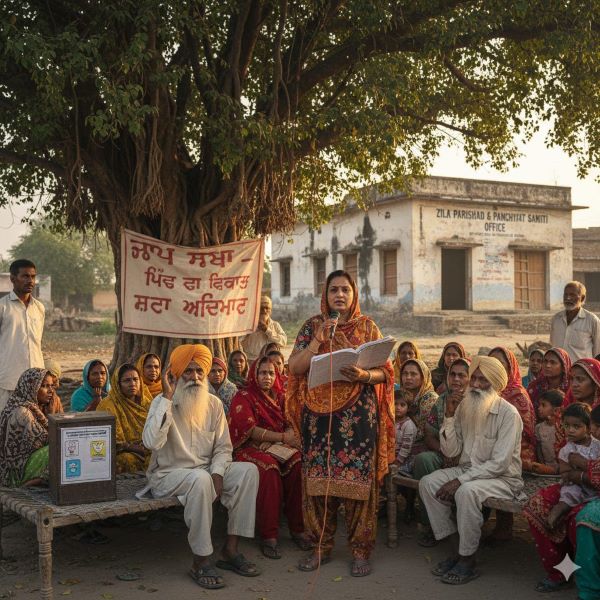
 The recent Panchayat Samiti and Zila Parishad elections have, to a certain extent, reignited political interest in Punjab’s rural areas. That interest is understandable. With the Punjab Vidhan Sabha elections due as early as February 2027, every political party—and every poll analyst—has begun drawing conclusions, constituency by constituency, about what these local results might mean for the next Assembly contest. The temptation is particularly strong with Zila Parishads. Their direct constituencies are expansive, often socially diverse, and sometimes resemble the demographic complexity of a Vidhan Sabha segment. In many political conversations, Zila Parishad outcomes are treated as near-equivalents of Assembly indicators.
Yet that reading, while politically convenient, is administratively and electorally incomplete. Local body elections do reveal trends—organisational depth, cadre mobilisation, caste alignments, the mood in specific belts—but they are also shaped by a deeper institutional truth: for decades, Punjab’s Panchayati Raj has oscillated between democratic theatre and meaningful governance. To understand what these elections can and cannot predict, one must trace the longer arc of rural local government—an arc I have observed from the inside since I joined the Punjab cadre in August 1984, in the immediate aftermath of the most unfortunate Operation Blue Star.
Joining the Service: Panchayats Visible, Higher Tiers Dormant
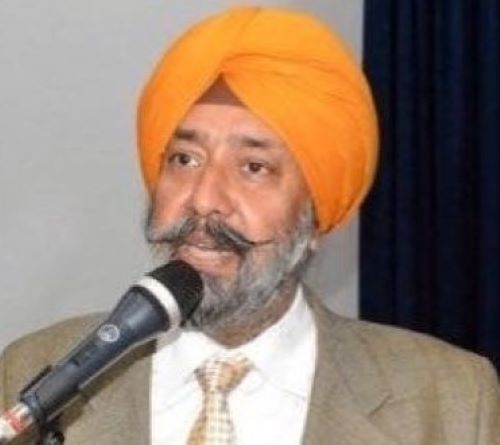
When I entered service, the three-tier Panchayati Raj structure existed more in concept than in lived reality. After my two-year training, my first substantive field posting was as SDM Samrala (district Ludhiana), in August 1986. The Gram Panchayat was visible, socially embedded, and politically consequential. But Panchayat Samitis and Zila Parishads were, for long stretches, either under supersession or so marginal that many in district administration scarcely encountered them as functioning institutions. In the field, one dealt with Panchayats—over village disputes, land and commons (including shamilat land), development schemes, and the informal hierarchies that shape rural life. The intermediate and district tiers were not absent in law, but they were largely absent in practice.
This institutional thinness matters because it shaped rural expectations. A system that does not routinely experience intermediate- and district-level self-government does not automatically develop the culture, procedures, and accountability habits that make such bodies effective. When those tiers are revived later, the gap between promise and performance is magnified.
1987–1992: Democracy Under the Shadow of Terror
By 1987–1992, when I served in the field as a Sub-Divisional Magistrate and later as Additional Deputy Commissioner, Punjab’s public life was deeply distorted by militancy and the State’s counter-response. The State remained under President’s Rule, with Governors coming and going like batsmen in a cricket innings that collapses before fifty. Democracy did not vanish formally, but it did not operate normally. Bye-elections, when they were conducted at all, were held under fear; participation was uneven; and institutions that require routine political functioning—such as multi-tier local self-government—found it difficult to develop.
In practical terms, Gram Panchayats remained the most visible elected bodies. They were not idealised instruments of popular sovereignty; rural power structures and coercions were real. But they were the primary institutional bridge between rural society and the State. In those years, to speak of Panchayat Samitis and Zila Parishads as an operating “third tier” would have been more constitutional aspiration than administrative fact.
1992–1994: The Legitimacy Gap and the “Return of Democracy”
The February 1992 Punjab Vidhan Sabha election, held under the shadow of terror, produced a government but also a paradox. The Congress under Beant Singh assumed office, yet the very low polling percentage created a legitimacy deficit that everyone could see. Constitutional authority existed; moral confidence rooted in mass participation did not. I was posted as Deputy Commissioner, Amritsar, in May 1992, and remained there until August 1996. Amritsar—then including the present-day Tarn Taran district—had 16 development blocks, the highest for any district in the State, and therefore offered a particularly wide canvas on which to observe the changing relationship between rural society, administration, and democratic participation.
It is in this context that the January 1993 state-wide Gram Panchayat elections acquired significance far beyond local development—and were seen by many as a considerable political risk. The massive turnout was widely interpreted, and universally applauded, as a marker of Punjab’s “return to democracy”. For many citizens, it was the first opportunity in years to participate in a political and electoral exercise that felt less constrained by fear. For the state government, it also served as a means of reaffirming legitimacy in the countryside—where some of the most durable political verdicts in Punjab are often forged.
1994 and After: Constitutional Promise Meets Administrative Reality
Soon thereafter came the constitutional reimagining of local governance. The 73rd (and 74th) Constitutional Amendments aimed to convert local bodies from administrative conveniences into a constitutional tier—complete with periodic elections, reservations, and a framework for devolution. Punjab followed with the Punjab Panchayati Raj Act, 1994.
The early years carried genuine enthusiasm. Elections to Panchayats, Panchayat Samitis and Zila Parishads were seen as the institutional flowering of democracy after a decade of disruption. Chairmen and Vice-Chairmen were elected. New local leadership emerged. Political parties treated the exercise as both governance and groundwork.
And yet, the optimism did not survive prolonged contact with the State’s real distribution of power. Very quickly, citizens and local representatives grasped an uncomfortable truth: you can create elected institutions by law, but you cannot create local self-government without transferring actual authority. In day-to-day administration, the decisive levers—fund approvals, technical sanctions, staff control, scheme selection, release of money—remained concentrated in the official machinery. Politically, influence often rested with the local MLA, especially when he belonged to the ruling party.
University of Manchester, 1996–97: A Thesis on “Creeping Recentralisation”
My own engagement with this question deepened after my stint as Deputy Commissioner, Amritsar, when I proceeded to the University of Manchester for GOI-sponsored MA (Economics). In 1996–97, I wrote my dissertation on The Politics of Decentralisation in the Indian Punjab. The central finding was stark: even constitutionally mandated devolution was not taking place in the manner promised.
My hypothesis went further. I argued that decentralisation could function as a political rhetoric deployed by the central (and State) elite to stabilise and deepen control over the periphery. In other words, the language of empowerment could mask a process of creeping recentralisation—through rules, administrative discretion, fiscal dependence, and political patronage. At the time, this may have sounded like an academic provocation; later, it began to read more like institutional description. A few months ago, when I dusted off my dissertation and browsed through it again, I realised that decentralisation and devolution had failed to a degree far greater than what I had anticipated—indeed, apprehended—in 1997.
2006–07: A Rare Attempt to Transfer Functionaries and Accountability
A decade later, I saw an unusually concrete attempt to operationalise real devolution—followed, almost immediately, by a reversal that illustrated precisely the “creeping recentralisation” dynamic.
In 2006–07, the final year of the Captain Amarinder Singh government, I was posted as Secretary, Rural Development and Panchayats. The government’s focus—perhaps influenced by the Sonia Gandhi-led National Advisory Council—was institutionally bold: to place essential frontline service delivery under Panchayati Raj institutions, especially at the Zila level. The centrepiece was the recruitment of employees directly answerable to the PRIs.
We evolved transparent and rational criteria to recruit primary school teachers as employees of the Zila Parishad, with an explicit statutory provision that they would work under its control. Transfers were deliberately kept extremely limited—precisely because transfers are among the classic instruments through which departments retain hidden control.
A similar model was applied to health services. MBBS doctors were recruited on a contractual basis with the Zila Parishad, supported by an attendant pharmacist and a small budget for local expenditures on medicines and essentials. On technical matters, they could seek professional guidance from the Director of Health Services, but the administrative and local accountability framework was designed to remain with the Zila Parishad institution. Comparable recruitment was carried out for Animal Husbandry veterinary doctors as well.
Importantly, this restructuring was implemented without serious disruption. It worked smoothly enough that, at the grassroots, people were visibly satisfied. Local institutions appeared to be gaining real authority, and service delivery seemed to be moving closer to the citizen.
2007–2009: The Rollback That Proved the Rule
Then came the political transition. The 2007 Assembly election brought the Prakash Singh Badal government to power. Many expected that strengthened Panchayati Raj institutions would continue to grow and flourish. Decentralisation is, after all, a popular slogan across parties—especially the Shiromani Akali Dal, which has traditionally espoused rural and farmers’ causes.
But it soon became evident that the new dispensation did not want empowered Panchayati Raj institutions to exist in a substantive sense. The preference was to restore the original departmental hierarchy.
Ironically, I witnessed this reversal from the other side. From 2007 to 2009, I was posted as Secretary, School Education, and it became my responsibility to roll back precisely what had been implemented in 2006–07: to bring those employees recruited under the Zila Parishad framework back under the control of the School Education Department.
In administrative terms, such reversals are often justified as “technical” corrections. In political economy terms, they validate a deeper pattern. When decentralisation begins to acquire real teeth—control over staff, postings, and day-to-day accountability—higher-level political and bureaucratic systems often react by reclaiming that authority. The third tier is tolerated as an electoral layer; it becomes threatening when it begins to behave like an actual tier of government—or even governance.
Why Today’s Enthusiasm is Lower—and Why That is Rational
This institutional history explains why lower enthusiasm in recent Panchayat Samiti and Zila Parishad elections is not merely a sign of apathy. It is often the product of experience. Rural Punjab has learnt that the Gram Panchayat—particularly the Sarpanch—can exercise more immediate influence within the Gram Sabha area than the higher tiers, because the higher tiers remain fiscally dependent and administratively constrained.
A Chairman may have a title; a member may have a constituency; but without control over funds and implementing personnel, the institution cannot command outcomes. It can only claim them after someone else has decided. Where bureaucrats control releases, and where political gatekeeping determines priorities, intermediate- and district-tier elected bodies struggle to retain public credibility.
The Fiscal Trap: Money as the Real Measure of Devolution
The fiscal architecture reinforces this dependency. A genuine third tier requires predictable and meaningful devolution of resources. Yet the implementation of State Finance Commission and Central Finance Commission transfers has too often been partial, delayed, or conditional. When funds are tied, releases uncertain, and expenditure controlled by departments, elected bodies cannot function as governments. They become petitioners.
This is why “power to the people” frequently remains rhetorical. The structure exists, elections happen, and yet the decisive power remains elsewhere—largely where the purse and the implementing machinery are controlled.
Reading 2027 From Local Results: What Analysts Miss
Yes, Zila Parishad constituencies can resemble Vidhan Sabha segments, and parties will treat these elections as organisational tests. But voter motivations in local contests are not identical to those in Assembly elections. Local contests are shaped by personal networks, village factions, immediate grievances, and caste arithmetic in more intimate forms. In addition, where voters sense the institution is weak, participation itself can carry an element of cynicism: why invest emotionally in a body that does not truly govern?
Therefore, local results can suggest trends, but they cannot be treated as straightforward predictors of Assembly outcomes without recognising the institutional handicap under which these bodies function.
What Would Make the Third Tier Real
If Punjab wishes Panchayat Samitis and Zila Parishads to be taken seriously—not merely as pre-election barometers but as legitimate tiers of governance—fundamental changes are necessary. The transfer of functions must be real, not cosmetic. The transfer of functionaries must accompany functions, so that elected bodies can direct implementation rather than merely request it. Most crucially, the transfer of funds must be predictable, untied to the greatest extent possible, and protected from discretionary gatekeeping.
Without these three—functions, functionaries and funds—the third tier will remain a slogan.
The Message of the Recent PRI Elections
The recent Panchayat Samiti and Zila Parishad elections may well provide political signals about 2027. But their deeper message is institutional: Punjab’s rural democracy still lives with the unfulfilled promise of constitutional decentralisation. Unless the State moves beyond rhetoric to genuine devolution, the Panchayat Samiti and Zila Parishad will continue to be treated as stepping-stones for Assembly politics rather than as durable foundations of self-government.
Elections will recur, analysts will extrapolate, parties will celebrate and lament—but real power will remain where it has long resided: in the hands that control the purse and the administrative machinery. The people, meanwhile, will continue to participate—enthusiastically at times, reluctantly at others—in institutions that have not yet been allowed to become what the Constitution envisaged: a true third tier of government.