
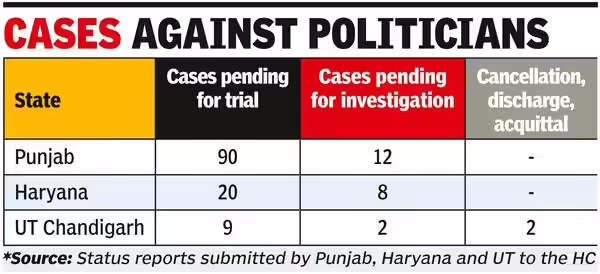
 The criminalisation of politics in Punjab is a cross-party phenomenon, cutting across ruling and opposition parties alike. No major political party—whether Aam Aadmi Party (AAP), Shiromani Akali Dal (SAD), Bharatiya Janata Party (BJP) or Indian National Congress (INC)—has been free from legislators who face FIRs, chargesheets or long-pending trials. While the nature and seriousness of allegations differ from leader to leader, the aggregate picture is alarming: more than 100 current and former MLAs and MPs from Punjab face criminal cases. This party-wise analysis shows how widespread the issue truly is and how it affects governance, public trust and the image of Punjab’s political system.
Aam Aadmi Party (AAP) – The Ruling Party with the Highest Number of High-Profile Cases
Being the ruling party with the largest number of MLAs in Punjab, AAP also has the highest number of active criminal cases against its legislators. The cases range from serious offences like sexual assault and extortion to financial fraud and intimidation. One of the most controversial examples is AAP MLA Manjinder Singh Lalpura, who was convicted and sentenced to four years in prison for molesting a Dalit woman in 2013. This conviction created a major embarrassment for the party, especially because it came at a time when AAP claimed to stand for clean governance. Another deeply troubling case involves AAP MLA Harmeet Singh Pathanmajra, who faces charges of rape, cheating and criminal intimidation. His alleged escape from police custody and months-long disappearance raised serious questions about how a sitting MLA could evade law enforcement so easily.
AAP has also been affected by corruption-related cases. Raman Arora, MLA from Jalandhar Central, has faced multiple FIRs related to extortion, coercion of contractors and misuse of official authority. Even after securing bail in one case, he was abruptly re-arrested in another, showing that the allegations against him are repeated and multi-layered. Financial crime cases further add to the party’s list, such as the arrest of Jaswant Singh Gajjanmajra by the Enforcement Directorate for alleged bank fraud and money laundering. Although he secured bail, the ED’s charges are serious and still under the court’s scrutiny. These cases collectively weaken AAP’s image as an anti-corruption party and reflect internal screening failures during ticket allocation.
Shiromani Akali Dal (SAD) – Older Political Leadership Facing NDPS, DA, and Corruption Probes
Shiromani Akali Dal, once the dominant political force in Punjab, has several senior leaders facing large-scale investigations and criminal allegations. One of the most high-profile cases is against Bikram Singh Majithia, who faces NDPS Act charges linked to alleged drug trafficking networks. His case has been under investigation for years, and injunctions, bail petitions and political pressure have kept the case alive in public debates. Additionally, Majithia was arrested in a disproportionate assets case, where authorities have accused him of possessing large amounts of wealth inconsistent with declared income. A voluminous chargesheet—running into tens of thousands of pages—highlights financial dealings that remain under judicial examination.
Other SAD leaders across districts have faced cases related to land disputes, corruption, illegal mining, and interference in police operations. In rural regions, clashes during panchayat, zila parishad and block samiti elections often result in SAD leaders and workers being booked for various offences. While many of these cases arise from political rivalry, others involve serious allegations such as intimidation of officials, misuse of influence and financial wrongdoing. SAD’s long political dominance has meant that many cases date back several years, and slow judicial processes have kept them unresolved, giving rival parties ammunition to question SAD’s moral standing.
Indian National Congress (INC) – Long Political History, Old and New Cases Still Pending
The Congress party, which ruled Punjab for decades, also has a significant number of MLAs and former MPs who face criminal cases. Many of these are older cases involving charges such as unlawful assembly, assault, corruption in municipal tenders, and financial irregularities during earlier tenures. Leaders from the Patiala royal family’s political circle, as well as former ministers, have been named in several vigilance investigations relating to misuse of authority, manipulation of panchayat funds and questionable land deals. While not all cases involve serious criminality, they highlight a historical pattern of administrative overreach and political interference.
In districts like Ludhiana, Jalandhar and Ferozepur, several Congress leaders also face allegations of extortion, threats, or direct involvement in political clashes. Some cases stem from aggressive protests where Congress leaders have been booked for violating Section 144, obstructing public officials, or inciting demonstrators. Others relate to internal district-level rivalries, where local leadership struggles often spill into FIRs. Congress has repeatedly blamed ruling parties for “political vendetta,” but the existence of multiple cases, including corruption inquiries, cannot be denied. The party’s long tenure in power left a long paper trail that continues to appear in vigilance and court records.
Bharatiya Janata Party (BJP) – Fewer MLAs but Several Leaders Facing Long-Pending Charges
The BJP has fewer MLAs in Punjab compared to other parties, but some of its leaders face serious allegations, particularly in relation to communal disturbances, property fraud cases and misuse of authority during earlier coalition governments. Certain BJP leaders in districts like Hoshiarpur, Amritsar and Pathankot have been named in cases involving assault, intimidation, illegal construction and financial irregularities. While many BJP cases are not as high-profile as those involving AAP or SAD leaders, they nevertheless reflect deeper structural issues within the party’s local leadership.
Some BJP leaders have faced FIRs during farmer protests and agitations, where charges have included unlawful assembly, obstruction of duty and incitement. Cases linked to inflammatory speeches or communal remarks have also been registered in a few instances. Although BJP often positions itself as a party promoting discipline and accountability, the existence of criminal allegations against its Punjab leadership shows that the problem of criminalisation is not limited to any single political party in the state.
Independent Candidates & Smaller Parties – Localised Clashes and Land Disputes
Besides major parties, several independent MLAs and leaders from smaller parties such as BSP and Lok Insaaf Party also face criminal cases. Most of these cases arise from local clashes, land disputes, interference in police matters or allegations of threats and intimidation during elections. Some independent MLAs have been involved in long-standing property conflicts, particularly in rural areas where political influence is used to settle personal disputes. Though not widely reported, these cases contribute significantly to the overall number of criminal cases involving elected representatives.
Across AAP, SAD, Congress, BJP and independents, criminal cases against Punjab MLAs and MPs show a pattern of deep-rooted political dysfunction. The criminal allegations—ranging from molestation, rape, extortion and NDPS violations to corruption and financial fraud—demonstrate that the issue is not confined to one party but spans the entire political spectrum. Courts have now begun tightening oversight, but political parties continue to field candidates with serious criminal backgrounds. Unless swift judicial action and strict party-level screening are enforced, Punjab will continue to suffer from a political culture where power is mixed with criminality, ultimately weakening public trust in democracy.