
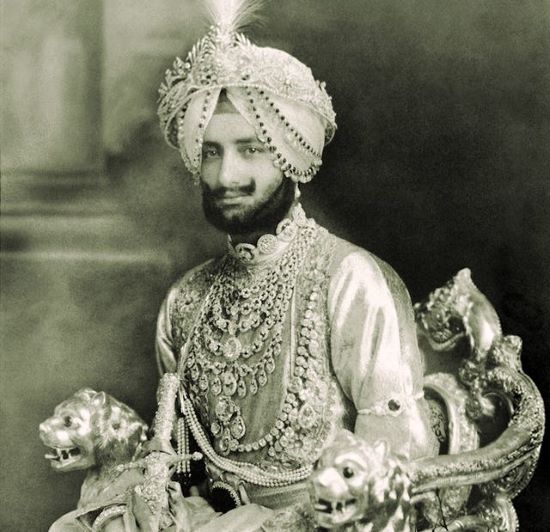
 Most of us identify Patiala with the Patiala Peg, the Patiala ‘Pug’ or turban, the Patiala paranda as a colourful flourish in a woman’s long hair, and the fashionable Patiala salwar that swung its way from royal patios to Bollywood and global wardrobes. These images of generous measure, flamboyant style and easy self-confidence form the popular memory of Patiala. Yet behind this cheerful cultural montage lies a far more complex political story: that of a dynasty which, for almost three centuries, mastered the art of surviving and prospering through carefully calibrated submission to whichever authority ruled the subcontinent at a given time.
Patiala’s trajectory through the eighteenth, nineteenth and twentieth centuries is not a saga of heroic defiance or martyrdom, or even unqualified nationalism. It is, instead, a case study in political pragmatism—or, as critics might argue, systematic opportunism. The state founded by Baba Ala Singh in 1763 represents a remarkable historical arc in which a Sikh warrior-administrator transformed a modest Phulkian chieftaincy into one of Punjab’s most powerful princely states through a conscious strategy: align with the supreme power, preserve real autonomy at home, and wrap it all in the language and symbolism of Sikh sovereignty. That alliance-based model of rule would shape not only Patiala’s relationship with empires, but also the political style of its modern heir, Captain Amarinder Singh.
The Foundation of Submission: Baba Ala Singh and Ahmad Shah Abdali
Baba Ala Singh enters the historical record during the collapse of Mughal authority and the rise of Sikh misls. Born in 1691, he gradually consolidated control over a cluster of villages in the Barnala region and emerged as an important leader of the Phulkian Misl in the Malwa belt. His reputation in popular lore emphasises his role as a builder and organiser, but his decisive political choice came under the shadow of Afghan swords.
When Ahmad Shah Abdali surged repeatedly into Punjab, Baba Ala Singh was captured and brought before the Afghan ruler. The episode that followed is striking not for dramatic resistance but for a hard-headed negotiation. Through the efforts of his wife, Mai Fatto, and key intermediaries in Abdali’s camp, a deal was struck. Baba Ala Singh agreed to pay a substantial tribute and to accept Afghan suzerainty; in return, Abdali recognised him as Raja, conferred upon him a robe of honour and acknowledged his authority over defined territories.

This was not simply a personal reprieve. It was a conscious pivot from the politics of defiance to the politics of vassalage. Baba Ala Singh gambled that formal submission to Kabul would buy him the time and recognition needed to construct a Sikh-ruled territorial base in the cis-Sutlej region. Instead of becoming another casualty of Afghan campaigns, he turned imperial patronage into the scaffolding of a new state.
The wager quickly paid off. With Abdali’s blessing providing a shield of legitimacy, Baba Ala Singh extended his influence over key towns like Sunam, Samana and Sanaur. In 1763, at the age of 72, he laid the foundation of Patiala and constructed Qila Mubarak, the fort that became the heart of his emerging kingdom. The city’s very name—Patiala, often explained as “patti” (strip of land) of Ala—embodied this transformation: a fragment of land elevated into a capital through the alchemy of imperial recognition and local ambition.
The Price of Pragmatism: Sikh Resistance and Internal Criticism
Within the wider Sikh community, Baba Ala Singh’s accommodation with Abdali was deeply controversial. Other Sikh leaders in the Dal Khalsa saw the Afghan invader as the principal tormentor of the Panth; to accept his overlordship appeared dangerously close to betrayal. Memories of repeated Afghan atrocities, culminating in massacres like the Vadda Ghallughara, made any notion of compromise morally suspect.
Baba Ala Singh defended his conduct with an argument that would echo through Patiala’s subsequent history: total confrontation with Abdali, given the balance of forces, would have meant annihilation and the loss of any Sikh-ruled foothold in the region. Limited submission, he maintained, preserved a Sikh authority—even if under foreign suzerainty—that might otherwise have been wiped out. His position was that of the lesser power choosing survival and consolidation over glorious but futile resistance.
This reasoning did find acceptance, notably with figures such as Jassa Singh Ahluwalia. With his mediation, Baba Ala Singh was gradually re-accepted within the Sikh collective, and he joined in wider Sikh campaigns, including action against Zain Khan, the Mughal governor of Sirhind. The pattern thus established would become the hallmark of Patiala: enter into arrangements with the supreme power when necessary, but retain enough space—and enough credentials—to participate in panthic politics when it suited the state’s interests.
Baba Ala Singh’s death in 1765 left behind not just a fortified city and an expanded tract of territory, but a durable political doctrine: sovereignty, for a mid-ranking power in a violent landscape, was best secured by bending at the right moment rather than breaking.
From Abdali to the Raj: Shifting Allegiances in the Anglo-Sikh Wars
By the early nineteenth century, the axis of power had shifted again. Abdali and his successors no longer dictated events in Punjab; the British East India Company and later the British Crown became the decisive presence. Once more, the house of Patiala adjusted its compass.
Under Maharaja Karam Singh and his successors, Patiala drifted steadily into the British orbit, even as Maharaja Ranjit Singh’s kingdom in Lahore tried to preserve full sovereignty west of the Sutlej. The First Anglo-Sikh War (1845–46) exposed this divergence. As the Khalsa army fought the British, Patiala supported the Company, providing troops and logistical backing to the imperial side.
Patiala’s gamble was rewarded. While the Sikh kingdom was progressively dismantled after the Second Anglo-Sikh War, Patiala emerged as a favoured princely state, rewarded with a high gun-salute and a privileged place in the hierarchy of loyal allies. The state gained in security and prestige precisely because it did not share Lahore’s determination to stand against British encroachment. Once again, the dynasty had read the wind correctly: it was better to be the Raj’s most trusted Sikh prince than to risk annihilation in a lost cause.
The 1857 Uprising: Loyalty Under Fire
The uprising of 1857 was the Raj’s gravest early crisis. In large parts of north India, Indian soldiers and civilians rose in revolt; British authority looked dangerously fragile. In this moment of turmoil, Patiala’s choice was entirely consistent with its established pattern.
Maharaja Narinder Singh remained steadfastly loyal to the British. Patiala supplied troops, served as a secure base in Punjab and helped to shore up imperial control in a region that was otherwise volatile. The state did not flirt with rebellion, even though some of its subjects and soldiers may have sympathised with the broader anti-British sentiment.
This loyalty was handsomely acknowledged. Narinder Singh received high imperial honours; Patiala’s position as a trusted ally of the Crown was reaffirmed. While the rebellion was crushed, the political lesson for the princes was clear: those who gambled on the insurgents lost everything, while those who wagered on the Raj kept their thrones and, in some cases, enhanced their authority. Patiala, yet again, was on the side that prevailed.
The Nabha Question and the Akali Movement: A Phulkian Contrast
The early twentieth century brought a new type of struggle: not just over territory, but over control of religious institutions. The Akali movement and the Gurdwara Reform campaign sought to free Sikh shrines from mahants seen as corrupt and excessively beholden to British authority. This was a direct challenge to the colonial state’s habit of intervening in the management of Sikh religious life.
Within the Phulkian family of states—Patiala, Jind and Nabha—a revealing divergence emerged. Nabha, under Maharaja Ripudaman Singh, chose for a time to side with the reformists. He showed sympathy for the Akali cause and for the Shiromani Gurdwara Parbandhak Committee, effectively aligning himself with a mass movement that the British viewed as dangerously seditious.
The imperial response was ruthless. In 1923 Ripudaman Singh was forced to abdicate and exiled; Nabha was placed under external control. This act of repression sparked the Jaito Morcha, as Akali jathas marched repeatedly to Jaito in Nabha state to complete an Akhand Path that had been interrupted under official pressure. The brutal firing on peaceful marchers there turned the episode into a landmark in Sikh memory: a moment when ordinary believers, and a smaller princely state, had stood up to the Raj and paid the price.
Patiala, the largest and most powerful Phulkian state, chose a different course. It remained within the imperial comfort zone, neither endorsing the Akali challenge nor risking its own security for the sake of gurdwara reform. The contrast is stark. Nabha’s experiment with principled defiance resulted in humiliation and deposition; Patiala’s prudence ensured continuity.
From a narrow dynastic perspective, Patiala’s choice looks vindicated. From the perspective of Sikh religious and political assertion, it looks like another missed opportunity to align the prestige of a major princely house with the aspirations of the Panth.
Maharaja Yadavindra Singh and the Chamber of Princes: The Final Pivot
As the 1940s unfolded, the British Empire’s grip on India weakened irreversibly. Nationalist mobilisation, economic exhaustion and global realignments made independence inevitable. For the princes, the central question became: how to navigate the end of paramountcy without losing everything?
Maharaja Yadavindra Singh, who acceded to the Patiala gaddi in 1938, once again demonstrated the family’s instinct for aligning with the rising power. As a leading figure in the Chamber of Princes, he was positioned at the heart of negotiations over the future of the princely states. In 1947, he used that platform to urge his fellow rulers to recognise the reality of Indian independence and to join the new Union.
This was no simple conversion from imperial loyalty to nationalist fervour. It was a carefully measured pivot. By openly backing integration with India, Yadavindra Singh ensured that Patiala would be seen in New Delhi as a cooperative partner rather than a recalcitrant hold-out. The reward followed swiftly: in 1948 Patiala became the dominant constituent of the Patiala and East Punjab States Union (PEPSU), and Yadavindra Singh was made its Rajpramukh.
Once more, the dynasty had transformed obedience into office. Where some princes sulked, others plotted, and a few dreamed of a third path between India and Pakistan, Patiala opted for early accession, and was repaid with status in the new constitutional architecture.
Even in matters of marriage politics, the dynasty displayed an eye for the changing climate. Yadavindra Singh’s marriage to Mehtab Kaur from an influential Sikh Jat family strengthened the house’s Sikh credentials at a time when its future stakes increasingly depended on the goodwill of a politically conscious Punjabi Sikh electorate, not just on British favour or royal mystique.
Captain Amarinder Singh: The Dynasty in Democratic Dress
In the formally democratic era, the Patiala lineage no longer ruled as princes, but the political instincts honed over generations did not disappear. Captain Amarinder Singh, the most prominent modern scion, carried those instincts into the world of party politics, elections and coalition games.
His rise within the Indian National Congress, after unceremonious exit from the Shiromani Akali Dal, was built on loyalty to the party’s central leadership, specifically the Nehru–Gandhi family. When a group of senior Congress leaders questioned the family’s continuing dominance, Amarinder publicly rebuked them, insisting that the Gandhis were the only universally recognisable face of the party and that Sonia and Rahul Gandhi should continue to lead. It was the familiar Patiala template: when others grow restive, nail your colours to the mast of the supreme authority.
As Chief Minister of Punjab (2002–2007 and 2017–2021), Amarinder Singh did not function as a mere rubber stamp. He projected himself as a defender of Punjab’s interests, particularly on water-sharing disputes, and as an adversary of the Badal family’s dominance in Sikh and Akali politics. Yet his room for manoeuvre always depended on his standing with the Congress high command in Delhi. When that relationship soured, particularly amid conflicts with Navjot Singh Sidhu and changing calculations in the run-up to the 2022 elections, his position collapsed.
His subsequent moves followed the historical script almost too neatly. First, he attempted to create his own vehicle, the Punjab Lok Congress, and allied it with the BJP, anticipating that proximity to the ruling party at the Centre would compensate for reduced influence within the Congress. When this experiment failed disastrously in the 2022 Assembly polls, Amarinder Singh closed the loop by formally joining the BJP and merging his party into it.
In his newest role, he has again adopted the posture of the regional elder advising the central power. His recent suggestions that the BJP must ally with the Shiromani Akali Dal if it hopes to win Punjab, and that the party does not yet understand the state’s political culture, are entirely in character. He is no longer the supreme authority in Patiala or Punjab, but he remains determined to be at the elbow of those who wield power in Delhi.
The Consistent Pattern: Alignment as Strategy
Across nearly three centuries, the behaviour of Patiala’s rulers reveals a striking continuity:
Under Afghan overlordship, Baba Ala Singh accepted vassalage in exchange for recognition and space to build a Sikh-ruled state.
Under British dominance, Patiala fought on the Raj’s side in the Anglo-Sikh Wars and the 1857 uprising, and was rewarded with prestige and security.
During the crisis of colonial religious policy, the state avoided the high-risk confrontations that destroyed Ripudaman Singh of Nabha’s career.
At the transfer of power, Yadavindra Singh shifted allegiance to the Indian Union early and was entrusted with high constitutional office in PEPSU.
In the era of electoral politics, Amarinder Singh aligned first with the Congress high command and, when that channel closed, repositioned himself under the BJP umbrella.
The doctrine underlying these moves is simple: for a mid-sized power, it is more rational to embed oneself within the authority of the centre than to challenge it head-on. The task is to remain so useful, so knowledgeable and so rooted locally that the centre finds it advantageous to work with you rather than around you.
Internal Autonomy: The Non-Negotiable Core
Crucially, Patiala’s allegiance has always been accompanied by a demand for internal space. The dynasty has rarely sought to shape the grand ideology of the overlord—whether Afghan, British or Indian—but has consistently insisted on wide latitude within its own domain.
Under the Raj, Patiala enjoyed control over revenue, justice and patronage within its borders, maintaining its army and ceremonial life, even as foreign policy and defence lay with the Crown. As Rajpramukh of PEPSU, Yadavindra Singh wielded genuine influence over the trajectory of a multi-state union. As Chief Minister of Punjab, Amarinder Singh commanded the state machinery, took consequential decisions on water, law and order and patronage, and shaped the political careers of many others.
In this sense, Patiala’s submission has always been conditional: the dynasty would bend to the supreme power, but only in exchange for a substantial and respected sphere of internal authority. The bargaining chip was not ideological compatibility but practical usefulness and regional rootedness.
Pragmatism and Its Discontents
The Patiala pattern has been highly effective on its own terms. The dynasty survived where others collapsed. It prospered where others were annexed or exiled. It converted obedience into offices, titles and influence under radically different regimes. Many political theorists would recognise this as classic realpolitik.
Yet the very success of this pattern has generated its own discontents, particularly within Sikh political thought. For those who prioritise ideals of panthic autonomy and dignity over dynastic continuity, Patiala’s history is troubling. At several key moments, the state stood with the power that was perceived as oppressing or constraining Sikh aspirations—Afghan invaders, British imperialists, or central governments indifferent to regional grievances—rather than with those who resisted, often at great cost.
The Nabha episode encapsulates the critique. Ripudaman Singh’s sympathy for the Akali movement cost him his throne but earned him a place in Sikh memory as a ruler who dared to put principles ahead of privileges. Patiala, by contrast, emerges as the house that always knew when not to rebel—and that always found reasons why rebellion, however morally appealing, was strategically unwise.
In modern times, similar criticisms attach to Amarinder Singh’s career. His long-standing alignment with the Congress, his final embrace of the BJP, and his repeated emphasis on working “with” whoever rules Delhi reinforce the sense that the dynasty’s first loyalty is to the logic of central power rather than to a distinctive Punjabi or Sikh political agenda.
Conclusion: Patiala as a Mirror of Indian Power
The story of Patiala is more than the chronicle of a single princely house. It is a mirror held up to the workings of power in the Indian subcontinent. It reveals how intermediate elites—too strong to be ignored, too weak to dominate—navigate shifting hierarchies by perfecting the art of strategic submission.
From the Patiala Peg to the Patiala turban and paranda, the state’s cultural symbols express confidence, flair and a certain exuberant pride. The political history behind them tells a more sober tale: of rulers who saved and extended their authority not by leading charges against the mightiest forces of their age, but by standing just behind those forces, close enough to be protected, far enough to remain locally potent.
Whether one applauds this as mature statecraft or condemns it as chronic subordination, the record is clear. For almost three centuries, the house of Patiala has shown extraordinary skill in reading the direction of history, identifying the ascendant power and inserting itself as a necessary ally. It has preserved its relevance and much of its authority—but always as a partner to someone else’s supremacy, never as an independent pole around which others revolved. In that sense, the Patiala paradox remains unresolved: a dynasty that gained almost everything that prudence could win, while forever leaving open the question of what might have been lost by never quite choosing to defy.
Share The KBS Chronicle