
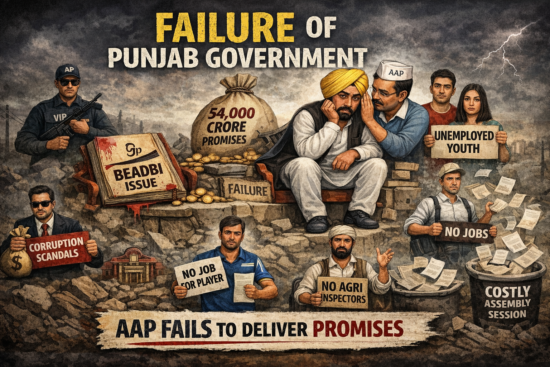
The rise of Bhagwant Mann to power in 2022 was built on hope, emotion, and a promise of clean governance. Backed by Arvind Kejriwal and the Aam Aadmi Party’s aggressive campaign, the people of Punjab were assured a “new model of politics” one that would eliminate corruption, end the drug menace, provide jobs, and restore Punjab’s lost glory. However, four years into the government, a growing chorus of criticism from opposition leaders and sections of society paints a very different picture one of unfulfilled commitments, alleged misinformation, and widening distrust.
One of the most frequently cited examples is the promise of financial assistance to women, a key election plank. The commitment to provide ₹1,000 per month to every eligible woman generated massive support during elections. Yet, critics allege that this promise has seen repeated delays and shifting timelines, with opposition leaders accusing the government of “deceiving women voters” and failing to implement the scheme even years later.
Similarly, the government’s claims of eliminating drugs from Punjab have come under scrutiny. Critics argue that despite tall promises of a “drug-free Punjab,” ground realities have not changed significantly, with continued reports of drug abuse affecting families across the state. According to opposition voices, the gap between political messaging and reality remains stark, raising questions about whether the issue has been addressed seriously or merely used as a political slogan.
The issue of law and order has also emerged as a major point of contention. Incidents of crime, including extortion threats, attacks, and political violence, have been cited by critics as evidence of administrative failure. Opposition leaders have even demanded accountability from the Chief Minister, alleging that the government has failed to control gang activity despite its promises of strict action.
Economic concerns further deepen the debate. Punjab’s rising debt and financial strain have been highlighted as signs of poor fiscal management. Critics argue that instead of strengthening revenue systems, the government has relied heavily on borrowing, potentially pushing the state into a long-term financial crisis. At the same time, industrial growth and employment generation — both key promises — are questioned, with allegations that job creation figures are exaggerated and industries continue to struggle.
Healthcare and education, often showcased by the government as major achievements, have also been criticized. Reports point to shortages of doctors, vacant posts in schools, and what some describe as “cosmetic reforms” rather than structural improvements. Critics claim that announcements such as free healthcare up to ₹10 lakh are limited in scope and do not translate into universal access for the common man.
On the other hand, the government strongly defends its record. Bhagwant Mann has repeatedly stated that his administration has fulfilled “core guarantees”, citing free electricity, job creation, expansion of Aam Aadmi Clinics, and welfare schemes as proof of delivery. According to him, the criticism is politically motivated, and the opposition is unable to accept the changing political landscape of Punjab.
This sharp divide between claims and counterclaims has created a complex political narrative. For supporters, the Mann government represents a break from decades of traditional politics dominated by Congress and Akali Dal. For critics, however, it is increasingly becoming a symbol of over-promising and under-delivering, where slogans overshadow substance.
As Punjab moves closer to the 2027 elections, the central question remains: Were these promises genuine commitments that faced practical hurdles, or were they simply political tools to capture power? The answer may ultimately lie not in speeches or press conferences, but in the lived experiences of the people of Punjab who continue to wait for the promises that once inspired hope.
This article is based on verified reports from The Quint, The Tribune, The Wire, Article-14, Oxford Human Rights Hub, and government data from the National Crime Records Bureau.