
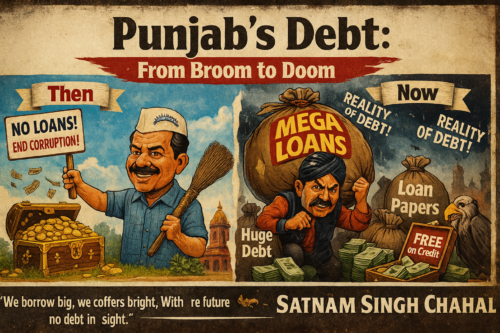
 In Punjabi folklore and everyday wisdom, there is a harsh but honest saying: a boy who sells his ancestral land, hosts grand feasts, and flashes new clothes may look rich for a season, but among his own people he is forever known as the one who sold the soil. Punjab today finds itself trapped in this very metaphor. The present Punjab government did not inherit a kingdom of gold, but neither did it inherit an empty vault. What it inherited was a struggling state and what it promised was transformation. What it delivered, however, is a state increasingly mortgaged to lenders, with future generations listed as silent guarantors.
When this government took charge, it positioned itself as morally superior to all previous regimes. Debt, it claimed, was the result of corruption and incompetence. The solution, according to Arvind Kejriwal and his team, was almost magical in its simplicity: stop illegal mining, crush corruption, and crores of rupees would automatically start filling Punjab’s treasury. There would be no need for loans, no need for begging from the Centre, no need to burden Punjab further. This narrative was sold with missionary zeal, as if corruption alone was the villain and the new rulers were saints with a broom.
Years later, Punjab’s debt has not shrunk it has swollen like an untreated disease. The government today borrows not occasionally, but routinely. Loans have become the oxygen cylinder of governance. Every new announcement, every so-called “historic decision,” arrives riding on borrowed money. The treasury resembles not a storehouse of recovered wealth, but a credit card maxed out in the name of public happiness.
A Poem from the Ledger Book
“We said we’d end the borrowing age,
We tore old books, we burned that page.
But every promise came on loan,
And every ‘free’ had interest shown.”
The strongest irony lies in the government’s double language. When in opposition, debt was portrayed as a crime against Punjab. In power, the same debt is rebranded as compassion. Yesterday’s “financial mismanagement” is today’s “people-first policy.” The government behaves like a landlord who lectures others on savings while secretly pawning the family jewellery to fund daily expenses.
Punjab’s debt today is not being accumulated to build new industries, revive manufacturing, or create sustainable employment. It is being used to maintain political optics. Welfare schemes are announced like festival discounts, but the bill is quietly sent to the future. It is governance by instalment—rule today, pay tomorrow. Or rather, make Punjab pay tomorrow.
The promise to end the mining mafia was once shouted from rooftops. Today, it is whispered, if mentioned at all. If illegal mining had truly been stopped and corruption genuinely uprooted, Punjab’s finances would have shown at least some relief. But instead of recovered crores, we see increased borrowing. Instead of surplus, we see expanding interest payments that now eat a frightening portion of the state’s revenue. Punjab is running not just a government, but a permanent loan repayment office.
What makes the situation almost comical if it were not tragic is the moral posturing that continues alongside this debt explosion. The same leaders who mocked earlier governments for “ruining Punjab” now defend their own borrowing as unavoidable. The broom that was supposed to clean the system now appears busy sweeping uncomfortable questions under the carpet. Corruption was blamed for everything, but accountability has vanished somewhere between press conferences and election rallies.
Another Verse, Bitter but True
“They sold us dreams, not balance sheets,
Gave slogans, not economic feats.
The debt kept rising, calm and slow,
While speeches said, ‘See how we grow.’”
As elections approach, the borrowing spree intensifies. Loans are taken not because Punjab has suddenly discovered a golden future project, but because political goodwill must be purchased in advance. This is not governance it is advance booking of votes using borrowed money. Punjab is being treated like a credit card with no spending limit and no concern for who will clear the dues.
History teaches us that governments may change, slogans may fade, but debt remains. Interest does not listen to speeches. Banks do not applaud rallies. Loans do not forgive intentions. They only demand repayment—with penalties. And when that day comes, it will not be the leaders who pay, but the farmers, the youth, the workers, and the small traders of Punjab.
Punjab does not need rulers who sell tomorrow to decorate today. It does not need sermons about honesty delivered from behind stacks of loan files. A government that truly believed in reform would show results in revenue, not excuses in borrowing. Otherwise, this era will be remembered not as a revolution, but as a reminder that even the loudest slogans cannot silence the sound of mounting debt.