
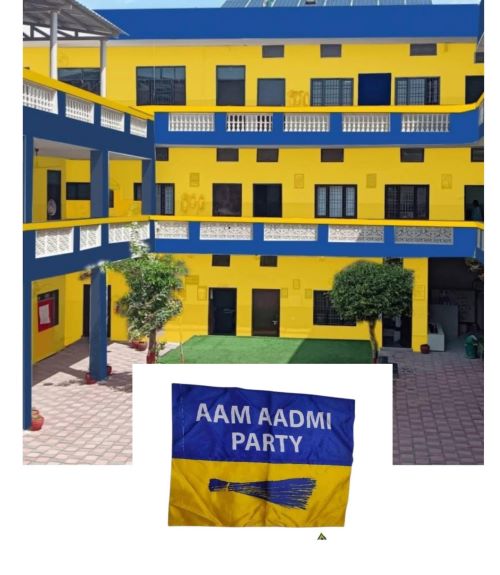
 In recent months, the government led by Bhagwant Mann of the Aam Aadmi Party (AAP) in Punjab has come under increasing scrutiny for its decision to repaint government assets across the state. Public buses, hospitals, schools, and numerous government buildings have been given fresh coats of paint in colors associated with the ruling party’s branding. While officials describe the exercise as part of an effort to improve public infrastructure and create a uniform identity for government services, critics argue that the initiative reflects misplaced priorities at a time when the state is struggling with deep financial stress.
Punjab’s fiscal situation has been a persistent concern. The state’s public debt has risen sharply over the years and is estimated to be nearing several lakh crores. With such a heavy financial burden, many economists and political observers believe the government should focus its limited resources on structural reforms, agricultural relief, job creation, and improving basic services rather than cosmetic projects.
The large-scale repainting of buses operated by Punjab Roadways and PEPSU Road Transport Corporation (PRTC), as well as government hospitals and schools, has therefore sparked debate about whether the move is more about political branding than governance. The ruling party maintains that the repainting campaign is intended to give public institutions a clean, modern appearance and instil a sense of pride in government facilities. However, critics argue that these efforts resemble political advertising funded by taxpayers.
One of the central questions being asked is what the government hopes to gain from such initiatives. Political analysts suggest that visual branding plays a powerful role in politics. By repainting buses, schools, and hospitals in recognisable colours and styles, a government can reinforce its presence in everyday life. Citizens repeatedly encountering these visual symbols may subconsciously associate improvements or services with the ruling party. In a competitive political environment, such symbolism can help build a strong political narrative.
However, the optics become controversial when viewed against the backdrop of Punjab’s economic realities. The state continues to grapple with a major agrarian crisis. Farmers in several districts are still waiting for compensation for crop losses caused by floods, pest attacks, or unseasonal weather. Delays in compensation payments have added to the financial stress faced by agricultural families, many of whom are already burdened with debt.
Agriculture remains the backbone of Punjab’s economy, yet farmers frequently complain about delayed relief packages, rising input costs, and uncertainty about crop procurement policies. For many in rural areas, the sight of freshly painted government buildings contrasts sharply with their own unresolved financial hardships.
Critics also point out that repainting alone does little to address the deeper challenges facing the state’s public institutions. Government hospitals still struggle with shortages of doctors, medicines, and equipment in many areas. Schools often face staff shortages, outdated infrastructure, and limited resources. Similarly, the public transport system requires modernization, better maintenance, and improved connectivity rather than merely cosmetic changes.
Supporters of the government counter that visible improvements can have psychological and administrative benefits. A cleaner and more organized appearance can create a more welcoming environment for citizens and employees alike. They argue that aesthetic improvements are part of broader governance reforms and should not be dismissed entirely.
Yet the larger debate continues to revolve around priorities. When a state carries massive debt and multiple sectors require urgent investment, public spending choices inevitably face close scrutiny. Critics argue that every rupee spent on cosmetic work should be weighed against pressing needs such as agricultural compensation, employment programs, healthcare staffing, and infrastructure development.
Ultimately, the controversy highlights a broader issue in modern politics: the balance between perception and performance. Governments often invest in projects that produce immediate visible results because they help shape public perception. However, sustainable governance requires deeper policy interventions that may not always produce quick visual impact but are crucial for long-term stability.
As Punjab continues to navigate economic challenges, the debate over “paint politics” raises an important question for policymakers and citizens alike—should scarce public funds be used to improve appearances, or should they be directed toward solving the structural problems affecting farmers, workers, and public services?
For many observers, the answer lies in ensuring that governance goes beyond symbolism and addresses the real economic and social issues confronting the state.