
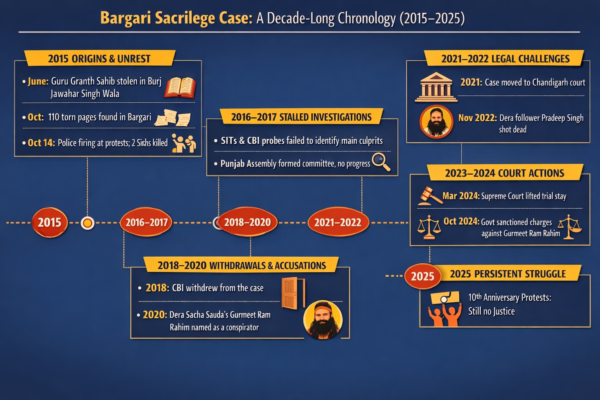
 The issue of sacrilege in Punjab is not merely a legal matter but a deeply emotional and religious one, especially for the Sikh community. For nearly a decade, the people of Punjab have been waiting for justice in the sacrilege cases that shook the state in 2015. Every government since then has promised strict action and strong laws against sacrilege. However, despite repeated announcements, committees, and legislative efforts, the core issue of delivering justice remains unresolved. This has led many political observers to question whether the latest Sacrilege Bill introduced by the Punjab government is a genuine attempt to protect religious sentiments or simply a political move aimed at gaining public support.
The controversy began in June 2015 when a sacred “bir” of Sri Guru Granth Sahib was reported stolen from a gurdwara in Burj Jawahar Singh Wala village in Faridkot district. The incident deeply hurt the sentiments of the Sikh community and quickly turned into a major issue across Punjab. Later in October 2015, torn pages of Sri Guru Granth Sahib were found scattered in Bargari village. This shocking discovery triggered widespread protests throughout the state, with thousands of people demanding immediate action and justice.
The situation escalated further when police opened fire on protesting demonstrators in Kotkapura and Behbal Kalan in October 2015. The firing resulted in the death of two protesters and injuries to several others. This incident intensified public anger and transformed the sacrilege controversy into a major political and social crisis in Punjab. The demand for justice grew louder, and political parties began to promise strict laws and swift punishment for those responsible.
In 2016, the then Shiromani Akali Dal–BJP government attempted to address the issue by proposing amendments to the law that would impose life imprisonment for sacrilege of Sri Guru Granth Sahib. However, the proposal faced legal complications and did not receive the required approval from the central government. As a result, the law could not be implemented.
When the Congress government came to power in 2017, it formed the Justice Ranjit Singh Commission to investigate the sacrilege incidents and the subsequent police firing. The commission submitted a detailed report highlighting serious lapses and recommending action against several individuals. In 2018, the Punjab Assembly also passed amendments proposing life imprisonment for sacrilege of major religious texts, including Sri Guru Granth Sahib, Bhagavad Gita, Quran, and Bible. However, this bill too remained pending because it required approval from the President of India.
In 2022, the Aam Aadmi Party came to power in Punjab with a massive electoral mandate. Among its major promises was the assurance that justice would finally be delivered in the sacrilege cases and that strict legal provisions would be introduced. Despite these assurances, progress on the issue has remained slow, and many people believe the government has not shown the urgency expected on such a sensitive matter.
Recently, the Punjab government introduced a new anti-sacrilege bill proposing punishments ranging from ten years in prison to life imprisonment, along with heavy fines. However, instead of being immediately enacted into law, the bill was referred to a select committee for further review and consultation. This move has again raised questions about whether the government is genuinely committed to resolving the issue or merely prolonging the process.
Critics argue that the repeated introduction of sacrilege bills without final implementation suggests that the issue is often used for political messaging rather than real reform. Over the past decade, multiple governments have made strong statements and legislative attempts, yet the victims and families affected by the 2015 incidents still await justice.
Another major concern raised by experts is that the problem may not lie in the absence of strict laws but rather in weak investigations and administrative delays. India already has legal provisions that punish acts intended to hurt religious sentiments. Without strong and independent investigations, even the harshest new law may fail to deliver meaningful results.
The sacrilege issue holds immense emotional significance in Punjab, and it cannot be treated merely as a political slogan. For many people, it represents a matter of faith, dignity, and justice. If governments continue to delay investigations while introducing symbolic legislation, public trust in institutions may weaken further.
Ultimately, the people of Punjab are not demanding more promises or new bills alone. They are demanding accountability, transparency, and timely justice. Unless the government ensures credible investigations and decisive action against those responsible, the Sacrilege Bill may continue to be viewed by critics as a political stunt rather than a sincere effort to protect religious sentiments and uphold justice.