
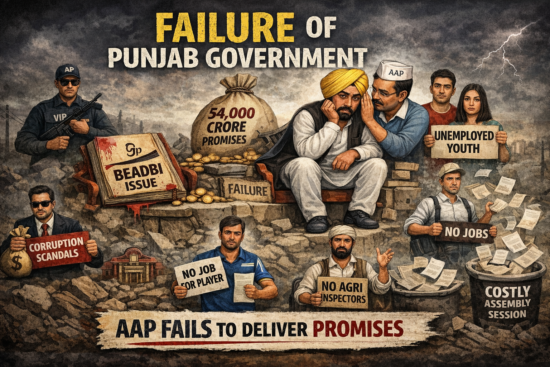
 The rise of the Aam Aadmi Party (AAP) in Punjab during the 2022 assembly elections was accompanied by extraordinary expectations among the people of the state. Led by Chief Minister Bhagwant Mann and backed strongly by party chief Arvind Kejriwal, the party promised a new political culture based on transparency, accountability, and governance focused on the welfare of ordinary citizens. The leadership repeatedly claimed that Punjab would witness a political transformation in which corruption would be eliminated, employment opportunities would expand, and justice would be delivered in long-pending sensitive matters. However, several years into the government’s tenure, critics argue that many of these commitments remain unfulfilled, raising questions about the gap between political promises and administrative reality.
One of the most emotionally charged issues in Punjab politics has been the sacrilege of the Guru Granth Sahib, incidents that deeply hurt the sentiments of the Sikh community. During the election campaign, AAP leaders assured the public that those responsible for the sacrilege cases would be identified and punished swiftly. The promise resonated strongly with voters who had already witnessed years of political controversy and incomplete investigations under previous governments. However, despite repeated assurances from the Mann government, decisive legal conclusions and accountability in these cases remain elusive. Many citizens believe that justice has been delayed yet again, which has further intensified public frustration over the handling of the issue.
Another major promise that captured public attention was the financial reform plan announced by Arvind Kejriwal. He had stated that the government would generate approximately ₹54,000 crore in additional revenue by curbing corruption and regulating illegal mining activities. According to AAP’s narrative, these funds would help stabilize Punjab’s finances and support welfare schemes. However, critics argue that the expected revenue windfall has not materialized at the scale that was promised. The mining sector continues to face allegations of irregularities, while the state’s fiscal challenges remain significant. As a result, many observers question whether the projections were overly optimistic or whether the government has struggled to implement its anti-corruption framework effectively.
AAP also campaigned on the idea of creating a new political culture in which leaders would not rely heavily on security privileges. The party had promised that its ministers, MLAs, and even the chief minister would minimize the use of security convoys and government-provided protection to demonstrate a closer connection with the public. However, over time, security arrangements for several leaders have expanded due to administrative and safety considerations. Critics argue that this development contradicts the party’s earlier pledge of a simpler and more people-centric style of governance.
Employment generation was another central pillar of AAP’s campaign. The government had promised unemployment allowances for young men and women who had completed their education but were unable to secure jobs. In a state where youth unemployment remains a major concern, this commitment generated significant hope among students and graduates. Yet many young people claim that the promised allowance scheme has not been implemented in a comprehensive manner. While the government highlights certain recruitment drives and job announcements, critics argue that the broader promise of financial support for unemployed youth remains largely unfulfilled.
A controversy that attracted widespread public attention involved a sportsperson who alleged that he had paid a large sum to former Chief Minister Charanjit Singh Channi in exchange for a government job. Chief Minister Bhagwant Mann publicly presented the player during a press conference and announced financial assistance while promising strict action in the matter. However, questions continue to be raised about whether the individual was ultimately given the promised employment and whether the issue led to a transparent legal resolution. For critics, the episode illustrates how dramatic announcements sometimes fail to translate into long-term administrative outcomes.
Agriculture, the backbone of Punjab’s economy, also featured prominently in AAP’s policy announcements. Chief Minister Mann had declared that the government would appoint an agriculture inspector in every village to provide technical guidance and support to farmers. The proposal aimed to modernize agricultural practices and strengthen rural advisory services. However, large-scale implementation of such a network of inspectors has yet to be clearly visible across the state. Many farmers’ groups argue that the policy has not progressed beyond announcements and partial initiatives.
During a convocation ceremony at Guru Nanak Dev University, the chief minister made a striking statement suggesting that the economic transformation of Punjab would become so significant that people from Western countries would eventually come to the state in search of employment. The remark was intended to convey optimism about Punjab’s future prospects. Yet critics frequently cite this statement to highlight what they view as unrealistic projections about economic growth and job creation in the state.
Another major concept promoted by the AAP leadership was decentralized governance. The party had promised that the government would effectively operate through village sabhas and mohalla-level committees in urban areas, allowing citizens to directly influence decision-making. This model was portrayed as a way to bring governance closer to the grassroots and ensure accountability. However, opponents argue that the institutional mechanisms required for such participatory governance have not been fully implemented, leaving the promise largely symbolic.
The functioning of the Punjab Legislative Assembly has also come under scrutiny. Several special sessions of the assembly were convened with significant expenditure of public funds. Critics claim that despite these sessions, little substantive legislative output or policy progress emerged. They argue that the sessions became platforms for political confrontation rather than meaningful governance initiatives, raising concerns about the effective use of public resources.
In conclusion, the debate over the performance of the AAP government in Punjab reflects a broader challenge faced by many political administrations: translating ambitious electoral promises into tangible results. While the government maintains that it has initiated reforms in sectors such as education, health, and anti-corruption measures, critics contend that many high-profile commitments remain incomplete. The gap between expectations and outcomes continues to shape public discourse in the state. For Punjab’s citizens, the central question remains whether the government can still deliver on its transformative agenda before the end of its tenure or whether these promises will remain part of the political rhetoric that accompanied the party’s historic rise to power.