
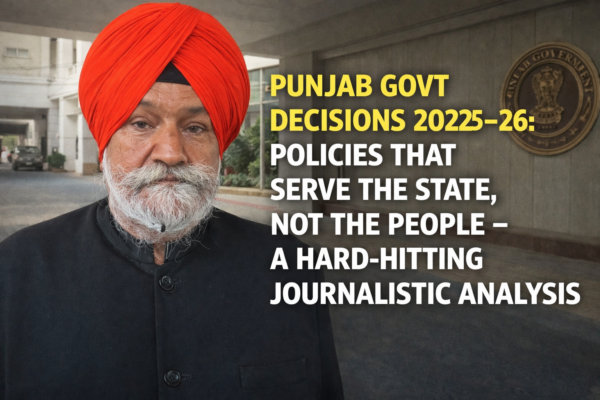
 The Punjab Cabinet, under Chief Minister Bhagwant Mann, recently approved a raft of policy decisions dressed up in the language of reform, welfare, and public safety. But strip away the government’s self-congratulatory press releases and what remains is a deeply troubling picture of a state that is raising taxes on the poor, building a surveillance-friendly reward economy, offering traders more leniency while ordinary citizens wait for real relief, and delivering hollow promises to women in the name of welfare. Each of these policies, examined critically, reveals a government more interested in revenue extraction and optics than in genuinely improving the lives of Punjab’s 30 million people.
The government has set an excise revenue target of Rs 12,800 crore for 2025–26, a figure it presents as a sign of ambition and good governance. What it fails to mention is that this target will be achieved primarily on the backs of working-class and lower-middle-class consumers who will now pay more for Indian Made Foreign Liquor (IMFL). Punjab has one of the highest rates of alcohol dependency in India. According to various public health studies, problematic alcohol use is heavily concentrated among daily-wage labourers, farmers, and rural men who use cheap liquor as an escape from economic distress and agrarian crisis. When the state raises excise duty and liquor prices in the name of revenue, it is not curbing consumption it is simply making an addiction more expensive for people who can least afford it.
A genuinely progressive excise policy would pair price hikes with investment in de-addiction centres, mental health support, and rural employment. This policy does none of that. The track-and-trace system and brand-registration fee are useful anti-smuggling tools, but they serve state revenue interests, not public health. Where is the allocation from this Rs 12,800 crore target for rehabilitation? Where is the roadmap to reduce dependence, not just regulate supply? The government is, in effect, running a monopoly on misery. It profits from addiction while offering no meaningful path out of it for Punjab’s most vulnerable families.
On the surface, rewarding citizens with up to Rs 2 lakh for providing information leading to the arrest of gangsters sounds like smart community policing. In practice, it is a policy built on dangerous assumptions with no visible accountability framework. Punjab has a troubled history with police-informant relationships. The 1980s and 1990s saw how the state’s intelligence networks built on a system of paid informants led to mass human rights violations, false encounters, and the targeting of innocent individuals. The government’s new anti-gangster policy makes no mention of how ‘credible information’ will be verified, what legal protections will be given to informants, or what recourse exists when false information is used to settle personal scores.
‘Cash rewards for tip-offs, with no oversight, are an invitation to fabricate evidence and frame innocents.’
In communities already fractured by caste tensions and land disputes, a Rs 2 lakh cash reward is a powerful incentive to misuse the system. There is no independent oversight body mentioned in this policy, no grievance redressal mechanism for those falsely implicated, and no transparency in how tip-off claims will be processed.Furthermore, the policy’s language ‘strengthen intelligence networks’ and ‘improve coordination among agencies’ is bureaucratic fog. It says nothing about reforming the police culture of impunity, addressing custodial deaths, or ensuring that anti-gangster operations do not sweep up ordinary citizens in their net. The government has handed police more tools without addressing the foundational accountability deficit that makes Punjab’s policing one of the most rights-violating in northern India.
The extension of the One-Time Settlement (OTS) scheme for pending VAT dues until December 31, 2025, is being presented as a gesture of goodwill to traders. But it raises a sharper question: why are traders who owe the state money being given repeated extensions, while the same state aggressively pursues small defaulters and rural debtors? This is the pattern of elite capture masquerading as policy relief. Large and medium traders who have withheld VAT payments potentially for years are being given yet another soft landing. The state loses crores in interest and penalties every time it extends such schemes. Meanwhile, farmers who default on crop loans face bank notices, land seizures, and social stigma. Daily-wage workers who fall behind on utility bills face disconnections. The state’s compassion is clearly calibrated by the size of one’s business.
‘Repeat OTS extensions normalise tax evasion at the top while criminalising poverty at the bottom.’A credible government would publish data on how many traders availed the previous OTS scheme, how much revenue was recovered versus waived, and whether repeated extensions are creating a moral hazard teaching businesses that non-compliance has no real consequences. None of this transparency is on offer. What is on offer is another quiet favour to a politically influential constituency.
The Rs 1,000 per month scheme for women in Punjab sounds generous in a press release. In reality, it is one of the most cynical uses of public money in the state’s recent history.
At current prices, Rs 1,000 per month does not cover a week’s worth of basic groceries for a family of four. It does not address the structural causes of women’s economic marginalisation in Punjab lack of land rights, wage gaps in agriculture, high rates of domestic violence, poor access to skilling, or the near-total absence of affordable childcare. It is a cash transfer designed to generate votes, not transform lives.’Rs 1,000 a month is not empowerment. It is a receipt proof that the government has paid for your silence.’
Compare this to what genuine women’s empowerment would require: investment in girls’ education at the secondary level, legal aid for women facing domestic abuse, property rights reform, microfinance with real support infrastructure, and community-led skilling programmes. None of these appear in the Cabinet’s announcements. Instead, the government offers a monthly stipend that is too small to change anything, but large enough to claim credit for caring.If the state were serious about women’s welfare, it would publish data on how many women in Punjab own land, how many domestic violence cases are resolved annually, and how many women-led rural enterprises have received institutional credit. These numbers would tell a far more honest story than any welfare cheque.
Taken together, these four policies reveal a government that is fluent in the language of progressive governance but practices something far more conventional: extracting revenue from the vulnerable, rewarding the well connected, building law-enforcement capacity without accountability, and substituting cash transfers for structural reform.
Punjab is a state in deep crisis agrarian distress, drug dependency, organised crime, youth unemployment, and a deteriorating public health infrastructure. The Cabinet’s decisions this week offer no serious reckoning with any of these challenges. What they offer instead is a revenue target, a reward scheme, a deadline extension, and a monthly allowance.
The people of Punjab deserve better than policy dressed as performance. They deserve a government willing to ask hard questions, make uncomfortable choices, and invest in long-term transformation not one that governs by press release.