
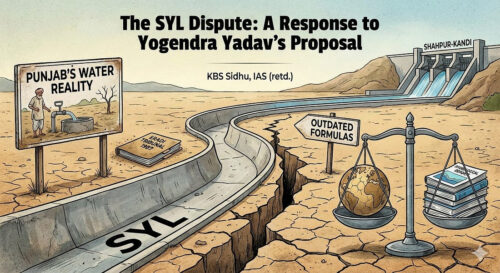
 On January 27, 2026, Punjab Chief Minister Bhagwant Mann and Haryana Chief Minister Nayab Singh Saini met in Chandigarh to discuss the decades-long Sutlej-Yamuna Link (SYL) canal water sharing dispute. The meeting lasted approximately 40 minutes and was held following Supreme Court directions urging both states to resolve the matter through dialogue .Both chief ministers described the talks as positive and conducted in a cordial atmosphere, though no concrete breakthrough was achieved.
During the meeting, Punjab Secretary (Water Resources) Krishan Kumar made a presentation on the state’s available water resources and the rapidly depleting groundwater table in Punjab.. The meeting included senior officials from both states, with Punjab’s Irrigation Minister Barinder Kumar Goyal and Haryana’s Irrigation Minister Shruti Choudhry in attendance. This was the sixth meeting between the two sides since 2020, when the first dialogue was initiated during Captain Amarinder Singh’s tenure as Punjab Chief Minister.
CM Bhagwant Mann adopted what critics describe as a conciliatory tone during the meeting. He stated “Haryana is not our enemy, but a brother” and emphasized that both states agreed officials would meet frequently rather than wait for Supreme Court hearing dates.Mann invoked Sikh religious teachings, referring to Bhai Kanhaiya, who gave water even to enemies during war, to emphasize Punjab’s compassionate approach.
However, beneath this brotherly rhetoric, Punjab’s position remained adamantly firm. Mann categorically asserted “Not even a single drop of Punjab’s rightful water can be allowed to be taken away” and stated that “land for the SYL canal is not available in Punjab as of today”.He warned that the state would face serious law and order problems if the canal construction was imposed.
Mann highlighted that out of 34.34 million acre feet of water from three rivers, Punjab was allocated only 14.22 MAF (40 percent), while the remaining 60 percent was allocated to Haryana, Delhi and Rajasthan, even though none of these rivers flow through these states. This remains Punjab’s core argument as a riparian state, it should have primary rights to its river waters, especially given the severe water crisis it currently faces.The data presented during the meeting paints a dire picture of Punjab’s water situation. Reports indicate that 115 out of 153 blocks in Punjab have been declared over-exploited, with 79 percent of the state’s blocks categorized as overexploited according to the Central Groundwater Board
. Punjab has the highest rate of groundwater extraction in the country, with farmers now having to drill to depths of 300 feet or more to access water.From 1982-87, the water table in Central Punjab fell on average 18 centimeters per year, but that rate accelerated steeply to 42 centimeters per year from 1997-2002 and to 75 centimeters during 2002-2006.This alarming depletion is primarily driven by water-intensive paddy cultivation, which was encouraged during the Green Revolution but has now become ecologically unsustainable.
Experts warn that if present depletion rates persist, Punjab’s groundwater could drop below 300 meters by 2039, rendering it highly contaminated and unsuitable for both irrigation and domestic use. The aquifers being tapped now require many years to recharge, and disturbing them through deeper drilling further depletes Punjab’s natural water resources permanently.
Haryana maintains a fundamentally different position. The state insists that the Supreme Court order on the SYL canal be followed. pointing to multiple court rulings in its favor. Haryana has already completed its 92-kilometer portion of the planned 214-kilometer canal and argues that it is entitled to its share of river waters as allocated by the central government.
The SYL canal was conceived after Haryana was carved out from Punjab in 1966. Under various agreements and tribunal awards, Haryana was allocated a share of Ravi and Beas river waters. The Supreme Court ruled in favor of Haryana in 2002, and dismissed Punjab’s challenge in 2004. From Haryana’s perspective, this is not a matter of negotiation but of implementing existing legal orders and honoring decades-old water-sharing agreements.
The meeting and CM Mann’s conciliatory approach have drawn sharp criticism from opposition parties in Punjab, who accuse him of potentially betraying the state’s water rights through weak negotiation tactics.Punjab Congress leader Partap Singh Bajwa accused Chief Minister Mann of neglecting the state’s rightful claim over its river waters, claiming Mann’s neglect of constitutional principles and casting doubt on his commitment to Punjab’s riparian rights
Bajwa particularly criticized Mann’s emphasis on a “brotherhood narrative” instead of firmly defending Punjab’s constitutional rights as a riparian state. According to Bajwa, Mann’s sudden silence over Punjab’s water crisis and his failure to assert the state’s environmental fragility and lack of surplus water amounts to abandoning Punjab’s interests.Shiromani Akali Dal’s Sukhbir Singh Badal criticized Mann for allegedly misusing Sikh teachings to rationalize sharing Punjab’s water
The SAD has historically taken a hardline stance against any water sharing with Haryana, viewing the SYL canal as an existential threat to Punjab’s agricultural economy and water security.The criticism from opposition parties centers on several key concerns: First, that Mann’s “brotherly” approach fails to adequately defend Punjab’s legal position as a riparian state with constitutional rights to its river waters. Second, that by agreeing to continued negotiations without establishing clear red lines, Mann may be preparing the ground for eventual concessions. Third, that the invocation of religious teachings like those of Bhai Kanhaiya is inappropriate and potentially misleading, as it creates moral pressure to share water that Punjab literally does not have to spare.
At previous meetings, CM Mann has proposed an alternative solution to the SYL deadlock. Mann urged the Centre to utilize water from the Chenab river to resolve the dispute, noting that the Indus Water Treaty with Pakistan has been suspended, which opens up opportunity for India to utilize Chenab water.He suggested diverting Chenab’s water to Indian dams like Ranjit Sagar, Pong, or Bhakra, which would require new canals and infrastructure to be built in Punjab.
This proposal would theoretically allow India to meet Haryana’s water needs without taking water from Punjab’s already depleted resources. However, such infrastructure would require massive investment and years to complete, and it’s unclear whether the central government or Haryana find this alternative acceptable. Critics also point out that this proposal, while creative, may be seen as a delaying tactic rather than a genuine solution to Haryana’s immediate water needs.
The SYL canal was conceived to facilitate sharing of Ravi-Beas river waters between Punjab and Haryana following the reorganization of Punjab in 1966.Construction began in the early 1980s but was stalled due to strong public opposition, political resistance, and law-and-order concerns. The issue gained further prominence after the 1985 Rajiv-Longowal Accord, which provided for completion of the canal along with a fresh assessment of water availability—an assessment that was never fully carried out.
In 2004, the Punjab Assembly passed the Punjab Termination of Agreements Act, terminating all earlier river water-sharing agreements. This move was challenged by Haryana in the Supreme Court. In 2016, the Parkash Singh Badal-led Punjab government denotified and returned over 4,000 acres of land acquired for the SYL canal to farmers, further complicating the matter.
The dispute carries deep political and emotional significance in Punjab. Any government seen as conceding on water rights faces severe backlash. The issue is intertwined with Punjab’s agricultural identity, Sikh religious teachings about protecting natural resources, and historical grievances about the state’s treatment by the central government following the 1966 reorganization.Both states agreed to form a joint committee of secretary-level officers to further deliberate and find an amicable resolution. Officials from Punjab and Haryana will hold joint meetings every 10 to 15 days and brief the two governments on progress.
However, the fundamental positions remain unchanged: Punjab maintains it has no surplus water to share due to declining river flows and severe groundwater depletion, while Haryana insists on its legal right to water as per Supreme Court orders. The “brotherly” rhetoric may represent a softening of tone, but the core conflict persists.
The question of whether CM Mann is attempting to mislead or “fool” the people of Punjab depends on one’s perspective on his strategy. Supporters might argue that Mann is skillfully managing an impossible situation maintaining cordial relations with Haryana while making Punjab’s water crisis clear through data presentations, asserting that no water can be spared, and proposing alternative solutions like utilizing Chenab water. From this view, the “brotherhood” language is diplomatic rhetoric that costs Punjab nothing while keeping negotiations alive.
Critics, however, see a dangerous pattern of weakness. They argue that by repeatedly meeting without establishing firm preconditions, by invoking religious and moral arguments about sharing, and by failing to categorically reject the SYL canal as unconstitutional and physically impossible, Mann is preparing public opinion for an eventual betrayal. They point out that previous Punjab governments, despite their own historical failures, were more forceful in their opposition to the SYL canal.
The opposition’s concern is that Mann’s approach emphasizing dialogue, brotherhood, and finding “mutually acceptable solutions”implicitly accepts the premise that some water sharing is possible and desirable. This, they argue, contradicts the scientific reality that Punjab has no water to spare and undermines Punjab’s legal position as a riparian state. By creating an atmosphere of goodwill and compromise, Mann may be boxing himself into a corner where refusing to share any water appears unreasonable, even though such refusal is scientifically and legally justified.
The upcoming secretary-level meetings will be crucial. If these meetings result in any agreement to share even minimal water, or to allow any SYL-related surveys or land acquisition, opposition parties will likely accuse Mann of betraying Punjab under cover of his “brotherly” diplomatic approach. The fact that the Supreme Court case is coming up in April adds urgency any perception that Punjab is not vigorously defending its position could influence the court’s proceedings.
Ultimately, whether Mann is “fooling” people depends on what emerges from these negotiations. If Punjab maintains its absolute refusal to share water and the talks simply continue without resolution, Mann may be successfully managing an intractable problem. But if any concessions emerge, the opposition’s accusations of betrayal will likely gain significant traction among Punjab’s farming communities and water activists who view the SYL canal as an existential threat to the state’s future.