
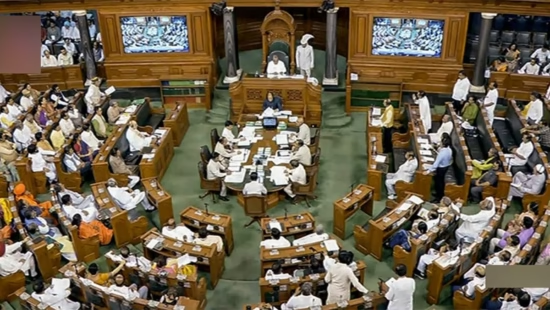
 Punjab’s parliamentary delegation in the 18th Lok Sabha and the current Rajya Sabha term presents a familiar paradox: a mix of energetic legislators who actively use the floor, and MPs who appear more like decorative props than active representatives. To separate the wheat from the chaff, MPs can be ranked based on a composite score combining attendance, debates participated, and questions asked. The results are both revealing and, at times, comical.
At the very top of the performance chart are Raghav Chadha (Rajya Sabha, AAP) and Vikramjit Singh Sahney (Rajya Sabha, AAP). Chadha recorded 100% attendance in the winter session, participated in 11 debates, and raised 25 questions, proving that he treats Parliament as a working chamber rather than a lounge for photo opportunities. Sahney’s performance is similarly impressive, with high attendance, more than 20 debates, and over 200 questions. Both MPs exemplify what it means to turn physical presence into tangible legislative action, and they set the benchmark for active representation in Delhi.
Following closely are Gurjeet Singh Aujla (Lok Sabha, INC) and Gurmeet Singh Meet Hayer (Lok Sabha, AAP). Both have attended nearly all early sessions and participated in over 20 debates each, while asking upwards of 70 questions. These MPs have proven to be strong voices for Punjab’s agriculture, farmer welfare, and central funding issues. Manish Tewari (Lok Sabha, INC) also ranks high in composite performance, with around 95% attendance, 18 debates, and over 200 questions, reflecting his experience and commitment to active parliamentary engagement. These top performers demonstrate that attendance plus action is the real currency of representation.
The mid-tier of Punjab’s delegation includes Amar Singh (Lok Sabha, INC), Harsimrat Kaur Badal (Lok Sabha, SAD), Charanjit Singh Channi (Lok Sabha, INC), and Malvinder Singh Kang (Lok Sabha, AAP). These MPs maintain steady attendance, participate in debates, and ask questions, but rarely dominate discussions or force the House to focus on Punjab specific issues. They are performing their duties consistently, yet without creating headlines or substantial waves. While visible, their contributions are solid but unremarkable, illustrating the middle ground between highly active and minimally engaged MPs.
Lower on the composite ranking are Sandeep Pathak (Rajya Sabha, AAP) and Harbhajan Singh (Rajya Sabha, AAP). Pathak has only one debate contribution and limited attendance in the winter session, while Harbhajan Singh participates in questions but largely avoids debates. Their performances illustrate a phenomenon familiar to Indian politics: MPs who are physically present but functionally invisible, adding little to legislative discourse and leaving constituents wondering whether their voices are actually represented in Delhi.
At the very bottom of the ranking is Amritpal Singh (Lok Sabha, Independent/Khadoor Sahib). With attendance near zero, zero debates, and no questions asked, Singh’s parliamentary performance is negligible. Despite a strong local mandate, he has yet to make his mark in Delhi, proving that winning a seat does not automatically translate into effective representation. His minimal presence reflects a larger issue: having a seat is not the same as advocating for your constituents’ concerns.
Taken together, Punjab MPs ranked by composite performance show a clear spectrum. The top tier Chadha, Sahney, Aujla, Hayer, and Tewari are actively shaping debates, asking questions, and championing Punjab’s concerns. The mid-tier MPs maintain steady engagement without dominating the agenda. The lower tier, including Pathak and Harbhajan Singh, participate minimally, while Amritpal Singh remains virtually absent.
This ranking highlights a broader truth: attendance alone is no badge of honor. True representation comes from raising questions, participating in debates, and pushing for the state’s interests. Punjab’s delegation demonstrates this clearly a few stars actively use the platform, a larger middle segment performs adequately, and some MPs occupy seats without leaving any legislative footprint. As the 18th Lok Sabha and current Rajya Sabha term progress, constituents will need to watch closely whether MPs continue to convert presence into performance or remain passive observers in Delhi.
In conclusion, Punjab’s MPs reveal a stark contrast: a few legislators turn presence into performance, some maintain steady but unremarkable activity, and a handful are simply occupying seats. In a democracy where representation should mean advocacy and accountability, it is clear that voice, questions, and debates define real performance and Punjab’s MPs are a study in extremes.