
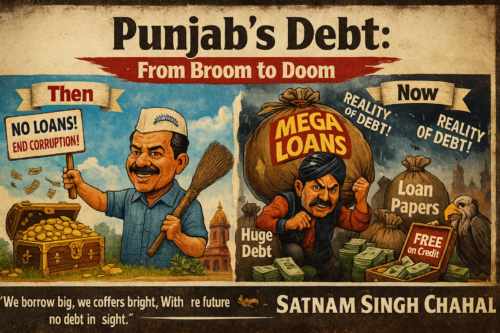
 Punjab, once regarded as one of India’s most advanced and prosperous states, has seen a noticeable decline in its overall ranking across major national development indicators in recent years. Various government reports, national surveys, and independent indices now place Punjab in the middle or lower-middle category on several parameters such as economic growth, employment, health, education, environment, and governance. This decline highlights structural weaknesses despite the state’s strong historical foundation.
From an economic ranking perspective, Punjab’s performance has weakened compared to other Indian states. Punjab’s average Gross State Domestic Product (GSDP) growth rate has remained around 4–5%, which is below the national average of 6–7% in recent years. In national economic rankings, Punjab generally falls between 15th and 20th position among Indian states. High public debt—estimated at over ₹3 lakh crore—and excessive dependence on agriculture have significantly affected the state’s economic competitiveness. States like Gujarat, Maharashtra, Tamil Nadu, and Karnataka rank far higher due to industrial diversification and stronger investment inflows.
In terms of unemployment rankings, Punjab performs poorly. According to Periodic Labour Force Survey (PLFS) data, Punjab has frequently ranked among the top 5 states with the highest unemployment rate in India. The unemployment rate among youth and educated graduates is particularly alarming, often exceeding 9–10%, which is well above the national average. This poor ranking reflects limited job creation in manufacturing, IT, and private-sector industries, leading to frustration and large-scale emigration.
Punjab’s education ranking presents a mixed outcome. While the literacy rate of Punjab stands at approximately 76.7%, which is higher than the national average, the state ranks lower in learning outcomes and higher education quality. In national school education indices, Punjab usually ranks between 10th and 18th position. Government schools face issues such as teacher shortages, declining infrastructure, and weak learning outcomes, while higher education institutions lag in research, innovation, and global competitiveness.
In health-related rankings, Punjab’s position has declined further. According to national health indices, Punjab ranks in the middle category, often between 16th and 20th position. Although basic healthcare access exists, the state struggles with rising cases of lifestyle diseases, drug addiction, shortage of medical professionals in rural areas, and uneven healthcare delivery. States such as Kerala, Tamil Nadu, and Himachal Pradesh consistently rank much higher due to stronger public health systems.
Punjab’s ranking in nutrition and hunger-related indicators has also raised concern. Despite being a food-surplus state, nutritional outcomes are not proportionately strong. National nutrition surveys indicate moderate levels of child malnutrition and anemia among women, placing Punjab below expectation in hunger and nutrition indices. This contradiction negatively affects Punjab’s social development ranking at the national level.
From a governance and ease of doing business ranking, Punjab remains in the middle tier. The state usually ranks between 12th and 18th position in governance-related indices. Issues such as bureaucratic delays, policy inconsistency, political instability, and slow industrial approvals have affected investor confidence. While some reforms have been introduced, Punjab still lags behind states that have aggressively improved governance and administrative efficiency.
Punjab’s environmental ranking is among the weakest. The state faces severe groundwater depletion, stubble burning, air pollution, and soil degradation. In national environmental sustainability indices, Punjab often ranks in the bottom third of Indian states. These environmental challenges pose serious long-term risks to agriculture, public health, and economic sustainability.
Overall, Punjab’s all-over ranking across national indicators reflects a state facing serious developmental challenges. While it retains strong human resources, agricultural capacity, and historical advantages, declining rankings in economy, employment, health, environment, and governance indicate the urgent need for structural reforms. Without diversification, investment in human capital, environmental protection, and effective governance, Punjab’s national ranking may continue to fall in the coming years.
Punjab: Overall Ranking Across National Development Indicators (With Data)
Punjab, once regarded as one of India’s most advanced and prosperous states, has seen a noticeable decline in its overall ranking across major national development indicators in recent years. Various government reports, national surveys, and independent indices now place Punjab in the middle or lower-middle category on several parameters such as economic growth, employment, health, education, environment, and governance. This decline highlights structural weaknesses despite the state’s strong historical foundation.
From an economic ranking perspective, Punjab’s performance has weakened compared to other Indian states. Punjab’s average Gross State Domestic Product (GSDP) growth rate has remained around 4–5%, which is below the national average of 6–7% in recent years. In national economic rankings, Punjab generally falls between 15th and 20th position among Indian states. High public debt—estimated at over ₹3 lakh crore—and excessive dependence on agriculture have significantly affected the state’s economic competitiveness. States like Gujarat, Maharashtra, Tamil Nadu, and Karnataka rank far higher due to industrial diversification and stronger investment inflows.
In terms of unemployment rankings, Punjab performs poorly. According to Periodic Labour Force Survey (PLFS) data, Punjab has frequently ranked among the top 5 states with the highest unemployment rate in India. The unemployment rate among youth and educated graduates is particularly alarming, often exceeding 9–10%, which is well above the national average. This poor ranking reflects limited job creation in manufacturing, IT, and private-sector industries, leading to frustration and large-scale emigration.
Punjab’s education ranking presents a mixed outcome. While the literacy rate of Punjab stands at approximately 76.7%, which is higher than the national average, the state ranks lower in learning outcomes and higher education quality. In national school education indices, Punjab usually ranks between 10th and 18th position. Government schools face issues such as teacher shortages, declining infrastructure, and weak learning outcomes, while higher education institutions lag in research, innovation, and global competitiveness.
In health-related rankings, Punjab’s position has declined further. According to national health indices, Punjab ranks in the middle category, often between 16th and 20th position. Although basic healthcare access exists, the state struggles with rising cases of lifestyle diseases, drug addiction, shortage of medical professionals in rural areas, and uneven healthcare delivery. States such as Kerala, Tamil Nadu, and Himachal Pradesh consistently rank much higher due to stronger public health systems.
Punjab’s ranking in nutrition and hunger-related indicators has also raised concern. Despite being a food-surplus state, nutritional outcomes are not proportionately strong. National nutrition surveys indicate moderate levels of child malnutrition and anemia among women, placing Punjab below expectation in hunger and nutrition indices. This contradiction negatively affects Punjab’s social development ranking at the national level.
From a governance and ease of doing business ranking, Punjab remains in the middle tier. The state usually ranks between 12th and 18th position in governance-related indices. Issues such as bureaucratic delays, policy inconsistency, political instability, and slow industrial approvals have affected investor confidence. While some reforms have been introduced, Punjab still lags behind states that have aggressively improved governance and administrative efficiency.
Punjab’s environmental ranking is among the weakest. The state faces severe groundwater depletion, stubble burning, air pollution, and soil degradation. In national environmental sustainability indices, Punjab often ranks in the bottom third of Indian states. These environmental challenges pose serious long-term risks to agriculture, public health, and economic sustainability.
Overall, Punjab’s all-over ranking across national indicators reflects a state facing serious developmental challenges. While it retains strong human resources, agricultural capacity, and historical advantages, declining rankings in economy, employment, health, environment, and governance indicate the urgent need for structural reforms. Without diversification, investment in human capital, environmental protection, and effective governance, Punjab’s national ranking may continue to fall in the coming years.