
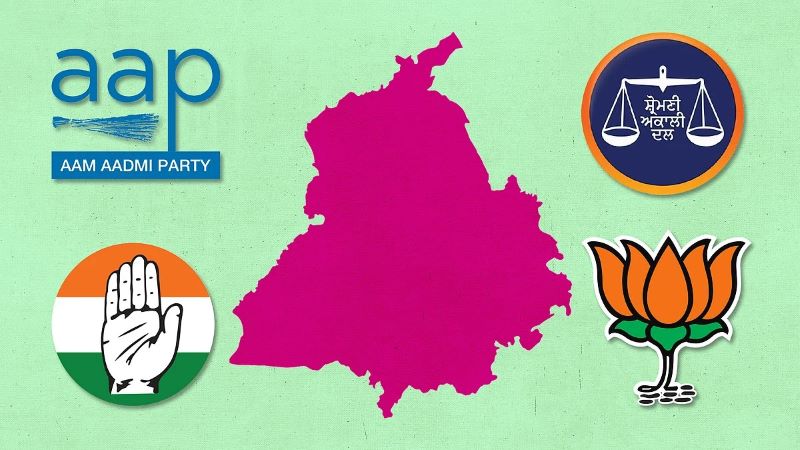
 Punjab’s political landscape has undergone a seismic transformation over the past few years. The 2022 Assembly elections marked the end of an era dominated by traditional powerhouses — the Indian National Congress and the Shiromani Akali Dal (SAD) — and ushered in a new political order under the Aam Aadmi Party (AAP). What was once a bipolar contest has evolved into a dynamic and unpredictable multi-party environment, reflecting the electorate’s growing impatience with established systems and its hunger for change.
Aam Aadmi Party (AAP): From Outsider to Dominant Force
The most remarkable story of Punjab’s recent politics is undoubtedly the rise of the Aam Aadmi Party. From a minor player in 2017 to an unprecedented victory in 2022, AAP’s performance stunned both analysts and traditional political elites. Under the leadership of Bhagwant Mann, the party won 92 of the 117 Assembly seats — a massive three-fourths majority — capturing about 42% of the total vote share.
The backbone of AAP’s success was the Malwa region, which alone accounts for more than half of Punjab’s total constituencies. The party swept Malwa almost entirely, winning 66 out of 69 seats there, and managed to make surprising gains in Doaba and Majha, regions that were once loyal to the Congress and SAD.
AAP’s campaign strategy blended the promise of Delhi-style governance — focused on education, health, and anti-corruption — with strong grassroots outreach. For many voters, AAP represented a clean break from decades of dynastic and corrupt politics. The party’s rise signified the emergence of a new political culture in Punjab, one rooted in urban aspirations, youth engagement, and issue-based politics rather than caste or family lineage.
However, governance remains AAP’s biggest test. The party’s first term in Punjab has been marked by both enthusiasm and scrutiny. Public expectations are high, and any failure to deliver tangible change could quickly erode the massive trust it currently enjoys. The future of AAP in Punjab will depend on whether it can sustain credibility through effective governance and local empowerment, not just rhetoric.
Indian National Congress (INC): From Dominance to Decline
Once the default ruling party of Punjab, the Congress now finds itself in a deep identity crisis. In the 2022 elections, the party managed to secure only 18 seats — a dramatic fall from its 77-seat victory in 2017. Its vote share shrank to around 23%, and the internal leadership chaos ahead of the elections further damaged its standing.
Infighting between then Chief Minister Charanjit Singh Channi, state Congress chief Navjot Singh Sidhu, and former CM Captain Amarinder Singh crippled the party’s credibility. The Congress campaign appeared unfocused and lacked a coherent narrative to counter AAP’s populist appeal. Even in its traditional strongholds in Doaba and Majha, the party suffered heavy setbacks.
The Congress’s decline in Punjab is not just electoral — it reflects a structural disconnect from ground realities. The party failed to build a new generation of local leaders or address core issues like unemployment, drug abuse, and agrarian distress with sincerity. Going forward, Congress must reinvent itself with clarity, unity, and strong grassroots organization if it hopes to regain relevance before the next polls.
Shiromani Akali Dal (SAD): A Party Searching for Relevance
For decades, the Shiromani Akali Dal was synonymous with Sikh politics and rural Punjab. It ruled the state multiple times, often in alliance with the Bharatiya Janata Party (BJP). But in 2022, the SAD’s fortunes collapsed. The party won just three seats and barely managed 18% of the vote share — its worst-ever performance in history.
The decline of SAD can be traced to multiple factors: the anti-incumbency wave after its 10-year rule till 2017, allegations of corruption, the sacrilege controversies, and its handling of the drug trade issue. The breaking of its long-term alliance with the BJP over the contentious farm laws further eroded its base without bringing any significant new support.
SAD, once the political voice of Punjab’s farmers and the Sikh community, is now struggling to find its ideological footing. Its leadership, centered around the Badal family, faces accusations of nepotism and stagnation. To survive, the party must undergo a generational and ideological shift — moving beyond legacy politics and addressing the aspirations of a younger, more politically aware electorate.
Bharatiya Janata Party (BJP): National Power, Regional Weakness
While the BJP dominates the national political landscape, its position in Punjab remains marginal. The party managed to win only two seats in the 2022 Assembly elections, even though it contested independently after the breakup of its long-standing alliance with SAD. Its vote share hovered around 6–7%.
The BJP’s limited success reflects its struggle to adapt to Punjab’s unique socio-political dynamics, where regional identity and Sikh sentiments play a much stronger role than national issues. The anger over the farm laws and the perception of central high-handedness alienated large sections of rural voters. Despite this, the BJP continues to maintain a strong organizational presence in urban areas and among Hindu voters in districts like Pathankot, Amritsar, and Ludhiana.
The party is now working to rebuild alliances and present itself as a development-oriented alternative rather than a communal or Delhi-centric force. Its future in Punjab will depend on how effectively it can balance national appeal with regional sensitivity.
Bahujan Samaj Party (BSP) and Other Regional Forces
The Bahujan Samaj Party, once seen as a potential voice for Punjab’s Dalit population, has seen its political influence diminish over the years. In 2022, the BSP won just one seat despite its alliance with SAD. Punjab, which has the highest proportion of Dalit population among Indian states, remains an untapped space for Dalit-centric politics — but BSP has not been able to convert that demographic advantage into electoral strength.
Several smaller parties and independents also contested the elections but had little impact on the final outcome. Despite social media activism and local issues, none managed to break through the dominance of the larger players.
Changing Trends and What They Mean for Punjab
The 2022 elections redefined Punjab’s political geography. The traditional Congress–Akali rivalry has been replaced by a new contest between AAP and the older parties. AAP’s dominance reflects a generational shift — younger voters, educated citizens, and urban workers now form the new political core of Punjab.
Punjab’s electorate has become more impatient and performance-driven. Ideological loyalty is declining, while governance, transparency, and leadership credibility have become decisive factors. Voters are increasingly willing to experiment, as seen in the complete rejection of traditional parties in many constituencies.
Going forward, Punjab’s political future will depend on how effectively AAP governs and how well the opposition reorganizes itself. If AAP delivers on governance and public services, it could reshape Punjab’s politics for the long term. However, if it falters, there will be a vacuum that legacy parties or new regional forces could fill.
Conclusion: Punjab’s Political Map Redrawn
The Punjab of today is not the Punjab of five years ago. The Aam Aadmi Party’s historic victory has broken the old political monopoly and rewritten the rules of the game. The Congress and Akali Dal are fighting for survival, while the BJP continues to search for space in a state where national politics often meets regional resistance.
Punjab’s political experiment is still unfolding. The coming years will test whether AAP can sustain its clean, people-centric image under the weight of governance realities — and whether old parties can rise from the ashes of defeat. What remains constant, however, is the spirit of Punjab’s voters — independent, bold, and unafraid to overturn power structures when they stop delivering.