
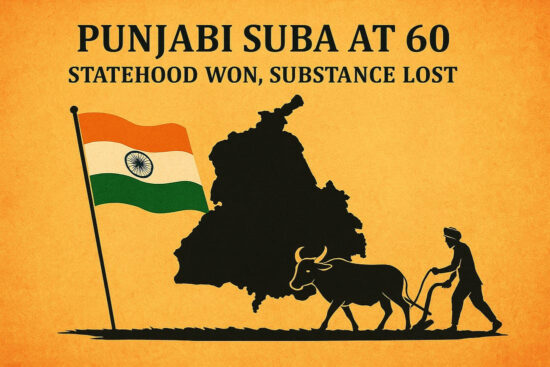
 In education, Punjab holds a mixed position. The state historically maintained a strong schooling network and better-than-average teacher–student ratios, which kept it among India’s mid-to-upper tier performers. However, falling enrolment, migration of students to private or out-of-state institutions, and comparatively lower government spending in recent years have weakened its ranking. Punjab no longer stands in the top bracket; rather, it hovers around the middle range, performing better than many BIMARU-origin states but falling behind southern states and progressive northern regions like Himachal Pradesh. The state’s scores reflect a system with good foundations but slipping momentum.
In farming, Punjab remains one of India’s leading contributors to wheat and rice procurement, continuing its identity as the “food bowl.” On sheer output and productivity, Punjab still ranks in the top three nationally. Yet the economic health behind this dominance paints a darker picture. Crop monoculture, groundwater depletion, very high farm debt, and declining profitability have pushed Punjab down in sustainability rankings. On prosperity indicators for farmers, the state now sits in the lower half, as rising input costs and low returns erode agricultural confidence. Thus, Punjab ranks high in production, but low in long-term viability.
In industry, Punjab’s position has slipped significantly. Once known for its robust small-scale industrial clusters, the state has fallen behind competitors like Gujarat, Maharashtra, Tamil Nadu, Telangana, and even Haryana in attracting investment, technology upgrades, and large-scale manufacturing. Punjab now stands in the bottom third among industrial states. Slow industrial growth, policy uncertainty, and limited high-tech or large-scale factories mean fewer job opportunities and slower economic diversification. The industrial pillar that could have balanced Punjab’s heavy agricultural dependence is no longer strong enough.
In employment, Punjab faces a structural crisis. With farming becoming less attractive and industry not creating enough jobs, educated youth increasingly migrate abroad. The state’s unemployment rate for youth is among the highest in northern India, contributing to large-scale emigration to Canada, UK, Australia, and other nations. Punjab ranks poorly in job creation, hovering in the lower category, especially for educated young men. This employment pressure shapes the social and political landscape of the state.
In per-capita income, Punjab sits comfortably above the national average, placing itself around the upper-middle tier among Indian states. But this ranking hides a serious long-term decline — a few decades ago, Punjab was consistently in the top three in per-capita income; today, it has slipped to around 10th place. The fall reflects slower growth and lack of economic diversification. Punjab is still richer than many states, but it is no longer among the richest.
In human development, Punjab retains a reasonable position thanks to long-standing infrastructure in health and education. On HDI-type indicators, the state stands in the higher middle range, but again, not among the top performers. It does well in life expectancy and basic social indicators but lags in cutting-edge health services, higher education quality, and service-sector expansion.
In debt and fiscal health, Punjab sits near the bottom nationally. With debt levels around 47% of GSDP and liabilities nearing ₹3.8 lakh crore, the state is ranked as the second-most indebted in India. High debt servicing and salary-pension obligations limit development spending, creating a cycle of slow growth and further borrowing. On fiscal sustainability, Punjab ranks in the bottom 3–4 states.
🧭 Overall Position — Where Punjab Stands
Taken together, Punjab stands at a critical crossroads. It ranks well in agricultural output and per-capita income, and moderately in education and human development. But it ranks poorly in industrial grow