
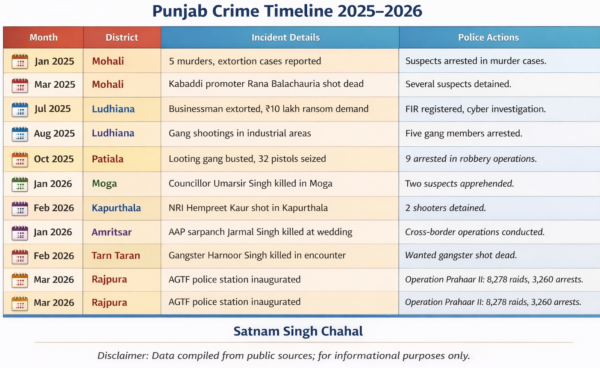
 Between 2025 and early 2026, the Indian state of Punjab saw complex and evolving criminal activity encompassing targeted murders, gang‑linked extortion, shootings, interstate organized crime, and heightened police action. Courts were informed that from 2023 to March 2025 alone, 569 FIRs were registered on complaints of gangster threats, illustrating persistent intimidation by criminal elements. A sharp spike in targeted killings in 2025 — at least 31 including civilians and gang operatives — marked a concerning development in gang violence, with links to overseas‑based syndicates and networks.
Mohali District — Rising Murders and Gang Rivalries
In Mohali, 2025 was marked by a steady rise in violent crime and gang rivalry. Local police handled numerous murder investigations, including cases involving inter‑group clashes that escalated into lethal violence. The spate of targeted killings underscored an emboldened criminal presence in the district’s urban and peri‑urban zones. In February 2026, police made significant progress in a Phase‑11 murder case in Mohali, arresting seven suspects — including two minors — after a fatal confrontation between rival groups. This incident highlighted how street disputes and intoxication‑linked confrontations can spiral into fatal attacks, reflecting deeper social and criminal tensions.
Ludhiana District — Extortion Threats and Gang Violence
Ludhiana continued to experience gang‑linked extortion attempts and shooting incidents across 2025 and into early 2026. One recent case involved a 43‑year‑old unemployed former businessman receiving WhatsApp death threats and a ₹10 lakh extortion demand from a number claiming to represent the Lawrence Bishnoi gang, prompting a formal FIR and cyber‑tracing efforts by police. Earlier in late 2025, multiple shootings — including the high‑profile killing of kabaddi player Gurvinder Singh — brought attention to gang influence and turf conflicts in the district. Law enforcement has arrested gang suspects and confiscated illegal weapons, yet extortion and intimidation remain concerns.
Moga, Jalandhar & Doaba Region — Targeted Killings
The Doaba region encompassing Moga, Jalandhar, Hoshiarpur, and Kapurthala saw a series of targeted killings in early 2026. On January 2, 2026, two motorcycle‑borne assailants fatally shot NRI returnee Hempreet Kaur in Kapurthala. On January 3, a Congress party worker, Umarsir Singh, was shot dead in Moga, with family alleging political rivalry as a factor. In Hoshiarpur village Miani, youth were also killed in separate shootings, and similar incidents were reported in Jalandhar’s Adampur area. These killings were widely linked to gang rivalries, extortion refusal, or intra‑community tensions, generating public debate on safety and law enforcement efficiency.
Border Districts — Amritsar, Tarn Taran, Gurdaspur
Border districts also faced organized crime and violent extortion. At the start of 2026, AAP sarpanch Jarmal Singh was shot dead at a wedding in Amritsar’s Verka area after reportedly facing extortion threats for over a year. A subsequent police encounter near Bhikhiwind in Tarn Taran resulted in the death of suspected gangster Harnoor Singh, underlining the confrontational nature of organized crime in these areas. Police also reported that multiple businessmen who refused to pay extortion demands were shot or targeted, suggesting that gangs were bold in executing attacks despite ongoing crackdowns.
Organized Crime — Transnational Networks
Punjab’s gang landscape has extended beyond domestic borders, with criminal syndicates operating from abroad. Investigations and media reporting have identified over 60 overseas gangsters — based in countries including the U.S., UK, Canada, UAE, Germany, Australia, Pakistan, and Thailand — believed to be directing extortion and contract killing networks within Punjab. Some of these groups, such as the Lawrence Bishnoi gang, have been linked to murders in Canada and calls for them to be designated as terror entities due to their cross‑border activities. Arrests and detentions of reputed gang members abroad, including in Georgia, reflect growing international cooperation against these networks.
Anti‑Crime Police Operations — 2025–2026
Responding to escalating gang power, Punjab Police launched several high‑impact operations:
Operation Prahaar II (January 2026)
In January 2026, Punjab Police executed “Operation Prahaar II,” a 72‑hour statewide crackdown targeting organized criminal elements. Over 8,278 raids were conducted, 3,260 arrests made, and 47 firearms seized, along with significant narcotics and illicit cash recoveries. The operation involved coordinated efforts across districts and represented one of the most extensive anti‑gangster actions in recent memory.
AGTF Police Station — Rajpura
In March 2026, the state inaugurated its first Anti‑Gangster Task Force (AGTF) police station in Rajpura, a move aimed at strengthening cross‑district investigations and dismantling overlapping criminal syndicates. The specialized unit operates independently to reduce intelligence gaps and procedural delays associated with local station boundaries, signaling a strategic shift toward intelligence‑driven policing.
Community Involvement & Rewards
Police have also intensified outreach to the public, urging community cooperation in reporting gang activity. A dedicated anti‑gangster helpline and reward schemes up to ₹10 lakh for credible crime leads have been introduced, emphasizing confidentiality and informant safety to build trust and drive actionable information.
Challenges & Controversies
Efforts have not been without controversy. In Chandigarh, two police officers were suspended over a suspected role in a firing incident connected to gang extortion networks, spotlighting concerns about internal corruption and complicity.
A Complex Crime Landscape
Punjab’s crime situation in 2025–2026 reflects a multipronged threat: local gang rivalries spilling into lethal violence, transnational organized crime influence, digital extortion tactics, and periodic mass police operations. While enforcement actions show strong resolve and measurable outcomes, the persistence of targeted killings and extortion attempts signals that systemic challenges remain. Continued public cooperation, cross‑border policing collaboration, and intelligent use of technology will be essential to reduce crime and restore public confidence across the state.