
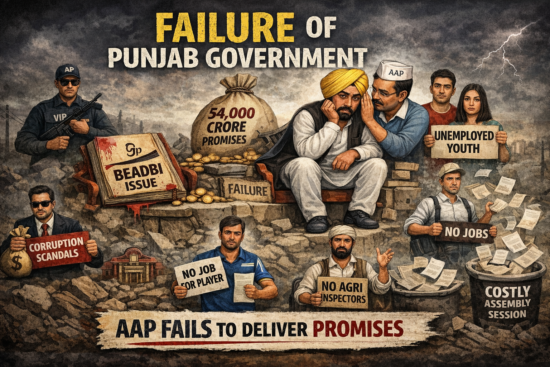
Punjab’s debt trap is deepening at a pace that has begun to alarm economists, auditors, and policymakers alike. With the state’s debt now estimated to exceed 45 per cent of its Gross State Domestic Product, Punjab finds itself in a cycle in which borrowing has become a routine tool for survival rather than development. Over the past decade, the state’s outstanding debt has more than tripled, rising from just over one lakh crore to well above three and a half lakh crore. What makes this trend particularly worrying is that a significant portion of new borrowing is not being used to build infrastructure or stimulate economic growth, but simply to service old loans, pay interest, and fund routine expenditure. This pattern reflects a classic debt trap: the state borrows to stay afloat, but each round of borrowing tightens the fiscal noose further.
A major driver of this crisis is Punjab’s persistent revenue deficit. The state spends far more on day‑to‑day operations than it collects in revenue. Salaries, pensions, interest payments, and subsidies consume the bulk of the budget, leaving little room for capital investment. In recent audits, the Comptroller and Auditor General has repeatedly flagged that Punjab’s revenue receipts are growing far too slowly to keep up with its expenditure. When a state must borrow even to pay for routine administration, it signals deep structural imbalance. This imbalance is compounded by the fact that Punjab’s economic growth has not kept pace with its rising liabilities, further widening the gap between what the state earns and what it owes.
At the heart of Punjab’s fiscal stress lies its enormous subsidy burden, especially in the electricity and agriculture sectors. Free or heavily subsidized power for farmers has been a political constant since the late 1990s, and while it remains popular, it comes at a staggering financial cost. The electricity subsidy alone runs into tens of thousands of crores annually, and arrears have accumulated over time. Agriculture‑related subsidies covering water, seeds, inputs, and procurement support—add another heavy layer of expenditure. Punjab’s groundwater depletion has forced farmers to rely on deeper tube wells, which in turn increases electricity consumption and pushes the subsidy bill even higher. These commitments, while politically sensitive, have become fiscally unsustainable, locking the state into a cycle where subsidies grow faster than revenue.
Punjab’s revenue‑raising capacity has also weakened over the years. Industrial growth has stagnated compared to states like Gujarat, Maharashtra, and Tamil Nadu, limiting the state’s ability to generate revenue through GST and excise. The introduction of the Goods and Services Tax further reduced the state’s flexibility, as it lost control over key taxes that once formed a major part of its income. Meanwhile, delays in central transfers such as the Rural Development Fund, GST compensation, and disaster relief have created cash‑flow pressures that force the state to borrow even more. These structural constraints mean that Punjab’s fiscal health is not just a matter of expenditure, but also of limited and unpredictable revenue streams.
Another major factor deepening the debt trap is the state’s high committed expenditure. Punjab spends an unusually large share of its budget on salaries, pensions, and interest payments. In the current financial year, the state is expected to spend nearly thirty‑seven thousand crore rupees on debt servicing alone. Interest payments themselves exceed twenty‑three thousand crore, while principal repayments account for the rest. This means that a significant portion of the state’s annual borrowing is immediately consumed by past obligations, leaving little for development or reform. When a state’s committed expenditure becomes this overwhelming, fiscal flexibility disappears, and long‑term planning becomes nearly impossible.
Successive governments have contributed to this situation by prioritizing politically popular schemes over structural reforms. Free power, loan waivers, and welfare promises have expanded over time, regardless of which party was in power. While each government inherited a difficult fiscal situation, none have taken the politically risky steps needed to rationalize subsidies, diversify agriculture, or expand the industrial base. As a result, Punjab’s debt has risen steadily across administrations, reflecting a bipartisan reluctance to confront the state’s underlying economic challenges.
All these factors together create a vicious cycle. High subsidies and high committed expenditure lead to a large revenue deficit. The deficit forces the state to borrow more, which increases interest payments. Rising interest payments reduce the funds available for development, which slows economic growth. Slow growth limits revenue generation, which then forces even more borrowing. Unless Punjab breaks this cycle through structural reforms, agricultural diversification, and strict fiscal discipline, the debt trap will continue to tighten. The state’s economic stability and its ability to invest in its future depends on decisions that are difficult but unavoidable.