
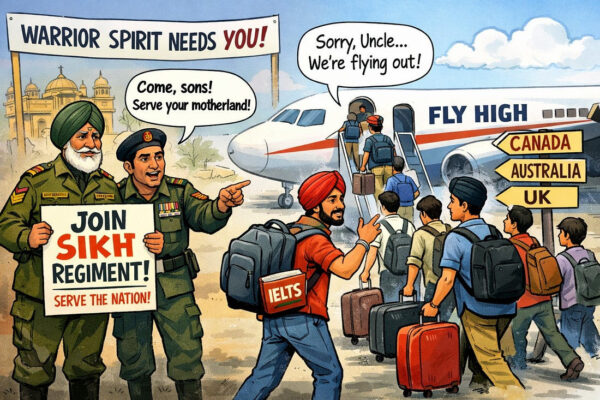
 On January 21, 2026, the Indian Army made an unusually direct appeal to Punjab’s youth, urging them to enlist in the Sikh Regiment. The appeal came at a time when recruitment numbers are falling and manpower shortages are becoming difficult to ignore. This, ironically, happened just days after seven battalions of the Sikh Regiment were honoured with major awards, including two Chief of Army Staff Unit Citations.
The contrast is uncomfortable. A regiment celebrated for valour and sacrifice is now struggling to attract young men from the very land that once filled its ranks almost automatically.
Rooted in the teachings of Guru Hargobind’s idea of Miri-Piri and Guru Gobind Singh’s creation of the Khalsa, the Sikh Regiment has earned 75 Battle Honours, 38 Theatre Honours and over 1,650 gallantry awards. For decades, joining the Army in Punjab was not a career choice—it was part of who you were.
Yet that relationship has weakened sharply. Before 1966, Punjab contributed nearly 31 per cent of Army recruits. Today that figure is down to about 7–8 per cent, overtaken by states like Uttar Pradesh and Rajasthan. Even the Sikh Regiment—once a matter of pride for Punjabi families—now faces vacancies that affect morale as well as operational strength.
This decline did not happen overnight. Nor can it be pinned on one policy or one government. It has been building quietly for years.
• Declining glamour of military service
One reason rarely stated openly is the loss of glamour attached to military life. Government jobs—police, PCS, even a peon’s post—today attract more applicants than the Army. Everyone knows why: fixed hours, predictable postings, local influence, and a sense of permanence. The Army, however, demands discipline, constant transfers and personal risk, with rewards that now feel uncertain.
Those who enter professional streams usually choose to stay there. Engineers look to the private sector or abroad. The Army barely figures in their plans anymore. I can say this from personal experience. When I was in my third year of Mechanical Engineering, I appeared for a campus interview for the Corps of Engineers and was selected. The package was decent. Yet I did not join—not because I opposed the Army, but because even then the profession was losing its pull among educated youth. That loss of lustre has only deepened since.
• Demography: smaller families, shrinking risk appetite
This is perhaps the most decisive change. Families in Punjab are no longer large. Most Sikh households today have one child, or at most two. Often it is a single son, or one son and one daughter. With fertility rates around 1.6, parents are understandably cautious. When there is only one son, sending him into a profession involving physical danger no longer feels like honour—it feels like risk. Tradition gives way to calculation.
• Mass migration abroad
For nearly two decades, Canada, Australia, the UK and the US acted as an escape route. Between 2016 and 2021 alone, more than 4.7 lakh Punjabis migrated abroad, mostly after 2016. These were the very young men who once filled recruitment rallies. Their departure thinned the Army’s recruitment base long before Agnipath entered the picture.
• Post-Green Revolution prosperity and altered aspirations
The Green Revolution changed Punjab’s social psychology. Farming, business and urban employment came to be seen as safer and more respectable. Even where farm incomes later stagnated, the Army was no longer viewed as the default ladder of mobility. Overseas education and migration further diverted family resources away from military careers.
• Substance abuse and physical fitness concerns
Recruitment drives have exposed uncomfortable truths. In 2014, candidates in Patiala, Amritsar and Jalandhar were caught using steroids to clear physical tests, forcing the Army to introduce compulsory dope testing. Later drives showed fewer positives, but concerns never disappeared. Addiction may not affect everyone, but it has damaged perceptions about fitness, discipline and readiness.
• Weak educational foundations for officer entry
At the officer level, Punjab faces a different problem. Schools often fail to prepare students for exams like the NDA and CDS. Weak foundations in mathematics, English and general knowledge mean many aspirants fall out early. Preparation usually begins too late, often after graduation, when the odds are already stacked.
• Perceived institutional and policy disadvantages
Punjab has long argued that recruitment quotas and declining proportional representation disadvantage its youth. These concerns were formally raised as early as 2008. Whether fully justified or not, such perceptions have discouraged participation and fed a sense of distance from the system.
• Lingering psychological impact of 1984
The shadow of Operation Blue Star has not fully lifted. For many families, especially in rural Punjab, it continues to influence trust in uniformed institutions. Decades later, the emotional residue remains part of the recruitment problem.
• Agnipath: an accelerant, not the cause
The Agnipath scheme was introduced in 2022, has certainly worsened the situation. However, it did not create the decline. That process was already underway, driven by demography, migration, changing aspirations and the steady erosion of the Army’s social prestige. Agnipath merely removed the last remaining attraction—long-term security. For families already risk-averse, a four-year contract was the final push away.
A narrowing window
Taken together, these factors explain why the Sikh Regiment’s appeal today feels less like a celebration and more like a warning.

Punjab’s warrior spirit has not vanished. It has been dulled by shrinking families, declining institutional glamour, policy drift and social change. However, circumstances are shifting again. Immigration routes to Canada, Australia and elsewhere are tightening. Student visas, work permits and permanent residency options are being cut back. The overseas exit door is slowly closing.
This creates a moment of choice. If military service continues to look uncertain and short-term, Punjab’s youth will remain disengaged. But if the Army is once again seen as a stable, dignified and respected career—with clear progression and long-term security—it can regain relevance.
That will not happen through slogans or nostalgia. It will require serious action: tackling drugs at the roots, fixing school education, restoring confidence in fair promotions, and rethinking recruitment models that treat soldiers as disposable labour.
A regiment’s legacy cannot survive on memory alone. If Punjab’s youth are to answer the call again, the system must stop invoking the past and start earning trust in the present.