
 The government of Punjab has expanded a wide range of free and subsidised services to provide relief to its people, particularly farmers, low-income families, and sections of the middle class. While these initiatives offer immediate support, they have also created a heavy and growing financial burden on the state, raising serious concerns about long-term sustainability.
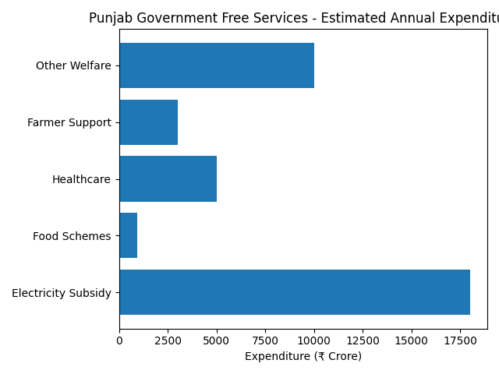
One of the most significant expenditures comes from free electricity. Households receive up to 300 units of free power every month, while farmers benefit from completely subsidised electricity for agricultural use. In addition, industries receive subsidised power. This sector alone costs the government between ₹15,000 crore and ₹20,500 crore annually, making it the single largest component of welfare spending. Over time, the cumulative cost of such subsidies has reached massive levels, reflecting the long-standing nature of this policy.
Food security schemes form another important part of government support. The state provides subsidised ration distribution and additional initiatives to deliver essential food items to millions of families, ensuring basic sustenance for a large population. These schemes cost approximately ₹900 to ₹1,000 crore per year. Although smaller than electricity subsidies, they still contribute significantly to the overall financial burden.
Healthcare services have also been expanded through free treatment programs and proposed large-scale health insurance coverage. These efforts aim to make medical care accessible to all, but they come at a cost of several thousand crores annually. As coverage increases, this sector is expected to become an even larger financial responsibility for the government in the coming years.
The agricultural sector receives further financial support beyond free electricity. Compensation for crop losses, subsidies on inputs, and occasional relief measures add thousands of crores to government expenditure each year. These costs are often unpredictable, particularly in cases of natural disasters such as floods, which require immediate financial intervention.
In addition, the government spends heavily on social welfare programs, including pensions, subsidies in transport, and educational support. These programs, combined with salaries, pensions, and interest payments, consume a major portion of the state’s revenue. As a result, very little is left for development projects such as infrastructure, job creation, and industrial growth.
Overall, the estimated annual cost of free and subsidised services in Punjab ranges between ₹30,000 crore and ₹45,000 crore. This represents a substantial share of the state’s total income and has forced the government to rely increasingly on borrowing to meet its obligations.
Visual Representation of Expenditure
The following chart provides a clear picture of how expenditure is distributed across major free services, with electricity subsidies dominating the financial outlay:
Rising Debt Since March 2022
The financial pressure created by these schemes is reflected in the rapid rise of state debt. In March 2022, Punjab’s total debt stood at approximately ₹2.8 to ₹3 lakh crore. Within a year, by March 2023, it increased to around ₹3.3 lakh crore due to continued borrowing.
By 2024, the debt had crossed ₹3.7 lakh crore, as the state struggled to balance welfare spending with limited revenue growth. The trend continued into 2025 and 2026, with total debt now exceeding ₹4 lakh crore. This sharp increase highlights how borrowing has become essential not only for development but also for sustaining existing subsidies and repaying past loans.
A major concern is that interest payments and fixed liabilities now consume a large portion of the state’s revenue. This leaves less than 10 percent of funds available for development activities. In effect, a significant share of new borrowing is being used to service old debt, creating a cycle that is difficult to break.
Punjab’s welfare model provides short-term relief and political appeal, but it comes with long-term economic risks. The dominance of electricity subsidies, combined with expanding welfare schemes and rising debt from around ₹3 lakh crore in 2022 to over ₹4 lakh crore today shows a growing fiscal imbalance.
These services are not truly free; they are financed through public funds and borrowing. If this trend continues without structural reforms and improved revenue generation, the financial burden will increasingly fall on future generations, limiting the state’s ability to invest in growth and development.