
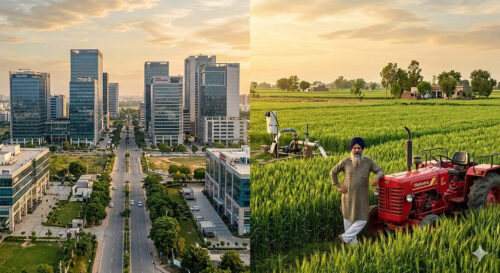
 Punjab’s new industrial policy deserves, at the very least, a fair and measured welcome. In both form and intent, it marks a serious effort by the State government to signal that Punjab wishes to return to the investment map with greater ambition than before. It is broader in design, more contemporary in language, more responsive to regional imbalance, and visibly more conscious of the fact that states today must compete, not merely hope, for industrial capital.
That, in itself, is no small thing.
For too long, Punjab has suffered from a paradox. It has retained many of the advantages that once made it a natural destination for manufacturing and enterprise — strategic location, an industrious population, strong agricultural linkages, and an entrepreneurial culture — yet it has often appeared hesitant, slow or fiscally constrained in translating these advantages into a modern industrial strategy. The new policy seeks to correct that. It attempts to reassure investors that Punjab is prepared to offer not only incentives, but also a more facilitative administrative environment.
The policy gets several things right
On paper, much about it appears sensible. It recognises the importance of targeted support for underdeveloped regions such as the border belt and Kandi areas. It appears to lower the barriers for smaller and medium units to access benefits. It also broadens the conversation beyond conventional industry by speaking to emerging sectors and by linking support to employment and sustained operations rather than merely to ceremonial announcements. In that sense, the policy is not merely ornamental; it appears to have been thought through.
Equally important is the effort to improve ease of doing business. Faster approvals, a more functional single-window mechanism, self-certification, and a more predictable interface with government all matter greatly. Investors are often willing to overlook the absence of extravagantly generous subsidies if a state can offer speed, clarity and consistency. Conversely, a state may offer a dazzling incentive package and still fail to attract serious investment if approvals are slow, compliance is uncertain, and the post-approval experience is mired in delay.
Punjab appears to have understood this distinction.
The larger question is fiscal credibility
Yet it is precisely here that a note of polite caution becomes necessary. For while the structure of the new policy may be commendable, the larger issue is not one of policy architecture alone. It is one of fiscal credibility. A state may promise much; the market will ask whether it can honour those promises in full, on time, and without arbitrariness.
That question cannot be brushed aside in Punjab’s case.
The State’s fiscal space is, by any fair assessment, limited. Punjab is burdened by high debt, substantial interest liabilities, large committed expenditure on salaries and pensions, and continuing subsidy obligations that already place sustained pressure on the exchequer. In such circumstances, any new reimbursement-heavy incentive regime must inevitably be examined not merely as a statement of policy intent, but as a future claim on already stretched public finances.
This is where caution begins to replace applause.
The reimbursement problem
Many of the most attractive features of industrial incentive policies are back-ended. Reimbursements linked to SGST, employment support, interest subsidy, and similar benefits generally accrue over time and depend on the enterprise reaching certain operational milestones. From a design standpoint, that is understandable and even desirable. It ensures that public support is linked to actual economic activity rather than speculative land acquisition or paper investment.
But from the point of view of the State’s balance sheet, back-ended incentives carry a built-in vulnerability. They may be announced generously in the present while their fiscal burden emerges later, when revenues may not grow as expected, when other political priorities may intervene, or when the treasury may find itself under pressure from far more immediate obligations.
That is why investors will look beyond the policy brochure.
Industry does not merely ask what the incentive is. It asks when it will be released, how it will be processed, whether it will be automatic or file-driven, and whether the payment cycle will be reliable. If reimbursements are delayed for months, or even longer, the incentive loses much of its practical value. What was meant to improve viability begins to impair cash flow. The entrepreneur who expected support from the State finds himself financing the State instead.
The danger of selective release
This is not only a question of delay. It is also a question of fairness.
Whenever incentives are reimbursement-based and the fiscal headroom is tight, a familiar administrative risk emerges: the possibility, or at least the perception, that releases may not occur uniformly or transparently, but on a pick-and-choose basis. Even where no actual favouritism exists, the absence of timely, rule-bound, automated disbursal can easily give rise to allegations of unequal treatment. Some units may feel that others are being preferred. Some may suspect that influence, proximity or discretion is entering what should have been a neutral fiscal process. In a politically charged environment, such perceptions can become almost as damaging as the reality.
For a State trying to rebuild investor confidence, that is a serious concern.
Nothing weakens an industrial policy more than the belief that implementation depends not on entitlement but on access. If investors begin to think that disbursal is uncertain, selective, or subject to invisible hierarchies of preference, the policy will cease to function as a transparent economic instrument. It will instead be viewed as an administrative negotiation. Serious investors generally avoid such ecosystems, or price the risk heavily into their decisions.
Mohali (SAS Nagar) Sector 66A-Sector 82, Airport Road.
Why today’s Budget matters
This brings us to today’s Punjab Budget for 2026–27, the last full-year budget before the next Assembly election. It assumes significance far beyond the usual annual exercise. The true test of the industrial policy will not lie only in the policy document or in the public messaging around it, but in the budgetary provisioning that accompanies it. The small print will matter more than the speech.
It will be important to examine whether, and to what extent, realistic reimbursement figures have actually been reflected in the budget. That would offer the clearest available indication of the type of response the government itself expects from industry. If the provisions are substantial and thoughtfully structured, they may suggest seriousness of intent. If, however, the amounts are pitched too low, the implications may be less comforting.
One possibility would be that the State simply does not have enough fiscal room to shoulder these reimbursements in the face of its other committed liabilities. The other possibility would be that the government itself does not expect meaningful investment to materialise and commence production at a scale sufficient to generate large claims in the near term. Either interpretation would raise valid questions about the gap between policy ambition and fiscal preparedness.
Beyond the summit and the MOU
The coming Invest Punjab event, to be held from 13 to 15 March at Plaksha University, Mohalit will also have to be viewed in this wider context. Such summits are useful platforms. They create visibility, mobilise attention, and allow governments to project confidence. But Punjab now needs scrutiny beyond the headline MOU. The more relevant question is not how many investment expressions are announced on stage, but how many of the commitments made in previous years under similar festivals have translated into actual projects, production, employment and tax generation on the ground.
Punjab does not lack policy intent. The new industrial push clearly reflects a government trying to present itself as pro-growth, facilitative and open for business. That should be acknowledged. But intent alone will not settle investor doubts. The decisive issue is whether the State can create a reimbursement regime that is timely, rules-based, fiscally backed and insulated from the temptation — or even the appearance — of selective release.
The real test
In the final analysis, that is the credibility test before Punjab.
A good policy can attract interest. A fair policy can attract goodwill. But only a financially credible and transparently administered policy can attract durable investment. Punjab has made a promising start in form and purpose. It must now show that its treasury, its procedures and its political discipline are equal to the promise it has made. Otherwise, what begins as an industrial opening may yet end as another chapter in the long story of announced opportunity and deferred delivery.