
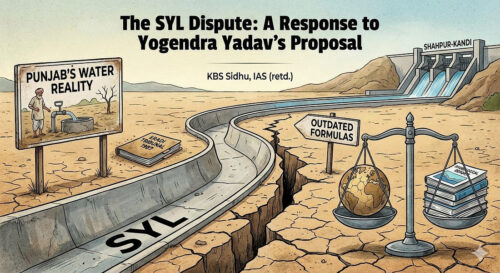
 The op-ed reproduced below was submitted by me to The Tribune within hours of Yogendra Yadav’s proposal appearing online in the newspaper on 12 January 2026. The editorial desk, however, did not publish the article in its intended form, choosing instead to carry only a brief and sketchy Letter to the Editor, on 14 January, which is reproduced at the end of this piece.
Readers may judge for themselves whether the issues raised here—central to Punjab’s water rights as an upper riparian state and to the larger questions of constitutional propriety and inter-State equity—deserve wider circulation among those who genuinely care about Punjab’s future. If so, please share.
The Tribune: A Response to Yogendra Yadav’s Proposal
Yogendra Yadav’s op-ed in The Tribune of January 12, “The SYL dispute is difficult, not impossible,” is thoughtful and well‑intentioned. His five‑point framework reflects a genuine desire to resolve one of India’s most fraught interstate disputes. Yet, seen from Punjab, his proposal rests on premises that are neither practically workable nor politically sustainable, and it glosses over historical and legal realities that any durable settlement must confront.
Supreme Court Decree and Its Limits
The first clarification is constitutional. The Supreme Court’s decree in the SYL matter mandates the construction of the canal; it does not amount to the Court placing its stamp of approval on the Eradi (now Ravi–Beas) Tribunal’s allocation of waters. The judgment is about infrastructure, not final inter‑se rights. To treat canal construction as if it automatically validates an old and never‑notified water‑sharing formula is to conflate two distinct questions: how water should be carried, and who has a legitimate claim to how much of it.

The Rajiv–Longowal Accord and Barnala Era
The 1985 Rajiv–Longowal Accord tied three elements together: transfer of Chandigarh to Punjab, reference of river‑water issues to a tribunal, and time‑bound completion of the SYL canal. The bargain was never honoured in full: Chandigarh did not move to Punjab, yet Punjab went ahead on its part. Land was acquired, villages were disrupted, and construction on the Punjab stretch was taken up under the Surjit Singh Barnala government (1985–1987) and pushed more vigorously during President’s Rule thereafter. Punjab thus paid a substantial price in advance for an accord whose core political quid pro quo never materialised. To now frame Punjab as an intransigent non‑performer that must first “complete the canal” is to invert this history. That is why any formula centred on completing SYL is a political non‑starter in Punjab.
Punjab’s Water Reality, Not the Surplus Myth
A second misconception is that Punjab is water‑surplus and profligate. The reality is almost the opposite. Only about a quarter of Punjab’s irrigated area now depends on canal water; roughly three‑quarters is sustained by tubewells drawing on rapidly depleting aquifers. Each extra acre of groundwater‑irrigated paddy may look like “over‑use” from afar, but on the ground it represents farmers trying to protect livelihoods in the absence of assured surface irrigation. Punjab is thus caught in a vicious cycle: inadequate and unreliable canal supplies have pushed cultivators into ever‑deeper dependence on groundwater, which in turn is driving the state towards an ecological precipice.
Riparian Rights, Liabilities and Asymmetries
Riparian status comes with liabilities as well as rights. A river that passes through a state brings flood damage, embankment costs and environmental risk. The Ravi floods of 2025 illustrated this brutally: extensive inundation in Punjab’s border belt caused heavy losses to life, property and standing crops. If Haryana now asserts a substantial claim to Ravi waters, will it also accept a corresponding share of the financial burden and human suffering caused by Ravi flooding?
The Centre’s approach to riparianism is inconsistent. The undivided Punjab was riparian to the Yamuna in the Jagadri belt of what is now Yamuna Nagar district, yet when the Centre mediated a Yamuna water‑sharing arrangement among Uttarakhand, Himachal Pradesh, Uttar Pradesh, Haryana, Rajasthan and Delhi, Punjab was not even accorded observer status. Conversely, Haryana—no longer riparian to the Ravi since November 1, 1966—continues to assert claims on Ravi waters as if riparian continuity were irrelevant. Similarly, carrier canals taking water to Rajasthan have for decades caused extensive waterlogging, brackish groundwater and salinisation in several southern Malwa districts. Yet neither Rajasthan nor the Union has meaningfully shared the economic or ecological cost of this slow‑motion disaster, even as historical usage by downstream beneficiaries is cited to justify further pressure on Punjab’s share.
Obsolete Tribunal and a More Viable Interim Path
The status of the Eradi, now Ravi–Beas, Tribunal also demands candour. Its award was never notified by the Union government and was crafted in an era when climate change, glacial retreat, altered monsoon patterns and cumulative groundwater stress were not part of hydrological calculations. To resurrect those figures as if they were timeless is to anchor present policy to an obsolete baseline. The minimum first step must be to constitute a fresh tribunal to determine, with contemporary data, how much water is actually available in the Ravi–Beas system before any talk of inter‑se sharing is resumed.
Of course, there is a need to prevent India’s share of Indus‑system waters from flowing wastefully into Pakistan. But the way forward lies in infrastructure, not in squeezing Punjab’s internal allocations further. The Shahpur‑Kandi dam (a designated national project), the Ranjit Sagar dam downstream and the Madhopur barrage upstream on the Ravi still await full operationalisation and optimisation. The Centre should help Punjab complete and modernise these works and, in parallel, explore transfers from the Chenab basin to the Ravi or additional storage so that more of India’s share is captured and productively used, especially in light of the holding in abeyance of the Indus Waters Treaty.
Towards a Fair and Durable Settlement
For the next decade or so, instead of pressing Punjab to revive a canal its polity no longer accepts, the Union could provide Haryana with an annual grant—say ₹10,000 crore—to be deployed at Haryana’s discretion. The funds could support farmers in genuinely water‑deficit tracts and finance alternative irrigation infrastructure such as drip and sprinkler systems, canal modernisation and crop diversification. Crucially, this grant should taper to zero over ten years, encouraging Haryana to move towards long‑term water security rather than treating transfers from the Centre as a permanent entitlement.
Yogendra Yadav deserves appreciation for his reasoned, good‑faith intervention on a fraught subject. However, any framework that treats Punjab as an unreasonable negotiator, trivialises the dispute into a few percentage points, or demands completion of SYL on outdated terms will be rejected in Punjab at the very first instance. The reasons are rooted in history, hydrology, equity and the lived experience of Punjab’s farming and non‑farming communities.
A just and lasting settlement must rest on four pillars: updated facts grounded in contemporary hydrological reality; reciprocal recognition of riparian liabilities and not merely rights; correction of past asymmetries in how the riparian principle has been applied; and honest acknowledgment that Punjab is no longer the water‑abundant donor state of popular imagination. Only when these foundational issues are addressed can a compact be negotiated that stakeholders will willingly accept and sustain.