
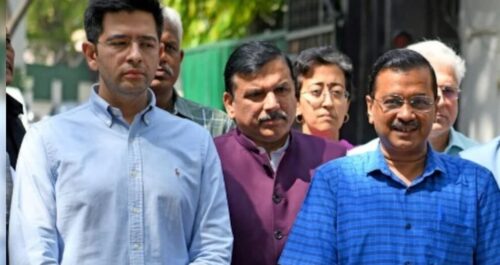
 The recent developments surrounding Raghav Chadha have sparked significant political debate within the Aam Aadmi Party (AAP). Once considered one of the closest and most trusted aides of party chief Arvind Kejriwal, Chadha’s gradual sidelining from key responsibilities signals a deeper internal shift within the party’s power structure, particularly concerning its Punjab leadership and representation in the Rajya Sabha.
Raghav Chadha was recently removed from the post of Deputy Leader of AAP in the Rajya Sabha, a position that holds both symbolic and operational importance. The Deputy Leader plays a crucial role in coordinating party strategy, speaking on key legislative issues, and representing the party’s stance in the Upper House of Parliament. His removal indicates not just a routine reshuffle, but a clear reduction in his political weight within the party hierarchy.
At one point, Chadha’s influence in AAP was unquestionable. He was often described as Kejriwal’s “right-hand man,” reflecting his deep involvement in policy decisions and political strategy. His importance was further demonstrated during his engagement to Bollywood actor Parineeti Chopra, when Punjab Chief Minister Bhagwant Mann offered his official residence, Kapurthala House in Delhi, for the ceremony. The presence of Arvind Kejriwal at the event further reinforced Chadha’s stature within the party’s inner circle. Notably, Kapurthala House had been used only once more for a personal event Kejriwal’s daughter’s wedding highlighting the exclusivity of the gesture.
However, the turning point in Chadha’s political journey appears to have come in 2024. During the controversy surrounding the Delhi Excise Policy case, Chadha maintained a noticeable silence, especially when Kejriwal was arrested and later acquitted by a Delhi court along with several others. In politics, silence during moments of crisis is often interpreted as distance or dissent. This perceived lack of vocal support may have contributed to a growing sense of distrust within the party leadership.
The situation escalated when AAP formally wrote to the Rajya Sabha Secretariat seeking Chadha’s removal from the Deputy Leader position. Reports suggest that another Punjab-based Rajya Sabha MP, Ashok Mittal, is likely to replace him. This move indicates a possible shift in the party’s internal balance, with Punjab leaders gaining more prominence in parliamentary roles.
Now, coming to the key line that requires explanation:
“According to sources, the letter also said that Chadha who is a Rajya Sabha member from Punjab should not be given time to speak in the House from the AAP quota.”
This statement is politically significant and requires careful understanding. In the Rajya Sabha, each political party is allotted a certain amount of speaking time based on its strength (number of MPs). This time is distributed among party members, and it is usually decided internally by the party leadership. Since AAP has 10 members in the Rajya Sabha seven from Punjab and three from Delhi the party has a fixed share of speaking time, often referred to informally as its “quota.”
When the letter suggests that Raghav Chadha should not be given time to speak from this quota, it effectively means that the party leadership does not want him to represent AAP’s voice in parliamentary debates. This is not just about limiting his participation; it is a strong political message indicating a loss of trust and authority. In parliamentary politics, speaking in the House is one of the most visible and influential roles of an MP. Denying this opportunity is akin to politically sidelining the individual without formally removing them from the House.
In essence, even though Chadha remains a Rajya Sabha MP, restricting his speaking opportunities reduces his relevance in national political discourse. It also allows other leaders—possibly those more aligned with the current leadership to take center stage. This move reflects a deeper internal recalibration within AAP, where loyalty, visibility, and alignment with the leadership’s narrative appear to be key factors determining a leader’s role.
Overall, the Raghav Chadha episode is not just about one leader’s rise and fall, but about the evolving dynamics within AAP. It highlights how quickly political fortunes can change and how internal party decisions can significantly impact a leader’s public and parliamentary presence.