
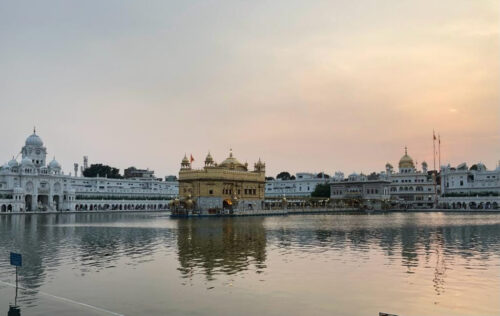
 The Sikh Gurdwaras Act, 1925, was framed for colonial “peace management”, not for recognising Sikh spiritual sovereignty. A century later, the Panth must author its own post-colonial framework. 1. A Colonial Law for a Mobilised Panth
Nearly eight decades after Indian Independence, most historic Sikh gurdwaras in Punjab and adjoining regions continue to be administered under a British-era statute: the Sikh Gurdwaras Act, 1925. That fact alone ought to invite reflection. The core institutions of Sikh authority precede this enactment by centuries. Akal Takht, for instance, goes back to 1606, to the time of the Sixth Guru, Guru Hargobind Sahib, and symbolises from its very origin the Sikh union of spiritual authority and temporal responsibility. Yet a community whose religious institutions arose from martyrdom, collective discipline, spiritual autonomy and temporal courage still finds many of its most sacred spaces legally structured by an enactment of the colonial state, the post-Independence amendments notwithstanding.
The statute was born in a very specific moment. The Gurdwara Reform movement and the Akali agitations had transformed Sikh politics and religious assertion into a mass force that the British could neither ignore nor crush without cost. The colonial state therefore sought what empires usually seek in such moments: not spiritual justice, but administrative settlement; not recognition of a people’s sovereign inner life, but a controlled mechanism through which agitation could be pacified, representation channelled, and order restored.
That is the true historical setting of the 1925 Act. It was not framed as a charter of Sikh self-definition. It was not conceived as a theological document. It was not designed to embody miri-piri, nor to recognise the Guru-Panth as a self-governing spiritual commonwealth. It was, instead, a law for managing a mobilised community through an acceptable legal structure.
Its language and architecture reflect that origin. The Act defines who is a Sikh, what qualifies as a Sikh gurdwara, how certain shrines are to be notified, who may vote, how committees are to function, how disputes are to be handled, and how property is to be administered. In other words, it is a statute of classification, regulation and management. It belongs to the world of bureaucratic order. However significant its historical role may have been, it does not speak in the language of Sikh spiritual sovereignty.
2. What the 1925 Act Does — and Does Not — Recognise
To understand why the present framework has become inadequate, one must first be clear about what the Sikh Gurdwaras Act, 1925 actually does.
It performs three central functions. First, it establishes the Shiromani Gurdwara Parbandhak Committee, or SGPC, as a statutory body. Secondly, it prescribes the machinery for elections, qualifications, membership, disputes, committees, office-holders and the administration of properties attached to specified gurdwaras. Thirdly, it confines this legal arrangement to a defined territorial field linked to the old Punjab and the regions later constituted as Punjab, Haryana, Himachal Pradesh and Chandigarh.
That is substantial, but it is also limited. The Act governs an institutional arrangement. It does not found a civilisation. It regulates management. It does not define the spiritual constitution of the Panth.
Its silences are therefore more revealing than its provisions. It does not expressly recognise the spiritual sovereignty of the Sikh Panth in matters of doctrine, discipline, or the status of the Takhts. It does not declare SGPC to be a supreme Panthic parliament. It does not establish an all-India or Panth-wide religious framework for all historic Sikh institutions. It does not create a unified constitutional order for the Sikh world. Nor does it place the authority of Guru Granth Sahib and Guru Panth beyond the reach of legislative rearrangement.
That is why the Act must be understood for what it is: a region-specific management statute, not a charter of Sikh self-rule.
3. SGPC: A Statutory Body, Not the Final Source of Panthic Authority
Over time, public discourse has often treated SGPC as though its statutory status had ripened into something higher—almost as though it were the natural and final embodiment of collective Sikh authority. This assumption has become so familiar that it often escapes scrutiny. Yet legally and institutionally, SGPC remains what it was created to be: a creature of statute.
It exists because a legislature created it. Its composition, powers, procedures and jurisdiction depend upon law. They can be amended, curtailed, expanded or restructured by legislative action. Its authority extends to institutions notified under the Act; it is not identical with the total spiritual will of the Panth.
This distinction matters greatly. Once a statutory management body begins to be treated as if it were itself the source of ultimate religious legitimacy, a subtle but profound inversion takes place. The flow of authority is silently reversed. Instead of institutional legitimacy proceeding from Guru Granth Sahib, Guru Panth, history, discipline and rehat, it begins to appear as though legitimacy proceeds from a legislative framework and the body constituted under it.
That is especially dangerous in matters touching the appointment, discipline, or removal of Jathedars, or in questions concerning the standing of Takhts and other institutions whose authority far predates the modern statute book. To accept SGPC as unquestionable simply because it is statutorily entrenched is, in effect, to accept that colonial and post-colonial legislative design has become the final arbiter of Sikh institutional life. That cannot be a satisfactory resting point for a community whose deepest theological instinct places authority in the Guru and in the collective Panth, not in civil enactment.
4. A Fragmented Legal Landscape: The Takhts Themselves Tell the Story
If the 1925 framework truly represented a coherent and unified structure of Sikh spiritual jurisdiction, one would expect all major Takhts and historic shrines to exist within a common legal order. They do not. The actual map of Sikh institutional governance is fragmented, uneven and revealing.
Takht Sri Hazur Sahib at Nanded is governed under a separate state law in Maharashtra, through a management structure in which the role of the state is both visible and consequential. Takht Sri Patna Sahib in Bihar is governed through its own arrangements, constitution and by-laws, shaped by local and state-level structures rather than by the SGPC or the Punjab-centred statute. Outside these jurisdictions, many gurdwaras operate under the ordinary law of trusts, societies, endowments or charities applicable to their locations. In the diaspora, governance is even more scattered, often resting on association law, charity regulation or local corporate structures.
This is not merely an administrative inconvenience. It exposes the absence of a consciously articulated Panth-wide constitutional grammar. Even the highest Sikh thrones do not function within a single legal design authored by the Panth itself. Instead, they are embedded in different statutory and civil arrangements shaped by different governments and local contingencies.
The resulting picture is unmistakable: decisive legal control over some of the most important Sikh institutions has been exercised not through a unified act of collective Sikh self-definition, but through a patchwork of state-mediated frameworks. That reality should compel serious introspection.
5. The Statutory Ecosystem and the Deeper Continuity of the Panth
The 1925 Act does not stand alone. Over time, an entire statutory ecosystem has grown around it: tribunals, election authorities, specialised mechanisms for service disputes, forums for management conflicts, and various layers of legal oversight. These bodies play a practical role. They adjudicate, regulate, supervise, and settle disputes arising from the administration of notified shrines and related institutions.
There is no need to deny their utility. Institutions of scale require procedures; public bodies require accountability; property and employment matters require legal resolution. But these mechanisms must be seen in proper proportion. They belong to the realm of temporal management, not spiritual foundation.
The Sikh faith, and especially the authority embodied in Akal Takht, precedes all of this by centuries. The moral and institutional authority of Akal Takht, as noted in our opening paragraph itself, goes back to Guru Hargobind and to the early seventeenth century. It emerges from Sikh memory, sacrifice, collective discipline, martyrdom, and historical practice from 1606 onward. No one can seriously claim that such an institution derives its essential legitimacy from a twentieth-century management statute.
Indeed, this is also the larger constitutional and civilisational point that underlies recent discussions on the State’s approach to Sikh sacred institutions. Justice R. S. Sodhi, in a recent article in The Tribune, rightly observed that the Guru’s Word does not need the crutches of ever-harsher penal provisions to retain its authority. His warning is an important one: when the State begins to treat Guru Granth Sahib as a mere legal object to be “protected”, it misunderstands both the nature of the sacred and the limits of criminal law. That warning may be extended further. If the Guru is not a being whose authority depends upon penal reinforcement, then Sikh institutions too ought not to remain trapped within inherited legal structures that were designed less to honour the sacred than to administratively contain a politically awakened community.
That is why a vital distinction must be preserved. If the 1925 Act were repealed, replaced or radically revised, the present statutory scaffolding around elections, employee disputes, property management and committee procedures would undoubtedly change. But the spiritual standing of Sikh institutions would remain untouched. Akal Takht would not become less sacred. Guru Granth Sahib would not become less central. The Panth would not lose its religious identity. What would change is only the legal shell through which these institutions are presently administered.
That legal shell should never be mistaken for the living body within.
6. India Re-Founded Its Sovereignty. Sikh Governance Did Not.
There is an instructive constitutional parallel here. India itself did not remain content to live indefinitely within the formal logic of colonial legality. Although the Constitution of India initially came into force within the transitional legal setting created by the Indian Independence Act, 1947, the Republic consciously re-founded its legitimacy. With the adoption of the Constitution, sovereignty was relocated in “We, the People of India,” and with provisions such as Article 395, the Constitution expressly repealed the Government of India Act, 1935 and the Indian Independence Act. Colonial authority was not merely inherited; it was superseded.
That was not only a legal act. It was a civilisational declaration. India did not deny historical continuity, but it refused to let colonial enactments remain the ultimate script of national legitimacy.
Sikh institutional governance has never undergone an equivalent re-founding. The Gurdwara Act continued, was adapted, and became familiar; but it was never consciously replaced by a post-colonial, Panth-authored framework grounded in Sikh doctrine, history and contemporary need. The consequence is a profound disjunction. The Indian Republic speaks in the language of self-given constitutional sovereignty, while much of Sikh institutional life remains legally structured through a compromise drafted under imperial conditions.
This does not mean that Sikh institutions should reject the Indian constitutional order. It means something subtler and more important: that within that constitutional order, the Panth has yet to author for itself a framework worthy of its own historical and spiritual self-understanding.
7. The Constitutional Space Already Exists
The case for such a re-founding is not anti-constitutional. On the contrary, it sits comfortably within the Indian constitutional structure.
Article 25 guarantees freedom of conscience and the right freely to profess, practise and propagate religion, subject to public order, morality, health and the other fundamental rights. Article 25(2) permits the State to regulate the economic, financial, political and other secular activities associated with religious practice, and to undertake social reform measures. Article 26 further grants to every religious denomination the right to manage its own affairs in matters of religion and to administer institutions and property in accordance with law.
Taken together, these provisions draw a principled distinction. The State may regulate secular and managerial aspects of institutions. It may create statutory bodies to ensure proper administration, accountability and legality. But it does not thereby become the source of spiritual authority, nor may it claim to define the religious will of a denomination merely by designing the management architecture around its institutions.
That distinction is crucial for the Sikh case. The Constitution already allows space for a model in which secular administration is lawfully structured, while religious self-definition and internal normative authority remain rooted in the community itself. Properly understood, Articles 25 and 26 do not weaken the case for a Panth-made charter. They strengthen it.
8. Why a Panth-Made Charter Is Now Necessary
The real question, then, is not whether the Sikh Panth should exist outside the Indian constitutional framework. It should not. The real question is whether Sikh institutions within that framework should continue to derive their operative shape mainly from an inherited colonial statute, or whether the Panth should consciously frame its own governing charter and then seek legal recognition for it.
The answer ought now to be clear.
A Panth-made charter would not be an act of rebellion. It would be an act of maturity. It would amount to saying that the Sikh community, after a century of statutory experience and nearly eight decades of republican India, is capable of setting out in deliberate form the principles by which its sacred institutions ought to function.
Such a charter could affirm without ambiguity the ultimate spiritual authority of Guru Granth Sahib and the centrality of Guru Panth in collective religious life. It could define more credible and broadly accepted procedures for the selection, duties, accountability and, where necessary, removal of the Jathedars of all Takhts. It could articulate common principles for the governance of all Takhts and historic gurdwaras in India, so that state-specific arrangements no longer substitute for Panthic coherence. It could lay down norms of financial transparency, educational activity, charitable service and ethical conduct in public life, not as managerial afterthoughts but as expressions of Sikh moral vision.
Most importantly, it could emerge through broad consultation across the Sikh world—scholars, sangat, seminaries, institutions, diaspora organisations and thoughtful lay voices—rather than being confined to the internal mechanics of statutory bodies and partisan caucuses.
9. Rebalancing the Relationship Between State and Panth
Any modern democratic state will retain legitimate functions in relation to religious institutions. Criminal law must apply. Corruption must be addressed. Public order must be maintained. Property and financial accountability require regulation. There is nothing objectionable in that.
The issue is therefore not whether the state should disappear from the field, but whether its role should remain foundational or become properly ancillary. At present, the structure of authority runs in effect from state to Panth: legislatures create bodies, define their powers, and thereby shape the terms on which Sikh institutions function. That may be administratively convenient, but it is normatively upside down.
A healthier model would reverse the direction in principle. The Panth would first define, through a carefully considered charter, its own internal constitutional order for religious affairs. Thereafter, legislatures would enact enabling laws consistent with that charter, subject of course to constitutional boundaries and to the State’s legitimate secular concerns.
That is not a claim of competing sovereignty. It is not separatism in legal disguise. It is simply the insistence that a religious community should, as far as possible, be the primary author of the internal principles governing its sacred institutions, while still functioning fully within the constitutional discipline of the Republic.
Such a rebalancing would, in fact, deepen constitutional democracy. It would demonstrate confidence in both religious autonomy and constitutional order, instead of forcing one to exist in permanent subordination to the other.
10. Repeal, Replace, Re-Found
The Sikh Gurdwaras Act, 1925 deserves respect for the historical role it played. It emerged from struggle. It marked the end of a phase in which many gurdwaras had been wrested from corrupt mahants. It created a mechanism through which institutional control could be stabilised. In that sense, it forms part of the history of Sikh assertion and sacrifice.
But honouring its historical place does not require treating it as sacred or permanent. No community can remain indefinitely bound to the legal psychology of a colonial settlement simply because that settlement once served a useful purpose.
A century later, the time has come to ask a larger question: should the foundational script of Sikh institutional life continue to be one written under imperial imperatives, or should it now be rewritten by the Panth itself?
The answer should take the form of three linked acts.
First, repeal the colonial script as the unquestioned foundation of Sikh religious governance.
Secondly, replace it with a Panth-made charter that reflects Sikh theology, history, moral discipline, institutional experience and present realities, while operating squarely within the Indian constitutional framework.
Thirdly, re-found the great institutions of Sikh collective life—Takhts, SGPC, boards, committees and related bodies—upon this conscious act of self-definition.
Such a project need not threaten the Indian state; indeed, it would strengthen the Republic by aligning Sikh institutional life more honestly with constitutional principles of religious freedom and denominational autonomy. At the same time, it would strengthen Sikh identity by ensuring that the living tradition of Guru Granth Sahib and Guru Panth is no longer mediated primarily through colonial and post-colonial statutory inheritances, but through a framework deliberately authored by the community itself.
That would not be an abandonment of history. It would be its fulfilment. What remains to be seen is whether Panthic leadership can rise to this moment with the vision and courage that such a cause demands.