
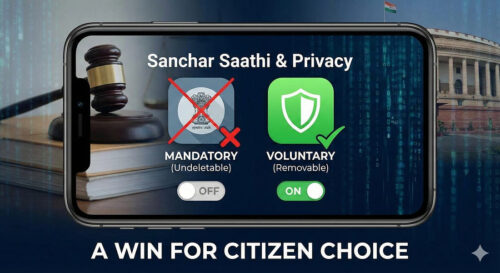
 On the opening day of the winter session of Parliament, our op-ed in ThePrint – “Make Sanchar Saathi removable. Good intentions don’t excuse State overreach” – argued that the Department of Telecommunications’ order on mandatory, non-removable pre-installation of the Sanchar Saathi app was constitutionally suspect. It tested the directive against the Supreme Court’s privacy framework in Puttaswamy, and warned of unintended consequences: erosion of consent, function creep and a push towards grey-market phones.
For a few hours that morning it seemed like a niche, lawyerly worry. By afternoon, it was the talk of the tech and political circuit. Opposition leaders seized on the “surveillance State” angle; digital-rights groups amplified the privacy critique; and global handset makers – most visibly Apple – began signalling that turning every device into a carrier of undeletable “stateware” was a bridge too far. What had been presented as a minor cyber-security tweak had suddenly become a live constitutional controversy.
The Government’s official climbdown
On 3 December, the Ministry of Communications quietly executed a retreat, formalised in a Press Information Bureau note titled, with refreshing candour, “Government removes mandatory pre-installation of Sanchar Saathi App.” The press note does three things at once: re-states the original intention, celebrates the app’s popularity, and recasts the retreat as a response to citizen confidence rather than to criticism.
First, the government stresses that the initial mandate flowed from a desire to give all citizens easy access to “cyber security”. Sanchar Saathi, it insists, is a secure application, “purely meant to help citizens from bad actors in the cyber world”, and its purpose is to protect users, not to watch them. The note casts the app as an instrument of “Jan bhagidari” – a participatory tool through which ordinary users can report fraudsters and suspicious activity while keeping their own interests safe.
Secondly, the government leans heavily on usage statistics. According to the ministry, 1.4 crore users have already downloaded Sanchar Saathi and are contributing information on some 2,000 fraud incidents every day. The number of registrations, it says, has been rising sharply; in the last single day before the clarification, six lakh citizens registered to download the app – a ten-fold jump in the daily rate. This surge is presented as “affirmation of faith” by citizens in the app’s protective value.

Finally – and most importantly for privacy – the note clarifies that users are free to remove Sanchar Saathi “whenever they want”. Given the app’s “increasing acceptance”, the government says, it has decided not to persist with the requirement of mandatory pre-installation for mobile manufacturers. In other words, the State gives up its bid for a permanent home on every handset, while claiming that public enthusiasm for the app makes compulsion unnecessary in any case.
What this U-turn tells us about accountability
As outcomes go, this is a good one. A useful cyber-security tool survives, stripped of its most troubling compulsory element. Citizens keep the choice to say “no”; manufacturers are spared the burden of being drafted, without consultation, into the role of software distributors for the State. For a directive that flirted so openly with overreach, this is quick – and welcome – riddance.
But the speed of the climbdown also underlines why constitutional guardrails and internal accountability matter. If a single executive order can attempt to smuggle an undeletable government app into every pocket, and then be withdrawn only after public fury, industry resistance and parliamentary noise, it is clear that the culture of Puttaswamy has not yet been fully internalised within the system. This cannot be dismissed as a harmless policy experiment. There must be consequences for those who drafted and cleared such a measure without seriously testing its constitutional footing or its political acceptability; unless some responsibility is fixed – and, yes, a few heads roll – future mandarins will feel free to try similar shortcuts again. The lesson of the past week should be simple: cyber security and citizen partnership are laudable aims, but they must be pursued through voluntary tools, transparent law-making and hard-wired privacy protections, not through executive adventures that assume good intentions will excuse State overreach.