
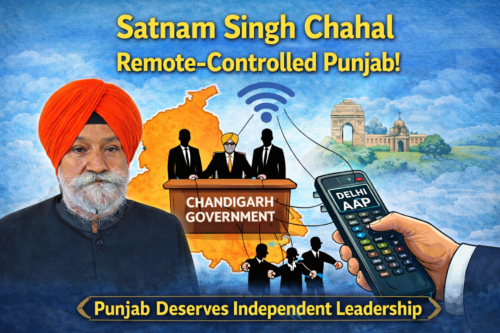
 Punjab today seems to be witnessing a unique political experiment, a government elected in Chandigarh but apparently operated from Delhi. Voters believed they were electing a state leadership that would make independent decisions for Punjab’s future. Instead, the situation increasingly resembles a franchise model where instructions appear to travel from the national capital before any major announcement is made.
The ruling party promised a revolutionary transformation of governance. What people expected was bold leadership addressing unemployment, farmer distress, rising debt, and law-and-order concerns. What they often see instead are carefully choreographed press conferences, social media campaigns, and announcements that seem designed more for headlines than for solving structural problems.
The Chief Minister of Punjab appears less like an independent administrator and more like a regional representative waiting for guidance from party headquarters. The irony is difficult to ignore: Punjab has a full-fledged cabinet, ministers, advisors, and bureaucrats, yet the political spotlight often shines brightest on leaders visiting from outside the state.
If governance were measured by press briefings, advertising, and painted government buildings, Punjab might already be competing with Singapore. But unfortunately, governance is measured by results, and that is where the gap between promises and reality is becoming increasingly visible.
Meanwhile, serious issues remain unresolved. Farmers still demand compensation, youth continue searching for employment opportunities, and concerns over law and order frequently dominate public discussions. These are not issues that can be fixed with slogans or new coats of paint.
The opposition, however, has not exactly covered itself in glory either. Instead of presenting a strong and united challenge, opposition parties often appear content with issuing statements and holding occasional press conferences. Their criticism may be loud, but their ground-level political mobilisation often feels surprisingly quiet.
As a result, Punjab’s politics sometimes resembles a theatre production. The ruling party performs the role of revolutionary reformers while critics question whether real power lies elsewhere. The opposition performs the role of outraged critics while struggling to convince voters that they themselves represent a credible alternative.
In the end, the people of Punjab are left watching this political drama unfold, wondering whether their state is being governed with a clear long-term vision or simply managed through daily political messaging.
Punjab has a proud history of strong leadership and political independence. Its people deserve governance that is accountable to them, not one that appears to function like a remote-controlled administration. Until that happens, the citizens of Punjab may continue asking a simple but uncomfortable question: Who exactly is running Punjab?