
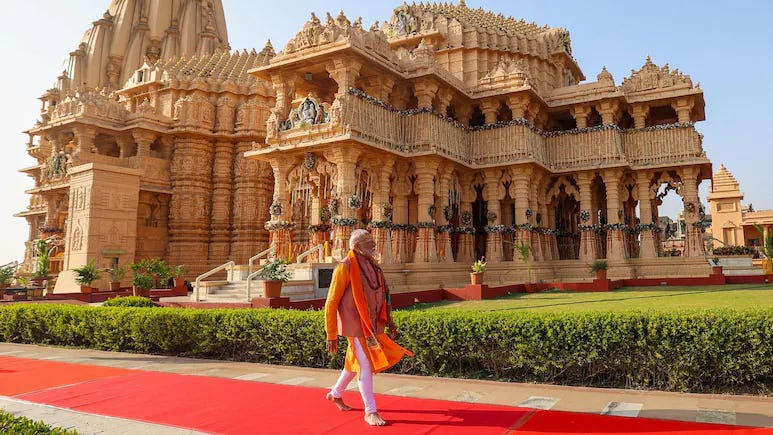
 The famous Somnath Temple at Prabhas Patan near Veraval in Gujarat’s Saurashtra region is revered as one of the twelve Jyotirlingas of Lord Shiva. Its antiquity is debated, with estimates placing its origins between the early centuries of the first millennium and the 9th century CE. Archaeological excavations led by B.K. Thapar indicate a substantial temple by the 9th–10th century, while the Mahabharata and Bhagavata Purana mention a pilgrimage site here. Somnath’s strategic coastal position made it both a prosperous religious centre and a vulnerable target for invaders.
Mahmud Ghazni’s Devastation (1026 CE)
Somnath’s most infamous assault came in January 1026 when Mahmud of Ghazni launched his fifteenth invasion of India, specifically targeting the temple. Al-Biruni, who accompanied his forces, recorded both the religious and economic motives. Contemporary accounts speak of immense wealth—offerings from thousands of villages in gold, silver, pearls and jewels.
Mahmud’s troops desecrated the Jyotirlinga, killed resisting devotees, and carried off the treasures to Ghazni for display in Friday mosques. Later literature inflated the numbers of those killed, but the raid undoubtedly became a defining episode in the region’s memory. The silence of a 1038 inscription of the Kadamba King of Goa on the destruction suggests either relatively quick restoration or damage short of complete annihilation.
Long before the 20th-century reconstruction of Somnath, Maharani Ahilyabai Holkar of Indore emerged as a major royal patron of temple restoration. In the 1770s–1780s, using her personal treasury, she rebuilt or restored key shrines across the subcontinent, including Kashi Vishwanath in Varanasi, Somnath in Gujarat, and temples in the Gangetic and Narmada belts. Her work was conceived as civilisational repair after repeated waves of political upheaval and iconoclasm.
At Somnath, she is credited with commissioning a new stone temple on or near the ancient sacred site, completed around 1782–83 CE. This became the principal structure associated with Somnath in the late 18th and 19th centuries. Later debates on “rebuilding” Somnath thus centred not on an empty spot but on a functioning Ahilyabai-era shrine that testified to her far-reaching and lasting cultural patronage.
Positioning Maharaja Ranjit Singh Within This Sequence of Patronage
By the early 19th century, when Maharaja Ranjit Singh began his celebrated donations to major shrines, Somnath and Kashi Vishwanath already stood largely due to Ahilyabai Holkar’s prior initiatives. Ranjit Singh’s role was that of a later patron who conferred exceptional honours—especially large quantities of gold—on select shrines, notably Kashi Vishwanath Mandir and Sri Harmandir Sahib (Darbar Sahib), Amritsar.
Placing his contributions in this chronology clarifies the record: the 18th-century reconstruction of Somnath is rightly attributed to Ahilyabai Holkar, while the famous 1835 gold offering of about a tonne belongs to Maharaja Ranjit Singh’s patronage of Kashi Vishwanath in Varanasi, not Somnath.
The Enigmatic Doors: From Somnath to Ghazni to Amritsar
The Ghazni Connection
For centuries, narratives claimed that Mahmud carried away Somnath’s sandalwood doors, studded with precious metals and jewels, and installed them at his tomb in Ghazni. Firishta popularised this story in the 16th century, and Alexander Dow helped entrench it in colonial writing through his History of Hindostan.
British Colonial Intervention
In 1842, Governor-General Lord Ellenborough issued his famous “Proclamation of the Gates,” ordering British troops returning from Afghanistan to “restore” the supposed Somnath gates from Mahmud’s tomb. General William Nott’s forces removed the doors in September 1842, and the 6th Jat Light Infantry carried them back to India in triumph.
Scholarly examination in India later showed that the doors were made of local Deodar wood, not sandalwood, and bore no resemblance to Gujarati craftsmanship. Their motifs did not match Indian design traditions, and they are now widely regarded as never having come from Somnath. The disputed doors remain in Agra Fort under the custody of the Archaeological Survey of India, a living testimony to a colonial misadventure undertaken in the name of “restoring” a legacy asset to its supposed rightful place.
A separate tradition loosely links Maharaja Ranjit Singh to Somnath’s legacy, though evidence remains contested. According to some Sikh narratives, he brought back gates from Afghanistan—probably fort gates rather than temple doors—during his early 19th-century campaigns, and an oral claim developed that they had belonged to the original Somnath Mandir. When he learnt that the Somnath edifice no longer existed after Ghazni’s destruction, he is said to have requested that these beautifully crafted doors be installed at Darbar Sahib, Amritsar.
What is firmly established is that these doors at the Darshani Deori (viewway as well as gateway to the Sanctum Sanctorum) of the Golden Temple were installed during Maharaja Ranjit Singh’s reign. In October 2018, when the SGPC replaced these roughly 210-year-old doors because they were beyond repair, social media claimed they were “original Somnath doors” now being returned. Akal Takht Jathedar Giani Gurbachan Singh publicly dismissed this as negative propaganda, clarifying that the historic Maharaja Ranjit Singh–era doors had been preserved in the parikrama of the Golden Temple complex for devotees to see, and appealing to rumour-mongers not to create confusion among the sangat.
Post-Independence Reconstruction: The Nehru–Rajendra Prasad Divergence
Sardar Patel’s Vision and Pandit Nehru’s Reservations
After Junagadh’s accession in 1947, Home Minister Sardar Vallabhbhai Patel visited Somnath on 12 November and announced plans for a fresh reconstruction as a symbol of national revival. The Union Cabinet endorsed the project, and Patel insisted it be funded through public donations rather than state funds.
Prime Minister Pandit Jawaharlal Nehru, however, feared that an overtly state-associated religious reconstruction might undermine India’s secular credentials. He described the project as “Hindu revivalism” and repeatedly cautioned against state sponsorship or high-profile political participation. Mahatma Gandhi, before his assassination, had also held that such rebuilding should rely on private contributions, not government money.
The Rajendra Prasad–Pandit Nehru Confrontation
Tensions came to a head when President Rajendra Prasad agreed to inaugurate the rebuilt temple on 11 May 1951, despite Pandit Nehru’s objections. Nehru wrote to him expressing his discomfort with the President associating himself with a “spectacular opening,” and criticised the Saurashtra government’s contribution of Rs 5 lakh at a time of cuts in education and health spending.
President Rajendra Prasad stood firm, arguing that he would attend similar ceremonies at a mosque or church if invited, and that this reflected the essence of Indian secularism: the state is neither irreligious nor anti-religious. He went to Somnath and delivered a speech that All India Radio controversially declined to broadcast, turning the event into an early touchstone in India’s debate on religion, secularism and the republic.
Contemporary Controversies and Political Dimensions
The Congress “Double Standards” Debate
In recent years, Somnath has resurfaced in political rhetoric, often to attack the Congress Party. The BJP contrasts Congress leaders’ presence at Somnath’s 1951 inauguration with their 2024 boycott of the Ram Mandir consecration ay Ayodhya, citing Pandit Nehru’s earlier reservations and casting the party as “anti-Hindu”.
Yet the contexts differ significantly. The Somnath reconstruction was framed as national reconstruction after Partition, with Sardar Patel presenting it as a unifying project and leaders like Rajendra Prasad maintaining a broadly secular idiom. The Ram Mandir, by contrast, emerged from a long legal dispute and a mass movement centred explicitly on Hindu identity politics, which the Congress has tended to regard as a partisan project of the RSS–BJP. For its supporters, however, the Ayodhya temple also represents the fulfilment of a millennia-old civilisational aspiration: to construct a Ram Mandir at the very spot where Lord Rama is widely believed to have been born, rather than at any alternative location, even if this meant replacing a Babur-era medieval mosque or “disputed structure”, depending on one’s standpoint.
Summing Up: Legacy and Interpretation
Somnath’s history spans ancient sanctity, medieval destruction, Maratha reconstruction under Maharani Ahilyabai Holkar, Sikh-era patronage, and post-independence ideological contestation. Mahmud Ghazni’s raid underscores the vulnerability of sacred sites in the medieval age of conquest, while the successive waves of rebuilding reflect not only resilience but also a deeper civilisational self-confidence that has repeatedly restored the temple’s place in India’s cultural imagination.
The disagreement between Pandit Nehru and President Rajendra Prasad over the 1951 inauguration encapsulates a continuing question: can constitutional secularism accommodate visible state participation in religious ceremonies without eroding neutrality?
The enduring legends around Somnath’s doors—whether linked to Ghazni, British spectacle, or Maharaja Ranjit Singh—illustrate how history, faith, and politics continually intermingle. The contrast between Somnath and the Ram Mandir is not merely a question of partisan double standards, but of fundamentally different historical contexts and political projects. Recognising this nuance is essential to understanding how Somnath functions today not just as a temple, but as a symbol in India’s ongoing debate over religion, memory, and the modern state—and as an emblem of an increasingly self-assured and resurgent independent India.