
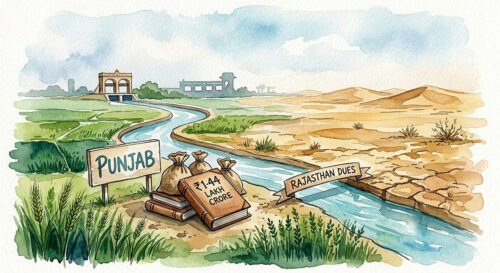
 Punjab has finally asked the right question on river waters. By publicly putting a figure of ₹1.44 lakh crore on Rajasthan’s “water dues”, the Chief Minister has converted a century-old grievance into a concrete claim — and opened a much bigger debate on how India treats Punjab’s rivers, from Ferozepur to the Chenab. This moment will matter only if it now moves from microphone to memorandum, from slogan to suit.
The forgotten canal that started it all
The story begins not with Harike or Bhakra, but with a Maharaja. In the 1920s, Maharaja Ganga Singh of Bikaner negotiated with British India for a share of Sutlej waters to transform part of his desert into canal command. The result was the Gang (Ganga/Bikaner) Canal, taking off from the Ferozepur-Hussainiwala headworks. Its pre-Partition draw was modest by today’s standards — about 2,700 cusecs, utilising roughly 1.11 MAF of water for Bikaner’s Ganganagar tract. Yet that arrangement — between a princely state and the colonial government, fed by infrastructure built at British India’s expense — became the moral foundation for Rajasthan’s later claim that Punjab’s rivers must continue to feed its desert.
After Independence and Partition, Hussainiwala lay on the firing line. In the mid-1950s, India built a new barrage at Harike, deep inside Indian territory at the confluence of the Beas and Sutlej, to safely feed the same canal system. Supplies to Bikaner’s Gang Canal and the Eastern Canal were shifted from Hussainiwala to Harike via the Ferozepur Feeder. Over time, a much larger canal — the Rajasthan/Indira Gandhi Feeder — was constructed with a head capacity of about 18,500 cusecs to carry Sutlej-Beas waters from Harike through Punjab and Haryana into Rajasthan. What began as a 2,700-cusec princely bargain is today a 15,000-18,000-cusec lifeline for the Thar, built and maintained in the post-colonial era as a “national project”.
The 1955 deal: Rajasthan gets the lion’s share
The first formal division of Ravi-Beas “surplus” waters came in 1955 at a conference of Chief Ministers convened by the Union government. The surplus — over and above pre-Partition use — was then assessed at 15.85 MAF. Of this, undivided Punjab (including PEPSU) got 7.20 MAF, Rajasthan 8.00 MAF, and Jammu & Kashmir 0.65 MAF. In other words, from the very first post-Independence settlement, a non-riparian desert state was given a larger Ravi-Beas share than the riparian state through whose territory the rivers flowed.

This pattern hardened over time. After the reorganisation of Punjab, the 1976 notification split Punjab’s 7.20 MAF between Punjab and Haryana. The 1981 Indira Gandhi Agreement, using a revised higher availability of 17.17 MAF, allocated 4.22 MAF to Punjab, 3.5 MAF to Haryana, 8.6 MAF to Rajasthan, 0.2 MAF to Delhi, and reconfirmed 0.65 MAF to J&K. The numbers changed at the margins; the underlying hierarchy did not. The riparian state remained squeezed. The non-riparian desert consolidated its “entitlement”.
The selective radicalism of 2004
In 2004, Punjab appeared to revolt. The Punjab Termination of Agreements Act was presented by the then Chief Minister, Captain Amarinder Singh, as a final assertion of Punjab’s rights. It purported to terminate the 1981 Indira Gandhi Agreement and “all other agreements relating to the Ravi-Beas waters”. On a plain reading, this swept in arrangements ranging from the 1976 notification to bilateral understandings such as the 1978 pact between Parkash Singh Badal and Sheikh Abdullah concerning J&K’s use of waters.
But the political thunder concealed a crucial legal compromise. The Act, while terminating agreements, protected “existing utilisation” through existing systems. In practice, the gun was pointed squarely at the Sutlej-Yamuna Link canal and Haryana. The largest beneficiary of continuity was Rajasthan, which continued to enjoy the benefit of its 8.6 MAF allocation and the massive Rajasthan/Indira Gandhi Feeder and main canal system. The legislation looked radical in the Assembly; it was conservative where it mattered most — on the flows to the desert.
2016: The Supreme Court resets the board
Twelve years later, the Supreme Court brought Punjab back to constitutional ground. In November 2016, responding to a Presidential Reference under Article 143, the Court held that a state cannot, by passing a law, unilaterally terminate inter-state water agreements and decrees. The 2004 Act was declared unconstitutional. The Court’s message was blunt: if a state is unhappy with allocations or arrangements, the route lies through tribunals and the Court’s original jurisdiction — not through unilateral legislative self-help.
The practical effect was that the pre-2004 legal architecture revived. The 1955 allocation, the 1976 notification, the 1981 Agreement, the 1985 Settlement, and the pending Ravi-Beas Tribunal once again became the operative framework. Symbolically, Punjab’s “Brahmastra” had created the impression of a radical break. Legally, it produced only a temporary illusion. Rajasthan’s position, cushioned by the protection of existing use and the politics of “national interest”, remained untouched.
Rajasthan’s gain, Punjab’s loss
Meanwhile, Punjab’s hydrological reality changed dramatically. The same decades that saw the expansion of the Rajasthan canal system also saw the entrenchment of the wheat-paddy monoculture in Punjab, backed by procurement policy and free power. Groundwater tables in central Punjab fell decade after decade. Canal systems like the Upper Bari Doab Canal, Sirhind Canal, and even segments of the Bhakra Main Line began operating below design capacity because of siltation and deterioration. The Gang Canal, once a 2,700-cusec pre-Partition draw for Bikaner, was, after relining, carrying about 3,000 cusecs — but now as a tail-end of the Indira Gandhi canal network rather than a small independent off-take.
Taken together, this means that a set of decisions made when Punjab’s aquifers were healthy and its own canal potential under-utilised now operates in a completely different ecological context. Yet the legal assumptions have not caught up. Rajasthan’s 8-8.6 MAF sits like a fixed constant, while the supposed “surplus” from which it was drawn has shrunk from 17.17 MAF to around 14.3 MAF on more recent flow series. The illusion of surplus continues to haunt the riparian state.
From press conference to plaint
Against this backdrop, the Chief Minister’s move to publicly quantify Rajasthan’s “dues” at ₹1.44 lakh crore is more than a political jab. It implicitly recognises that historic and continuing transfers of water from Punjab to a non-riparian state have a calculable economic and ecological cost. But numbers announced at a press conference cannot be recovered by press conferences. They must be taken to court.
The Constitution provides the route. Under Article 131, the Supreme Court has exclusive original jurisdiction over disputes between states and the Union. Punjab should now prepare and file an inter-state civil suit against Rajasthan, impleading the Union of India as a party. The suit need not — and realistically cannot — ask the Court to overnight rewrite the 1981 Agreement or short-circuit the Ravi-Beas Tribunal. It can, however, seek declaratory and monetary relief on clear issues: that Rajasthan’s long-term non-riparian use, far in excess of the original Gang Canal arrangement, has caused quantifiable loss to Punjab; that such use must be compensated at a fair rate; and that, if Rajasthan fails to pay, the Union can be directed to adjust the decreed amount against Rajasthan’s share of central taxes or grants.
Rajasthan will contest this bitterly. It will argue limitation, delay, and acquiescence. It will rely on the 1955 and 1981 settlements, claim that India sought full control of the eastern rivers under the Indus Waters Treaty precisely to irrigate its desert flank, and insist that projects like Harike, Pong, and Bhakra were “national” endeavours in which Punjab willingly participated. It may even argue that the Maharaja Ganga Singh arrangement cannot simply be extrapolated into a twenty-first-century financial formula. All true — and all matters for adjudication. The key is this: without a plaint, there can be no decree; without a decree, there can be no recovery.
The Haryana risk — and why it should not paralyse Punjab
What about Haryana? Any attempt to monetise non-riparian use will inevitably embolden Haryana to make its own claims, whether for a larger share of Ravi-Beas water or for a slice of any financial settlement. That is a risk. For half a century, Punjab’s political class has treated Haryana’s possible reactions as the sole metric for any move on water. The result is visible: Punjab is paralysed, Haryana is hyper-vigilant, and Rajasthan quietly enjoys its 8.6 MAF.
The answer is not to ignore Haryana, but to stop allowing the Haryana question to block any action vis-à-vis Rajasthan. A carefully drafted suit that defines the cause of action in terms of Punjab-Rajasthan equities — with the Union as fiscal guarantor — can at least force a long-overdue accounting. Haryana will litigate its own case; Punjab must litigate its own.
Tribunal, not just theatre
The Supreme Court’s 2016 opinion also underlines another point: real change in water allocations will come only through tribunals and original jurisdiction, not through dramatic resolutions in the Vidhan Sabha. The Ravi-Beas Tribunal gave only an interim report in 1987. Clarificatory references and modification requests have remained pending for decades, even as the hydrology has shifted.
Punjab needs a serious, technical brief before the Tribunal — with updated flow data, groundwater trends, cropping patterns, and climate stress. That brief must argue that the premise of “surplus” which underpinned the 1955 and 1981 arrangements no longer holds, and that allocations to non-riparian states must be revisited. The Tribunal is slow. But it is the forum that can actually alter shares.
Double standards from Yamuna to Indus
All of this sits within a larger pattern of central double standards. On the Yamuna, the Union happily brokered accords between Uttar Pradesh, Haryana, Delhi, Himachal Pradesh, and later Uttarakhand. Punjab was not even an observer, despite being a major foodgrain state whose cropping choices depend on how water and power policies evolve across basins. On Ravi-Beas, however, the same Union treats every earlier arrangement — especially those favouring non-riparian users — as sacrosanct and lectures Punjab on constitutional propriety if it protests.
On the western side, the Indus Waters Treaty has already been put in abeyance by the Modi government, with India formally suspending performance and seeking to modify the terms in light of Pakistan’s continued support for terrorism. An international treaty, under World Bank auspices, has thus been reopened. In that context, it is simply untenable to argue that domestic allocations which give Rajasthan more Ravi-Beas water than Punjab must remain frozen forever.
Ravi-Chenab-Ujh-Shahpur Kandi: the northern flank
The suspension and proposed modification of the Indus Waters Treaty also creates an opening for a more integrated eastern-western river strategy. India has cleared and advanced several projects on the Chenab and its tributaries in Jammu & Kashmir precisely to maximise its lawful share and reduce unutilised flows to Pakistan. For Punjab, this is not just a security issue; it is also a water-security opportunity.
Two projects are crucial. First, the Shahpur Kandi dam on the Ravi, downstream of the Ranjit Sagar/Thein dam, which will finally allow full utilisation of water releases that now partly escape below Madhopur. Second, the Ujh Multipurpose Project on a Ravi tributary in Kathua, designed to store water now flowing unutilised to Pakistan and use it for irrigation and power in J&K. Along with prospective Ravi-Beas links below Ujh, these works can strengthen both Punjab’s and J&K’s water position and help India fully utilise its eastern-river quota.
Punjab must therefore link its Rajasthan “dues” discourse with a positive agenda: complete Shahpur Kandi, fast-track Ujh, and insist that any redesign of the post-Treaty Indus architecture formally involves Punjab as a riparian stakeholder. The same state that has long been treated as a canal corridor for others must now be recognised as a principal in its own right.
Towards a Punjab water doctrine
The controversy triggered by the Chief Minister’s press conference will fade, as most controversies do. The opportunity it creates should not. Punjab now has a chance to articulate a coherent water doctrine built on three pillars.
First, riparian principle and equity: no non-riparian state should draw more from Punjab’s rivers than Punjab itself, and where historic arrangements require such transfers, they must be explicitly time-bound, revisable, and compensated.
Second, constitutional method: Punjab must commit to fighting its case where it matters — before the Ravi-Beas Tribunal and the Supreme Court in original jurisdiction — rather than relying mainly on fiery laws that will not survive judicial scrutiny.
Third, strategic integration: Punjab must demand a seat at the table whenever the Union redraws the hydrological map, whether for the Yamuna basin or the Indus system. From the Rajasthan Feeder to Shahpur Kandi and Ujh, from Bhakra Main Line to Upper Bari Doab Canal, Punjab should treat its canal network as an integrated strategic asset, not merely as a legacy irrigation system.
Invoices without plaints do not yield decrees, and decrees without enforcement do not yield money. If Punjab is serious about its ₹1.44 lakh crore claim, it must now take the next step: from rhetoric to remedy.