
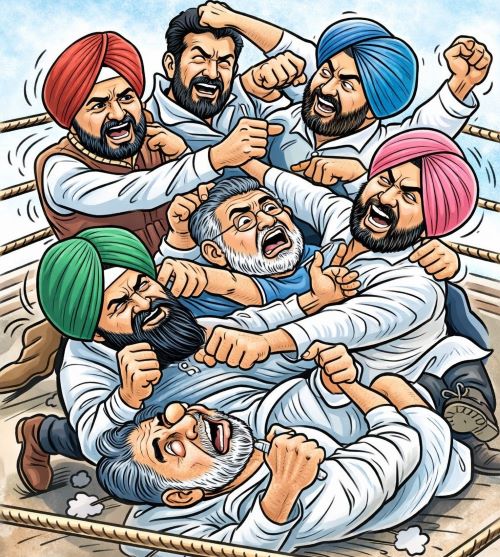
 Even before the political impact of the Tarn Taran by-election had fully faded, Punjab politics was pushed into fresh turbulence by a rapid sequence of statements, counter-statements and internal manoeuvres. What has followed is not a routine bout of factionalism, but a deeper exposure of unresolved issues within the Congress and the shrinking political space for a BJP–Shiromani Akali Dal (SAD) understanding.
The chain reaction began with a statement by Bhupesh Baghel, the Congress general secretary in charge of Punjab. Baghel said the party would not repeat the “mistake” of 2022 and would fight the 2027 Assembly elections without projecting a chief ministerial face. While framed as a lesson learnt, the remark was widely interpreted in Punjab as a quiet disowning of the decision to project Charanjit Singh Channi, the state’s first Dalit chief minister. Instead of calming the organisation, the statement reopened old wounds about leadership trust and Delhi’s understanding of Punjab’s social realities.
Almost simultaneously, BJP leader Ravneet Singh Bittu added another layer to the unfolding drama. Bittu warned that any alliance with the Shiromani Akali Dal would mean the return of drugs (“chitta”) and gangsterism to Punjab. The impact of this statement was significant. It weakened already tentative speculation about a BJP–SAD tie-up and reinforced public memory of the Akali Dal’s controversial record in power. Politically, it narrowed the options for both parties and signalled that alliance politics in Punjab carries heavy baggage.
Inside the Congress, matters escalated quickly. A group of leaders, largely from the Jat Sikh community, launched a signature campaign and approached the high command, seeking organisational changes and backing Charanjit Singh Channi more firmly. Rather than settling the debate, this move highlighted a contradiction: a party claiming to avoid projecting faces, while sections of its leadership openly mobilised around one.
The controversy deepened further with the circulation of a video of Channi speaking at a party meeting. In the clip, Channi argues for proportionate representation of Scheduled Castes within the Congress organisation, pointing out that despite Dalits forming a large share of Punjab’s population, key posts remain concentrated in a few hands.
Though initially portrayed by some as divisive, the video shows Channi making a case for structural inclusion rather than caste polarisation.
These tensions soon spilled into organisational arenas, including the Youth Congress, where rival camps aligned with PPCC chief Amrinder Singh Raja Warring and Channi have turned internal elections into proxy battles for future control. What should have been a routine exercise has instead become a symbol of deeper unease over leadership pipelines and social balance.
Recognising the seriousness of the situation, the Congress high command has now convened a meeting of the Congress Working Committee on January 23, summoning senior Punjab leaders to Delhi. The meeting is expected to review the recent controversies, the party’s electoral setbacks, and the growing perception that Punjab Congress is drifting without a clear internal compact. Whether this intervention leads to genuine course correction or merely temporary firefighting will be crucial.
Meanwhile, the Akali Dal’s decline appears structural, marked by organisational erosion and loss of credibility. With alliance options shrinking and public trust still fragile, its room for revival looks limited.
Taken together, these developments point to a larger political vacuum in Punjab. The Congress is struggling in its leadership issues, while the Akali Dal remains trapped by its past.
How the Congress resolves or fails to resolve these contradictions, the infighting, the problem of plenty, after January 23 may well determine whether it regains coherence or continues to weaken from within, well before the 2027 contest.