
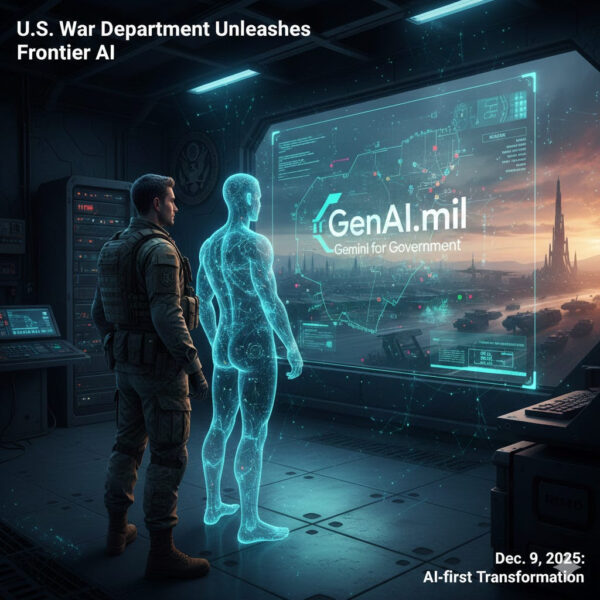
 In a landmark move underscoring its drive for technological superiority, the War Department has officially launched GenAI.mil, a bespoke generative AI platform that brings frontier artificial intelligence directly to the entire military enterprise. Its debut capability is Google Cloud’s Gemini for Government, setting the stage for an “AI-first” transformation of the Department’s three-million-strong civilian, contractor, and uniformed workforce.
The launch is a direct response to President Donald Trump’s July mandate to secure unmatched AI superiority over strategic competitors. From Pentagon offices to forward-deployed installations, every echelon of the force is now being equipped with industrial-grade AI that promises faster planning cycles and sharper analysis, with digital agents and human warfighters operating side by side.
Agentic AI for a New Era of Operational Dominance
At the heart of GenAI.mil is the ambition to move beyond small pilots towards AI-native ways of working. The deployment of Gemini for Government as the inaugural system is framed as a decisive step in this direction, empowering intelligent agentic workflows and accelerating experimentation at scale.
Under Secretary of War for Research and Engineering Emil Michael underlined the competitive stakes. “There is no prize for second place in the global race for AI dominance,” he said. “AI is America’s next Manifest Destiny, and we are ensuring that we dominate this new frontier.” The AI Rapid Capabilities Cell in the Office of Research and Engineering has been tasked to turn GenAI.mil into the engine of a cultural shift that revives the warrior ethos and re-establishes deterrence through technological edge.
In practical terms, that means embedding AI into the “daily battle rhythm” of the force. Routine processes that once consumed days or weeks—from staffing a policy paper to preparing a deployment brief—are now intended to be drafted, refined, and quality-checked in minutes using natural-language interfaces that any soldier or civil servant can operate.
Gemini for Government: From Back-Office Tasks to Battle Rhythm
Gemini for Government is being rolled out across the War Department to support unclassified business processes at scale. Its immediate use-cases span three broad domains.
First, policy and compliance: Gemini can ingest complex manuals and directives, then generate tailored checklists and summaries for specific projects or missions. A programme manager wrestling with overlapping acquisition rules, export-control requirements, and cybersecurity standards can receive a structured roadmap instead of wading through hundreds of pages of guidance.

Second, administrative automation: routine but labour-intensive tasks such as personnel onboarding, contracting workflows, and extracting key terms from statements of work can be orchestrated by AI agents. By collapsing friction in the bureaucracy, the Department hopes to free human time for planning, leadership, and innovation rather than form-filling.
Third, operational planning and analysis: Gemini for Government can assist with risk assessments, red-team style scenario exploration, and enterprise search across vast troves of documents. While humans remain firmly “on the loop” for decisions, the system is designed to surface options and risks that might otherwise be missed in the fog of paperwork.
Critically, these capabilities are underpinned by Retrieval-Augmented Generation (RAG) and web-grounding with Google Search. RAG connects the model to controlled internal repositories so that answers are anchored in official doctrine, policy, and historical records. Web-grounding allows the system to pull in current, publicly available information to cross-check or enrich its outputs. Together, these mechanisms are meant to reduce hallucinations and increase factual reliability—an essential requirement when AI is used in high-stakes planning environments.
Security, Sovereignty, and Training the Force
Security and compliance considerations have shaped GenAI.mil from the ground up. Tools deployed on the platform, including Gemini for Government, are certified to handle Controlled Unclassified Information and hold Impact Level 5 (IL5) authorisation. Data is processed in secure cloud environments with strict sovereignty guarantees: War Department information remains ring-fenced and is not used to train public or commercial models.
Yet technology alone does not deliver transformation; people do. A department-wide training push is therefore being rolled out at no cost to employees, with content tailored to different communities. For the general workforce, training focuses on the foundations—what generative AI is, how to spot valuable use-cases, and how to craft effective prompts—so that AI becomes a trusted colleague rather than an opaque black box.
For commanders, programme managers, and senior officials, the curriculum shifts to strategy, governance, and ethics. They are being asked to identify high-impact AI projects, weigh risks such as bias or over-reliance on automation, and design guardrails that ensure responsible use in line with US and international law. Specialist tracks for developers, data scientists, and cybersecurity professionals delve into model management, data preparation, and defence against AI-enabled threats, building a cadre that can tune and secure GenAI.mil over time.
Secretary of War Pete Hegseth captured the Department’s mindset succinctly: “We are pushing all of our chips in on artificial intelligence as a fighting force. The Department is tapping into America’s commercial genius, and we’re embedding generative AI into our daily battle rhythm.”
A Strategic Wake-up Call for India’s Defence Establishment
For India, a major defence partner of the United States and a frontline state in an increasingly contested Indo-Pacific, the launch of GenAI.mil lands as both a warning and a blueprint.
New Delhi has already identified AI as a core element of next-generation warfare, but GenAI.mil raises the bar from tactical experimentation to strategic integration. If the United States is equipping every staff officer and warfighter with frontier AI, India cannot afford to confine its own efforts to niche domains or scattered pilot projects.
Three imperatives stand out. First, India must accelerate the development of sovereign large language models tuned to its doctrinal, linguistic, and operational realities, hosted in secure cloud environments with protections comparable to IL5. Second, it should leverage initiatives like the INDUS-X defence innovation bridge to pursue interoperable AI standards and jointly developed solutions in areas such as logistics optimisation, predictive maintenance, and multi-sensor fusion. Third, the Services need to weave AI explicitly into doctrine, command-and-control concepts, and training pipelines, recognising that decision cycles in future crises will compress dramatically.
As China pushes ahead with its vision of “intelligentised warfare”, AI is fast becoming the decisive asymmetric advantage that will determine whose forces see more, decide faster, and act with greater precision. In that emerging contest, GenAI.mil is not just a new software platform for the United States. It is a declaration that frontier AI, deployed securely and at scale, will be central to deterrence and war-fighting in the twenty-first century—and that those who lag will find it ever harder to catch up.