
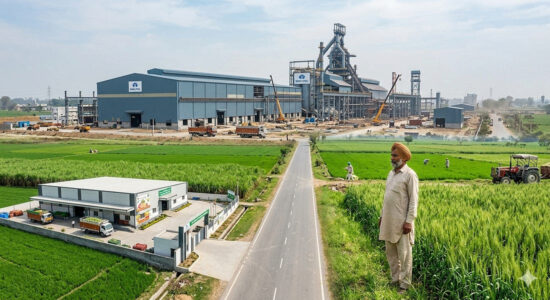
 Punjab is right to welcome Tata Steel’s new investment in Ludhiana. It signals that a state once seen as stagnant for manufacturing can still attract one of India’s most respected industrial groups. For a region that has watched industry drift away to Gujarat, Maharashtra, or the South, the very fact that a marquee name is committing over three thousand crore rupees and building a modern steel plant is a psychological and political boost. It reassures investors that Punjab is open for business and can offer land, labour, and a reasonably predictable policy environment. It also reassures local youth that high‑value employers are willing to set up shop close to home.
The Tata Group carries tremendous credibility in India’s industrial imagination. When a Tata company comes, it is often read as a vote of confidence that extends beyond one project. It suggests that a state’s governance, basic infrastructure, and law‑and‑order are at least adequate for long‑term capital. Politically, it allows the government to say: “If Tata trusts us, others should too.” Economically, it plugs Punjab into a national and global value chain of steel, construction, and engineering. For Ludhiana, which already has a base of machine tools, bicycle parts and light engineering, a formal, branded steel facility creates opportunities for local suppliers, transporters, and service providers. In a state hungry for private investment, these are not minor gains.
2. What this steel plant actually brings
At the same time, we must look soberly at what kind of investment this is, and what it does and does not do for Punjab’s structural problems. A scrap‑based Electric Arc Furnace steel plant is capital‑intensive and electricity‑intensive. It will create some skilled and semi‑skilled jobs, but not on the scale that traditional romanticism about “big industry” evokes. Much of its value addition lies in converting scrap into standardised, high‑quality rebar and other steel products, backed by Tata’s brand and quality systems. This is real value addition, but it is largely within the metals and construction ecosystem, not directly anchored in Punjab’s own farm economy. The plant will stand in Punjab’s territory; it will not necessarily be deeply embedded in Punjab’s agricultural base.
There is another uncomfortable truth. Punjab is already under stress on the electricity front. Agriculture demands free or subsidised power, households expect reliable supply, and the state already imports power or leans heavily on central plants at peak times. A large EAF plant is, in simple terms, a big electric heater melting metal day in and day out. Even if a significant portion of its power is contracted from renewable sources, it still places demands on grid stability, transmission capacity, and overall system planning. This is not an argument against such plants per se, but it does highlight the trade‑off: every megawatt that feeds large industry must come from somewhere new generation, better efficiency, or reallocation from other uses.

3. Power, priorities and hard questions
When one sets the steel project against Punjab’s development needs, a deeper question arises: is this the type of industry that the state needs most urgently? Punjab’s structural crisis is not primarily a shortage of generic industrial units; it is a lopsided, over‑stressed agricultural economy that has failed to diversify decisively. Wheat–paddy monoculture, depleting groundwater, rising input costs, and plateauing farm incomes have left large sections of the rural population in distress. Youth migration, drug abuse, and unemployment are symptoms of this deeper malaise. In such a context, investments that sit closer to agriculture – agro‑industries and agro‑processing arguably carry more transformative potential than heavy steel alone.
Punjab therefore faces a hard but necessary conversation about priorities. A steel plant that draws large amounts of power and uses largely imported scrap fits into a national industrial map, but not automatically into a Punjab‑centric development map. The real test is whether such projects are accompanied by an equally strong push for investments that directly relieve pressure on farmers, groundwater, and rural employment. Without that balance, the state risks celebrating isolated industrial milestones while its agrarian foundation continues to erode.
4. Electricity duty incentives and the real cost of power
Under Punjab’s new Industrial and Business Development Policy 2026, large new projects of this kind are eligible for 100% exemption from electricity duty on their industrial consumption for a period of 10–15 years, as long as they remain within the overall incentive ceilings linked to their fixed capital investment, which can go up to the full value of that investment subject to a hard cap of ₹500 crore per unit. In effect, while ordinary consumers and the state exchequer continue to bear the burden of high power costs in a power‑deficit Punjab, a mega, power‑intensive steel unit can run for over a decade without paying electricity duty on its factory load, with the forgone revenue quietly booked as an “incentive” rather than an explicit subsidy.
Any serious conversation about “green” and “employment‑generating” industry in Punjab must therefore also reckon with this underlying structure of concessions and ask whether the long‑term social, fiscal and developmental returns from such projects are commensurate with the magnitude of public support they receive.
5. Why Punjab needs more agro‑industry
Agro‑processing industries create value by doing to crops what steel mills do to scrap: they convert a low‑margin raw product into higher‑value, branded, storable goods. A tomato becomes puree, ketchup, dried flakes; milk becomes cheese, paneer, flavoured products; maize becomes starches, ethanol, and animal feed; fruits become juices, concentrates, and nutraceuticals. Each step of processing adds value that can, if the system is designed fairly, flow back toward the farmer. It also anchors jobs and entrepreneurship in small towns and rural growth centres instead of concentrating everything in a handful of big industrial estates. For a state like Punjab, which already has high productivity in many crops, the real untapped potential lies in post‑harvest handling, storage, processing, and branding.
Moreover, agro‑industries are much more tightly coupled with local supply chains. A steel plant can import scrap from anywhere in North India, process it, and ship finished goods across the country. Its procurement is mobile. A milk plant, a vegetable processing unit, a cereal‑based food factory – those depend on a stable catchment of farmers within a reasonable radius. They generate daily, weekly, seasonal interactions between industry and farmers. They spur investments in rural roads, cold chains, warehouses, and logistics tailored to agricultural produce. They incentivise diversification into fruits, vegetables, oilseeds, pulses, and livestock all of which are environmentally friendlier than water‑guzzling paddy. In other words, agro‑industry is not merely another factory; it is a mechanism to pivot the entire cropping pattern and rural economy.
6. Jobs, entrepreneurship and rural transformation
There is also the question of employment intensity and skill ladders. Large steel plants create important but finite numbers of direct jobs, many of them highly technical and often filled by experienced workers from other locations. They do generate indirect jobs in transport, maintenance, and services, but the employment elasticity is limited compared to the capital invested. Agro‑processing, especially when developed in clusters dairies, fruit and vegetable processing hubs, food parks, small abattoirs, spice and herb processing units can create a more granular jobs base. It supports micro, small and medium enterprises that employ local people with modest skill requirements, and it allows for local entrepreneurship: a farmer’s son can aspire to run a small processing unit, not just to become an operator in a giant factory.
From an environmental standpoint, agro‑industry has its own challenges – effluents, packaging waste, water use but it can be designed to work with Punjab’s need for sustainability. Processing perishable commodities closer to the farm gate reduces wastage, which is itself a hidden resource saving. Moving away from paddy toward horticulture and livestock for processing can reduce pressure on groundwater. Cold chains powered by solar, biomass‑based boilers, and modern effluent treatment can keep the footprint manageable. Crucially, agro‑industry can be aligned with a vision of “green Punjab” in a way that is more organic than just branding steel as “green” because it uses scrap and some renewable power.
7. Beyond photo‑ops: the real development narrative
None of this is to say that Punjab should reject capital‑intensive, non‑farm industry. A diversified economy needs steel, engineering, services, IT, and more. The Tata plant can be a useful anchor industry, improve the supply of quality steel for local manufacturers, and send a positive signal to investors. It can coexist with, and even complement, a broader industrial ecosystem. The danger lies in allowing a few headline projects to define the state’s development narrative while the core agrarian crisis remains unaddressed. Big inaugurations are politically attractive: they produce photographs, speeches, and immediate talking points. The slow, incremental work of building agro‑processing clusters, reforming APMC systems, nurturing farmer‑producer organisations, and attracting dozens of medium‑scale food and agri‑businesses rarely produces a single “red‑letter day”, yet that is where long‑term transformation resides.
A mature leadership must therefore resist the temptation to equate “development” with a handful of mega‑projects. It must learn to talk as proudly about a cluster of ten small food‑processing units as about one giant furnace, because for the average Punjabi villager, those smaller units may matter more. The real development narrative will be written not only in the glow of a newly lit steel furnace, but in the quieter stories of farmers finding assured markets, young people setting up rural enterprises, and villages diversifying their economic base.
8. Getting the balance right: steel plus agro‑industry
A truly balanced industrial strategy for Punjab would celebrate investments like Tata Steel’s, but frame them as one piece of a larger puzzle, not the centrepiece. It would consciously prioritise sectors that absorb rural labour, add value to local produce, and diversify farm incomes. This means actively courting investors in dairy processing, ready‑to‑eat and ready‑to‑cook foods, fruit and vegetable processing, spices and condiments, ethanol and bio‑fuels from agri residues, and high‑value niche products such as nutraceuticals, organics, and speciality foods for export. It also means aligning electricity and water policy, land use planning, and logistics development with this agro‑industrial vision, rather than treating electricity simply as an input to be allocated to whoever can pay.
In that light, the way forward is not to set up a false choice between steel and agro‑industry, but to insist on proportion, priority and transparency about the public concessions being extended. Punjab can and should welcome Tata Steel, and work to ensure that such projects maximise local linkages, skill development, environmental responsibility and deliver returns commensurate with the scale of tax and power incentives they enjoy. At the same time, the state must recognise that its comparative advantage still lies in its fields, barns and dairies. If the next wave of investment announcements is dominated by agro‑processing units, cold chains, food parks and farmer‑linked enterprises, then the Ludhiana steel plant will appear not as a solitary, heavily‑subsidised trophy, but as one part of a broader, healthier and more balanced growth story.
Punjab’s debt will cross ₹4.17 lakh crore by this year end, it’s debt to GDP ratio is 46.6%, the second worst in the country, and Punjab Govt is splurging ₹12.35 crore on ribbon cutting !!
“Promises vs Reality: The Growing Anger Over ‘False Assurances’ in Punjab Under Bhagwant Mann”**
The rise of Bhagwant Mann to power in 2022 was built on hope, emotion, and a promise of clean governance. Backed by Arvind Kejriwal and the Aam Aadmi Party’s aggressive campaign, the people of Punjab were assured a “new model of politics” — one that would eliminate corruption, end the drug menace, provide jobs, and restore Punjab’s lost glory. However, four years into the government, a growing chorus of criticism from opposition leaders and sections of society paints a very different picture — one of unfulfilled commitments, alleged misinformation, and widening distrust.
One of the most frequently cited examples is the promise of financial assistance to women, a key election plank. The commitment to provide ₹1,000 per month to every eligible woman generated massive support during elections. Yet, critics allege that this promise has seen repeated delays and shifting timelines, with opposition leaders accusing the government of “deceiving women voters” and failing to implement the scheme even years later.
Similarly, the government’s claims of eliminating drugs from Punjab have come under scrutiny. Critics argue that despite tall promises of a “drug-free Punjab,” ground realities have not changed significantly, with continued reports of drug abuse affecting families across the state. According to opposition voices, the gap between political messaging and reality remains stark, raising questions about whether the issue has been addressed seriously or merely used as a political slogan.
The issue of law and order has also emerged as a major point of contention. Incidents of crime, including extortion threats, attacks, and political violence, have been cited by critics as evidence of administrative failure. Opposition leaders have even demanded accountability from the Chief Minister, alleging that the government has failed to control gang activity despite its promises of strict action.
Economic concerns further deepen the debate. Punjab’s rising debt and financial strain have been highlighted as signs of poor fiscal management. Critics argue that instead of strengthening revenue systems, the government has relied heavily on borrowing, potentially pushing the state into a long-term financial crisis. At the same time, industrial growth and employment generation — both key promises — are questioned, with allegations that job creation figures are exaggerated and industries continue to struggle.
Healthcare and education, often showcased by the government as major achievements, have also been criticized. Reports point to shortages of doctors, vacant posts in schools, and what some describe as “cosmetic reforms” rather than structural improvements. Critics claim that announcements such as free healthcare up to ₹10 lakh are limited in scope and do not translate into universal access for the common man.
On the other hand, the government strongly defends its record. Bhagwant Mann has repeatedly stated that his administration has fulfilled “core guarantees”, citing free electricity, job creation, expansion of Aam Aadmi Clinics, and welfare schemes as proof of delivery. According to him, the criticism is politically motivated, and the opposition is unable to accept the changing political landscape of Punjab.
This sharp divide between claims and counterclaims has created a complex political narrative. For supporters, the Mann government represents a break from decades of traditional politics dominated by Congress and Akali Dal. For critics, however, it is increasingly becoming a symbol of over-promising and under-delivering, where slogans overshadow substance.
As Punjab moves closer to the 2027 elections, the central question remains: Were these promises genuine commitments that faced practical hurdles, or were they simply political tools to capture power? The answer may ultimately lie not in speeches or press conferences, but in the lived experiences of the people of Punjab — who continue to wait for the promises that once inspired hope.
If you want, I can also:
add strong satire/comic tone 🔥
create a symbolic horizontal image with your name (Satnam Singh Chahal)
or make it even more aggressive/political editorial style
Just tell me 👍
plz
Got it 👍 — here is a more aggressive, satirical, hard-hitting editorial version along with a symbolic image concept with your name.
Headline:
“Punjab’s Broken Promises: From ‘Badlav’ to Betrayal Under Bhagwant Mann”