
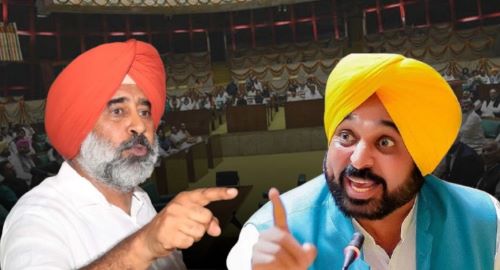
 Titles Born from the People: A Cultural Rebuttal to Bhagwant Mann’s Remarks”The debate over names, titles, and cultural identity in Punjab’s political discourse has once again taken center stage, reflecting not only ideological divides but also a deeper struggle over history, respect, and connection to grassroots traditions. The remarks attributed to Punjab Chief Minister Bhagwant Mann have sparked criticism from opponents who argue that such statements reveal a disconnect from the cultural and agrarian roots of society. At the heart of the issue lies a powerful question: who gives leaders their titles, and what do those titles truly represent?
Historically, many of the most enduring honorifics in India have not been self-assumed or politically manufactured—they have emerged organically from the people. Mahatma Gandhi, for instance, came to be known as “Bapu” during his involvement in the Champaran movement of 1917, when local farmers, inspired by his leadership and empathy, began addressing him as a father figure. Similarly, Jawaharlal Nehru was affectionately called “Chacha” by children after independence, reflecting his emotional connection with the younger generation and his vision for India’s future. In Haryana, Chaudhary Devi Lal earned the title “Tau,” a term of respect for an elder, from farmers and rural communities who saw him as their guardian and voice.
These examples underline a common thread—titles bestowed by ordinary people carry authenticity and emotional weight. Critics argue that dismissing or mocking such titles risks alienating the very communities that form the backbone of Punjab’s socio-political fabric, particularly its farmers. In a state where agriculture is not just an occupation but an identity, any perceived slight against farmer-driven traditions can quickly become a flashpoint.
The controversy also touches upon the use of the word “Bapu” in contemporary politics. In rural Punjab, “Bapu” remains a deeply rooted term of respect used for elders, symbolizing wisdom, care, and authority within the family and community. To question or trivialize its usage, opponents say, reflects a growing urban-rural divide, where leaders may appear increasingly detached from village life and its linguistic nuances.
Equally significant is the debate over the term “Bhai,” which holds profound historical and spiritual meaning in Sikh and Punjabi culture. From the time of Guru Nanak, the term “Bhai” has been used as a mark of brotherhood, equality, and respect. Early Sikh figures such as Bhai Bala and Bhai Mardana exemplified this tradition, serving as close companions and spreading the message of unity.
During the era of Guru Arjan, prominent personalities like Bhai Gurdas played a crucial role in documenting Sikh teachings. The legacy continued through the sacrifices of martyrs such as Bhai Mati Das and Bhai Sati Das, whose unwavering faith became a cornerstone of Sikh history. Under Guru Gobind Singh, figures like Bhai Mani Singh and Bhai Bachittar Singh further strengthened this tradition of courage and devotion.
The concept reached its most iconic expression in the formation of the Panj Pyare—the five beloved ones—who embodied the ideals of sacrifice and equality: Bhai Daya Singh, Bhai Dharam Singh, Bhai Himmat Singh, Bhai Mohkam Singh, and Bhai Sahib Singh. Their legacy continues to define Sikh identity and the spirit of collective brotherhood.
In this context, the criticism directed at Bhagwant Mann reflects more than just a political disagreement—it is a reminder of the importance of cultural sensitivity and historical awareness in leadership. Titles like “Bapu,” “Chacha,” “Tau,” and “Bhai” are not mere words; they are symbols shaped by people’s love, struggles, and shared history. Ignoring or undermining them risks weakening the emotional bond between leaders and the communities they serve.
Ultimately, the controversy underscores a broader truth in Indian politics: respect is not demanded, it is earned—and the most powerful recognition comes not from positions of authority, but from the voices of the people themselves.