
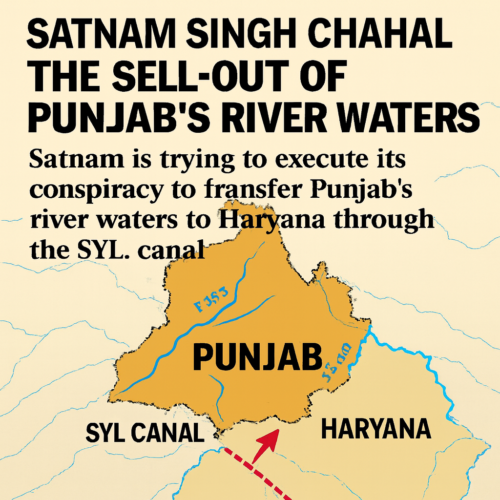
 The sell‑out of Punjab’s river waters is becoming increasingly evident as the state government has chosen to facilitate the visit of the Central Tribunal team—an action that critics say directly strengthens New Delhi’s long‑running effort to reopen the Sutlej‑Yamuna Link (SYL) canal dispute. By cooperating with the Tribunal’s assessment process, the government is being accused of enabling a mechanism designed to justify the diversion of Punjab’s already‑scarce river waters to Haryana. For many in Punjab, this cooperation is not a routine administrative step but a deeply troubling signal that the state’s leadership is willing to compromise Punjab’s lifeline resources at a time when groundwater depletion and ecological stress are already at critical levels.
Opposition leaders and farmer groups argue that the Tribunal’s visit is part of a broader conspiracy to execute the transfer of Punjab’s river waters to Haryana through the SYL canal. They warn that any such move would be disastrous for Punjab’s agrarian economy, which is already struggling under falling water tables and shrinking river flows. The fear is that the Tribunal’s findings could be used to revive construction activity or strengthen Haryana’s legal claims, thereby undermining Punjab’s long‑standing position that it simply does not have surplus water to share.
Amid these developments, leaders opposing the government’s stance have reaffirmed their unwavering solidarity with the farmers who are protesting this move. They insist that Punjab will not allow even a single extra drop of its river waters to be transferred to Haryana under any circumstances. For them, this is not merely a political disagreement but an existential fight for the survival of Punjab’s agricultural backbone, its rural economy, and its ecological future. They argue that the state’s water scarcity is too severe to permit any concessions, and that Punjab’s rights must be defended with absolute clarity and resolve.
In defending their position, critics have also invoked the historical precedent set by the late S. Parkash Singh Ji Badal. During his tenure as Chief Minister, Badal’s government took decisive action to permanently settle the SYL issue by denotifying the canal land and returning it to the original owners and farmers. This landmark decision was widely celebrated across Punjab as a bold and protective measure that safeguarded the state’s water rights and prevented the canal’s construction. Those opposing the current government now argue that facilitating the Tribunal’s visit undermines that historic achievement and reopens a chapter that Punjab had already closed through democratic, legal, and administrative means.
As tensions rise, farmer unions across the state have intensified their mobilization, warning that any attempt to revive the SYL project will be met with widespread resistance. With political pressure mounting, ecological concerns deepening, and public sentiment hardening, the controversy over Punjab’s river waters is once again poised to become one of the most defining and emotionally charged issues in the state’s political landscape.