
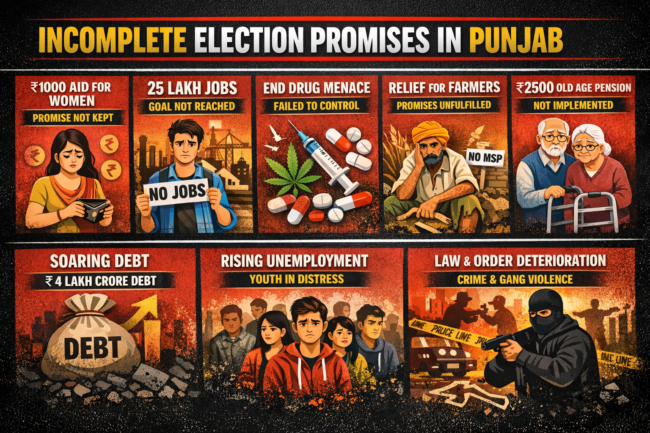
 Before coming to power, the Punjab government made several ambitious promises aimed at providing relief to women, youth, farmers, senior citizens, and vulnerable sections of society. These assurances played a major role in shaping public expectations. However, as the government completes a significant part of its term, many of these commitments remain either partially fulfilled or entirely unimplemented, raising serious political and public concerns.
One of the most highlighted promises was financial aid to women, under which every eligible woman was to receive ₹1,000 per month. This scheme was projected as a transformative step toward women’s economic empowerment. However, the government later cited fiscal constraints and rising debt as reasons for delaying or shelving the scheme. As a result, millions of women who had hoped for direct financial support continue to wait, leading to disappointment and erosion of trust.
Employment and job creation was another major election plank. The promise of 25 lakh jobs raised hopes among Punjab’s unemployed youth, especially graduates and skilled workers. While the government claims to have provided a notable number of government jobs, the overall target remains far from achieved. Youth unemployment continues to be high, and the private sector has not absorbed job seekers at the expected pace, making employment one of the most debated failures of the administration.
The drug menace, a long-standing and sensitive issue in Punjab, was promised to be controlled within a few months of forming the government. However, opposition parties and social organizations allege that drug abuse and trafficking have instead increased in several regions. The repeated extension of deadlines and shifting timelines have weakened the credibility of the original promise, suggesting a lack of effective enforcement and systemic reform.
In the agricultural sector, farmer welfare promises remain largely unmet. Commitments such as a complete farm loan waiver, MSP top-up, and ₹10,000 monthly aid to labourers after crop loss were announced to support farmers during distress. Reports indicate that these assurances have not been fully implemented, adding to agrarian stress at a time when farmers are already struggling with rising input costs and climate-related losses.
The government had also promised to raise the old age pension to ₹2,500 per month, a move that would have significantly helped senior citizens cope with inflation and medical expenses. However, the pension amount has not been increased as promised, leaving elderly citizens dependent on inadequate support.
In education and healthcare, although some improvements have been acknowledged, several key commitments remain incomplete. The promise to establish 16 new medical colleges has seen little progress, with only one currently planned. Similarly, the pledge to fill all vacant principal and administrative posts in educational institutions has not been fully honored, affecting academic governance and quality.
Fiscal management has emerged as another area of concern. Punjab’s debt is expected to reach nearly ₹4 lakh crore by March 2026, placing immense pressure on public finances. Additionally, projected revenue sources such as sand mining have failed to generate expected income, further constraining welfare spending and development projects.
Finally, the law and order situation has drawn sharp criticism from opposition parties. Allegations of rising incidents of snatching, assaults, organized crime, and gang wars have raised public anxiety. Critics argue that the government has failed to maintain the firm policing standards it promised during the election campaign.
Overall, while the government highlights selective achievements, a large gap remains between pre-election promises and ground reality. These unfulfilled commitments continue to shape political debate in Punjab and may significantly influence public opinion in upcoming elections