
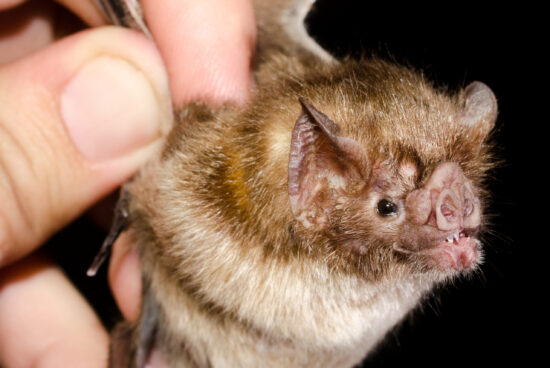
During a 2022 field expedition, Peter Larsen, PhD, was asleep in an open-air house in Guyana when he was awakened by the sensation of liquid on his feet, which were pressed against his mosquito net—except it wasn’t raining. He flicked on his headlamp, startled to find that the liquid was blood, and a vampire bat—a species he had gone there to study—was feeding on him.
That experience, along with his work with vampire bats in several Central and South American countries, prompted Larsen to ponder the pathogens the bats might carry. Specifically, as co-director of the Minnesota Center for Prion Research and Outreach (MNPRO), he wondered about vampire bats’ potential role in spreading the prions (infectious misfolded proteins) that cause chronic wasting disease (CWD) in cervids such as deer, elk, and moose.
The fatal disease has been spreading in North America for decades and has now been found as far south as New Mexico and Texas, with a prevalence as high as 11% in mule deer in one area. At the same time, climate change is driving vampire bats northward, and they are predicted to arrive in Arizona, New Mexico, and Texas in the next 10 to 50 years.
Common vampire bats (Desmodus rotundus) in northern Mexico, Larsen thought, may already be feeding on CWD-positive cervids there, further transmitting the prions. “If I had to guess, I would say it’s 70% possible that there are already vampire bats feeding on [CWD-] positive animals in Mexico,” he said.
Larsen’s curiosity led him, along with coauthors Lexi Frank, a University of Minnesota PhD student and research assistant, and Jason Bartz, PhD, a professor at Creighton University, to investigate the potential interface of bats and CWD prions, which Larsen called a national security issue. The team published the findings in the Journal of Mammology.
‘It turns into a nightmare if it’s real’
The fist-sized common vampire bats are known to feed on the blood of livestock, wildlife, and people by injecting an anticoagulant through a painless bite with razor-sharp teeth. The bats often regurgitate blood meals to share with other bats in their roosts who didn’t get their own, as well as participate in communal grooming—another potential transmission route.
In addition, captive cervid herds used for hunting, venison, or other byproducts are relatively common in southern Texas and Mexico, representing ample opportunity for the bats to feed. Cervids with clinical CWD, which often features cognitive impairment and limited mobility, would be especially vulnerable.
If I had to guess, I would say it’s 70% possible that there are already vampire bats feeding on [CWD-] positive animals in Mexico.
Peter Larsen, PhD
In fact, speaking with Texas Parks and Wildlife veterinarian J. Hunter Reed, DVM, MPH, the researchers learned that from 2021 to 2025, Texas ranches that were later confirmed to have housed CWD-positive deer shipped hundreds of live white-tailed deer to Mexico, potentially seeding the disease there. CWD can take years to cause symptoms, and prions can persist in the environment for well more than a decade.
That finding begs the question of whether the bats can be infected with certain CWD strains and, if so, if prion characteristics change after passage through the mammals, possibly gaining the ability to infect non-cervid species such as livestock, wildlife, or people.
That scenario is alarming to Brent Race, DVM, scientist at the National Institutes of Health’s Rocky Mountain Laboratories. “This is a speculative concern, but it turns into a nightmare if it’s real,” he said. “Their opinion that bats may become a vector for CWD, or even worse, that bats may enhance the host range of CWD, warrants further study.”
Even if vampire bats aren’t susceptible to infection with CWD prions, they could still serve as a disease vector to susceptible species, he said.
Race added that prion mutations are hard to easily describe. “The prion doesn’t really mutate like a virus or bacteria that can change their genome,” he said. “Prions change by misfolding slightly differently. It is possible that if bats were susceptible to CWD, the resulting prion may be folded differently than typical CWD and potentially have an enhanced ability to infect other species, including humans and livestock. This is, of course, very speculative.”
Rodrigo Morales, PhD, of the University of Texas Medical School at Houston, said that the study is interesting and important but still preliminary/hypothetical and didn’t provide enough evidence to raise alarm.
“As written in the article, this is something still hypothetical because there isn’t a very clear or frequent interaction between the infected animals [deer] and the vampire bats they are referring to,” he said. “Unfortunately, there are no models yet suggesting that this could happen. For that reason, interpretations need to be weighed with caution.”
Morales said that if bats and CWD deer do actually interact, there would be reason for concern. But the level of prion infectivity in blood is very low, and the bats would likely break down some of them after passing them through their gastrointestinal tract.
“If we take an infected animal and collect the blood, we may detect it, but that doesn’t mean that the amount of prions present in blood will be enough to transmit the disease,” he said. “Along this line, multiple factors, and not purely interaction, must be considered when evaluating potential vectors for disease transmission. Nevertheless, investigation in these and other areas are relevant to either confirm or discount events facilitating CWD dissemination.”
Need for ecological studies, experiments, surveillance
The authors strongly recommended conducting risk assessments. “These assessments should include ecological studies, prion transmission experiments, and surveillance in regions where Desmodus and CWD-positive cervids are likely to overlap,” they wrote. “Addressing this emerging issue proactively will be essential to mitigate future risks to wildlife and livestock health, related economies, and public health.”
Conducting these types of assessments is a massive undertaking, Race said. “And then if you start talking about looking at large animal species, it’s even more difficult to do,” he said. “So they probably would have to do a lot of it in mice.”
Addressing this emerging issue proactively will be essential to mitigate future risks to wildlife and livestock health, related economies, and public health.
Another factor hindering research is the apparent lack of CWD surveillance in Mexico, which is the only way to determine the risk.
Larsen called for the US Department of Agriculture to consider this mode of CWD transmission. “We know that some percentage of pigs and cattle are susceptible to CWD prions,” he said. “We also know that sheep and goats are susceptible. But if the vampire bats develop their own [susceptibility], we have no idea what the species boundaries of those prions are.”
In the meantime, MNPRO has launched a wildlife surveillance project in which it is working with a few veterinary diagnostic labs where wildlife are turned in for rabies surveillance, hoping to identify any CWD prions in those animals. As an example, Larsen cited a camel prion disease circulating in northern Africa.
“It was discovered because the animals were being turned in for rabies testing, because they were exhibiting symptoms that the veterinarians thought were similar to rabies,” he said. “But all the rabies tests came back negative. And it turned out that there was a prion disease.”