
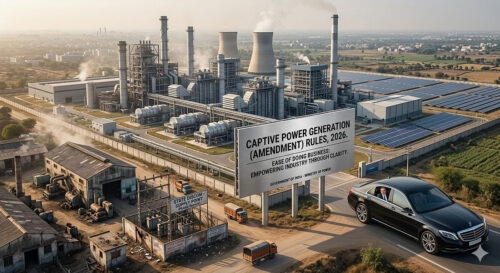
 The Central Government has amended Rule 3 of the Electricity Rules, 2005 through the Electricity (Amendment) Rules, 2026. The notification is terse, the language technical, the occasion — as always with subordinate legislation — low-key. The implications are anything but. Three things have materially changed.
First, “ownership” for captive generating plants now explicitly includes the holding company, its subsidiaries and co-subsidiaries, all of whom may be treated collectively as a single captive user. This legitimises the layered SPV-holding structures through which large industrial houses typically park their power assets — structures that distribution companies had previously challenged on the ground that the actual consuming entity did not directly hold the mandated 26 per cent. Second, the proportionality requirement for group captive and Association of Persons projects has been substantially relaxed. Earlier, a strict reading linked each member’s equity share to its consumption; minor mismatches could strip the entire project of captive status, triggering cross-subsidy surcharge (CSS) and additional surcharge (AS) liabilities running into hundreds of crores. The 2026 rules shift to collective compliance: so long as the group together consumes 51 per cent of generation, individual deviations do not imperil the project. Third, a formal verification architecture is now in place — state nodal agencies for intra-state cases, the NLDC for inter-state ones — with an interim shield from CSS and AS while captive status is under examination.
Buried in the fine print is a provision that deserves separate attention. Where a single AoP member holds 26 per cent or more ownership, the proportionality test does not apply to that member at all. Its entire drawal is treated as captive consumption. This “anchor exemption” writes into subordinate legislation what some appellate tribunals had suggested in case-specific rulings — that the dominant investor in a group captive project gets a free hand on consumption volumes.
Who Gains, and Who Does Not
The principal beneficiaries are the JSWs, the ArcelorMittal Nippon Steels, the UltraTechs, the Vedantas — integrated industrial houses with the capital to build large captive plants, the legal resources to structure them correctly, and the consumption volumes to anchor a group captive project. For them, group-level ownership recognition, relaxed proportionality, and the anchor exemption together substantially reduce regulatory risk. The prospect of a technical slip in internal power allocation suddenly triggering catastrophic surcharge liability is now sharply diminished.

What about the smaller industrial consumer — the medium-sized manufacturer who cannot afford a 26 per cent equity stake in a captive project and depends on the distribution company’s grid? These amendments offer very little. The framework is structurally oriented around large, capital-rich anchor loads. In a typical group captive arrangement, the anchor investor now has both legal primacy and operational flexibility; the tail of smaller equity holders becomes more replaceable. Whether that constitutes ease of doing business for the wider industrial ecosystem is a question the notification does not pause to answer.
The Fiscal Overhang for States
Electricity duty is a state subject, levied under individual State Electricity Duty Acts. The 2026 amendments do not directly disturb that. But the indirect effect on state revenues is significant and deserves to be stated plainly.
Where a state’s exemption or concessional-duty regime is linked to the central definition of a captive generating plant, the broadened Rule 3 automatically enlarges the universe of projects eligible for duty relief. Corporate structures that were earlier on the borderline — because of indirect shareholding chains or small mismatches in proportional consumption — are now more confidently within the captive fold, and may correspondingly claim state duty exemptions that were previously contested.
Punjab is an instructive case. The state competes aggressively on power pricing as an industrial incentive, offering concessional tariffs and duty exemptions to attract investment. Several of its exemption provisions track the central definition of captive generation. The 2026 rules, by pulling more group structures unambiguously within that definition, expand the exemption claim without any corresponding adjustment to Punjab’s fiscal framework. Revenue forgone through electricity duty is rarely captured cleanly in budget documents; it tends to surface only when PSPCL’s subsidy burden becomes unsustainable. The Centre has, in effect, reshaped the definitional battlefield while leaving states to absorb the fiscal consequence — a pattern that recurs in Centre-state relations in the energy sector and deserves more scrutiny than it typically receives.
The DISCOM Equation
Distribution companies depend partly on cross-subsidy flows to fund below-cost supply to agriculture and domestic consumers. Every unit that migrates to captive supply — escaping CSS and AS — shrinks that pool. The 2026 amendments accelerate that migration for precisely the largest industrial users, who contribute most to the cross-subsidy pool in absolute terms.
The dynamic is not new, but the amendments sharpen it. A large steel or cement plant that previously faced regulatory uncertainty about its captive status — and therefore kept a portion of its load on DISCOM supply as a hedge — now has stronger legal footing to shift entirely to captive. The DISCOM loses the revenue, retains the obligation to supply to agricultural and domestic consumers at below-cost rates, and must find the cross-subsidy shortfall elsewhere. In states where DISCOMs are already carrying accumulated losses — and that is most states — this is not an academic concern. The financial pressure on already-distressed utilities correspondingly increases. The cost will be borne somewhere: by the state exchequer through higher subsidy transfers, by the small consumer through upward tariff revisions, or by the DISCOM’s mounting deficit. The amendment notification is silent on this arithmetic, which is precisely where the honest accounting needs to happen.
Open Access: The Strategic Layer
None of the amendments dilute the relevance of open access — and that is itself significant. Captive generators retain the statutory right to wheel power through the grid to their own units and remain free to procure from multiple sources: DISCOM supply, long-term bilateral PPAs, or spot purchases on power exchanges, whenever that is operationally convenient or cheaper.
The strategic game for large industrial users now shifts to portfolio management. With greater legal certainty around captive status, a steel or cement major can treat its captive plant as firm base-load — insulated from regulatory challenge — while actively arbitraging between grid tariffs, third-party open access and exchange prices for incremental requirements. In periods of low exchange prices, it buys from the market; when captive generation is surplus, it manages internal allocation across group entities. The relaxed proportionality rules give it the headroom to do this without jeopardising the 51 per cent consumption threshold. Far from reducing dependence on open access, the amendments embed captive generation more deeply into a broader cost-optimisation strategy built around open access flexibility. For large industrial users, this is the real prize — not just cheaper power, but the ability to manage power costs dynamically across multiple procurement channels while retaining the regulatory protection of captive status.
A Policy Choice Dressed as Clarification
Is any of this unreasonable? The old regime did generate genuine uncertainty. Distribution companies levied surcharges first and argued legality later. The absence of a nodal verification mechanism meant the same corporate structure could be treated differently across states. Regulatory ambiguity translating into thousands of crores of litigation risk does deter investment.
But these are not neutral legal clarifications. They are a policy choice with a clear direction of travel: to back large, energy-intensive industry in securing cheap, predictable power through captive generation, even at the cost of shifting financial burden onto distribution companies, states and smaller consumers. That choice may be defensible on industrial competitiveness grounds. It should, however, be named for what it is.
The compensating questions — how do DISCOMs remain financially viable as their largest cross-subsidy contributors exit the grid, how do states recover the duty revenue they have implicitly been asked to forgo, how does the small industrial consumer remain competitive on grid power that is cross-subsidised by fewer and fewer large payers — receive no policy attention in this notification.
That omission is the real story.