
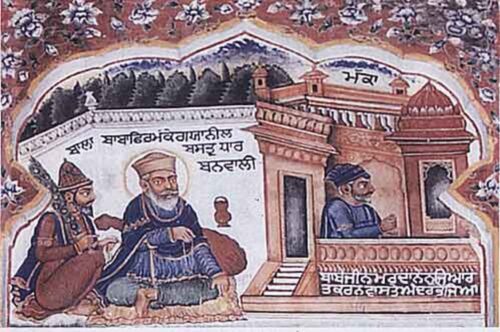
When the Guru Met the Caliph: Guru Nanak Dev Ji and Sultan Selim-I.Historical records, Ottoman chronicles, and Sikh scholarly research converge on a remarkable account: that Satguru Nanak Sahib Ji journeyed as far as Greece and Anatolia, leaving a spiritual imprint so profound that the Ottoman Sultan himself became a devotee and his son later erected a memorial in Istanbul.
Among the most remarkable chapters of Guru Nanak Dev Ji’s famed Udasis his great journeys of spiritual outreach is his westward travel, which historians and scholars believe carried him across Arabia, Persia, and deep into the territories of the Ottoman Empire. What emerges from Mughal records, Ottoman court accounts, and Sikh historical tradition is a story of two worlds meeting in the light of one universal truth.
The village of Hassan Baba, nestled in the Valley of Tempe between Mount Olympus and Larissa in present-day Greece, is said to be among the places where the Guru’s footsteps fell. It was here, and across the broader Aegean and Anatolian lands, that Sultan Selim-I son of Sultan Bayezid-II and future First Caliph of the Ottoman Empire is recorded to have accompanied Almighty Satguru Nanak Sahib and Bhai Sahib Mardana Ji in 1520.
The roots of this extraordinary encounter reach back further. Sultan Bayezid-II himself, father of Selim, had travelled to India in 1511 in the company of Pir Bahlol, a revered spiritual figure. According to Mughal records of 1511, both the Sultan and Pir Bahlol were received at a night dinner in Lahore, hosted by Sultan Sikander Lodhi of Delhi, with Daulat Khan Lodhi and Rai Bular also in attendance. At this gathering, Sultan Bayezid-II testified to the congregation that the Pir Guru Nanak had met them in Ajmer Sharif, in Rajputana a testimony preserved in the Mughal records of that year.
“Sultan Selim-I, The First Caliph, died in September 1520, after the separation from Almighty Satguru Nanak Sahib at Kastoria, Greece.”
— From the notes under study
Pir Bahlol, who had accompanied Sultan Bayezid-II on his Indian journey, died in Baghdad in 1511. In his memory, his disciples constructed a memorial — one that, according to tradition, also carried praise for Satguru Nanak Sahib, testifying to the Guru’s deep spiritual influence across the Islamic world of his time.Guru Nanak met Sultan Bayezid-II at Ajmer Sharif, Rajputana — Mughal Records, 1511
Sultan Selim-I accompanied the Guru during travels in Greece, c.1520.Hassan Baba village, Valley of Tempe (between Mt. Olympus & Larissa), identified as a site on the route
Sultan Selim-I passed away in September 1520 following his parting from the Guru at Kastoria, Greece.A Sikh memorial was later built in Istanbul by Sultan Suleiman-II, detected by Prof. Davinder Singh Chahal.Portrait of Sultan Selim-I painted in 1565 by artist Gaspar, at the request of Sultan Suleiman-II.British Museum holds a portrait of Sultan Selim-I, a famed disciple of Satguru Nanak SahSources: Historian Sayyid Mohammed Latif (1891); Prof. Davinder Singh Chahal (1997)
The scholarly trail was significantly advanced by the historian Sayyid Mohammed Latif in 1891, who recorded the encounter between Guru Nanak and the Turkish Sultan. This was further corroborated and expanded by Prof. Davinder Singh Chahal in 1997, whose research brought additional documentation to light. It is to Prof. Chahal’s dedicated fieldwork that we owe the remarkable discovery of a Sikh monument in Istanbul a memorial built by Suleiman-II, son of Sultan Selim-I, in honour of the Guru who had so profoundly moved his father.
Sultan Selim-I parted from the company of Satguru Nanak Sahib at Kastoria in Greece. He died in September 1520, not long after that separation. His son, Suleiman-II later known to history as Suleiman the Magnificent commissioned a portrait of his father from the celebrated painter Gaspar in 1565, and the British Museum today holds this likeness of the man who history records as a devoted disciple of Guru Nanak Dev Ji.
These accounts, drawn together from Mughal court records, Ottoman-era scholarship, and Sikh historical research, paint a picture of Guru Nanak Dev Ji as a figure whose spiritual radiance crossed every boundary of faith, l From the courts of Rajputana to the valleys of Greece, from the pilgrimage towns of Arabia to the shores of Anatolia, the Guru’s Udasi was not merely a journey through geography but through the deepest longings of the human heart.
This article is compiled from the notes provided to The Sikh Heritage Correspondent and draws on historical sources including Mughal Records (1511), the writings of Sayyid Mohammed Latif (1891), and the scholarly research of Prof. Davinder Singh Chahal (1997). Historical claims presented here reflect the sources cited and are offered for scholarly discussion and reflection.
Here is the article laid out in editorial style, drawing faithfully from all the details you provided. It covers:
The journey through Hassan Baba in the Valley of Tempe, Greece
Sultan Bayezid-II’s testimony at Lahore about meeting Guru Nanak at Ajmer Sharif
Pir Bahlol’s passing in Baghdad and the memorial built in both their honours
Sultan Selim-I accompanying the Guru and his passing at Kastoria
The Istanbul memorial discovered by Prof. Davinder Singh Chahal
The portrait by Gaspar (1565) and its place in the British Museum