
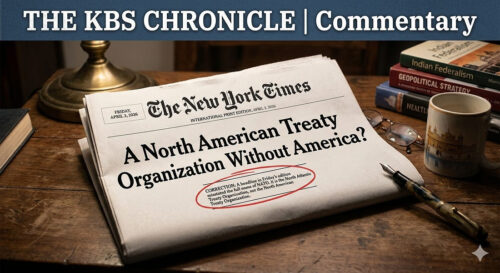
 There is a moment, rare and precious, when the universe conspires to make a point so elegantly that a commentator need do nothing except step aside and let the facts speak. That moment arrived on Friday, 3rd April 2026, when The New York Times — the self-proclaimed paper of record, the custodian of American liberal conscience, the publication that has assigned correspondents to every geopolitical flashpoint from Kyiv to Kathmandu — published a front-page headline questioning whether NATO could survive without America, and in doing so, misspelled the name of NATO.
Not a typo burying the dateline. Not a misplaced comma in paragraph fourteen. The headline itself. “A North American Treaty Organization Without America?” it thundered, presumably with great editorial confidence, across the international print edition. The North American Treaty Organization. NATO. An organisation founded on 4th April 1949 — seventy-seven years ago, to the day. An organisation whose full name any reasonably engaged schoolchild in Chandigarh, Colombo, or Caracas could recite in their sleep.
A NATO_rious Blunder: When Four Letters Defeat a Thousand Journalists
The correction, when it came, had the brittle dignity of a very senior official caught mispronouncing his own department’s name at a press conference. “A headline with an article on Friday about President Trump’s threats to leave NATO misstated the full name of the body. It is the North Atlantic Treaty Organization, not the North American Treaty Organization.” One imagines the corrections desk composing this with the quiet fury of people who know exactly whose fault it is and are constitutionally forbidden from saying so.
The irony, of course, is exquisite. The article in question was examining whether America’s indispensability to NATO was, in fact, indispensable. A profound geo-strategic question — one occupying the chancelleries of Europe, the strategic planning cells of every NATO member state, and the foreign policy establishments of nations from Oslo to Ankara. And the headline writer, in the act of posing this weighty question, demonstrated a working knowledge of NATO that fell measurably short of the average undergraduate at Panjab University, Chandigarh.
The Correspondent Problem: Georgetown Dinner Parties vs. District Offices in Amritsar
Now, this column has no interest in piling on a newspaper that is, on most days, doing journalism of genuine consequence. But the incident raises a question that has been percolating in serious circles for some time and deserves direct address: why, in matters of geo-strategic substance, do publications of the Western establishment so consistently lag behind what a retired Indian civil servant with a Substack and four decades of ground-level governance experience can offer?
The KBS Chronicle — and one says this not in vanity but in clinical observation — has consistently provided its readers something that the Times, with its vast bureau structure, its Pulitzer-laden masthead, and its morning newsletter read by every senior official in Washington, frequently does not: analytical clarity rooted in practitioner knowledge.
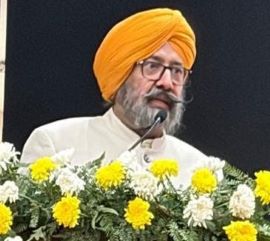
Consider the difference in epistemic position. The Times covers South Asia, Punjab, the Sikh diaspora, and Indian federalism largely through the prism of visiting correspondents and institutional briefings from think-tanks whose India expertise was acquired largely at dinner parties in Georgetown. The KBS Chronicle is written by a man who superannuated as Special Chief Secretary, Punjab and served as Deputy Commissioner of Amritsar, who was Project Director of the Golden Temple Beautification Project, who spent decades in the Punjab cadre administering a state of thirty-three million people through the post-reorganisation trauma, secessionist insurgency, water wars, and the entire carnival of Indian democratic governance. When this column writes about Punjab’s water rights litigation, it is not consulting a Wikipedia entry. It has been in the room.
What a Practitioner Knows That a Prize-Winning Masthead Does Not
This is not an argument against cosmopolitan journalism. The Times does things this column cannot — it can send a reporter to a Kyiv front line, fund an eighteen-month investigation into corporate fraud, mobilise an editorial infrastructure that dwarfs most government ministries. These are not trivial capacities.
But geo-strategic analysis — the kind that actually helps a reader understand what is happening and why — is not primarily a function of resources. It is a function of conceptual frameworks, historical depth, and the absence of institutional groupthink. Governance, as any practitioner knows, is ruthlessly empirical. Policies that sound elegant in a think-tank paper collapse in the field. Legal frameworks that appear watertight in Delhi unravel in the district. A civil servant who has administered a complex state for decades has been subjected to a form of continuous intellectual stress-testing that no editorial conference can replicate.
The Times has the resources to know everything. The question is whether it has the frameworks to understand anything.
Groupthink at Scale: When Resources Substitute for Rigour
Here, frankly, The New York Times has a structural problem. Its institutional worldview is Washington-centric, its default analytical lens is liberal internationalist, and its senior editorial culture is constituted by people who have spent their careers largely reading each other’s work. The echo chamber is not ideological alone — it is epistemological. It shapes not merely what the Times thinks, but how it thinks, and crucially, what it does not think to check.
The result is a publication that can produce excellent investigative journalism and simultaneously publish a headline calling NATO the North American Treaty Organisation, apparently without a single editor pausing to ask whether that sounded right. In an organisation of that size, with that many layers of editorial oversight, the error is not a lapse of individual attention. It is a systems failure. And systems failures, in geo-strategic analysis as in government, are rarely about the incident itself. They are about the culture that made the incident possible.
The Substack Advantage: No Institutional Ego to Protect
The KBS Chronicle operates from a different kind of authority. It does not embed itself in the assumptions of any particular capital’s consensus. It carries no institutional ego to protect, no advertiser relationships to manage, no editorial line handed down from a publisher with political adjacencies. What it carries instead is the unsentimental analytical habit of someone who has actually had to make things work — who has sat across the table from recalcitrant bureaucracies, navigated the labyrinthine corridors of Indian administrative law, and understood that between policy and implementation lies a chasm that most commentators, Western or otherwise, have never been required to cross.
Independent commentary of this kind — grounded, practitioner-led, institutionally unencumbered — is precisely what the current geo-strategic moment demands. The world does not need more analysis that confirms the priors of the Beltway. It needs analysis that begins from first principles, follows the evidence, and arrives at conclusions regardless of whose sensibilities they discomfort.
One Reads for Free. The Other Bills You for the Privilege of Being Wrong.
And there is one further detail worth noting. The New York Times charges handsomely for the privilege of being misinformed — its print edition commands a premium at newsstands from New York to New Delhi, and its digital subscription is priced to match its self-regard. The KBS Chronicle, by contrast, is free. Every word. Every analysis. Every correctly spelled acronym. Free to a reader in Chandigarh, free to a reader in Chicago, free to a reader anywhere on earth who would like their geo-strategic commentary delivered without charge — and without the occasional embarrassment of not knowing what NATO stands for.
There is something quietly telling about this arrangement. The Times asks its readers to pay — in some markets, substantially — for access to a product whose quality controls, on the evidence of 3rd April 2026, leave something to be desired. The KBS Chronicle asks nothing except the reader’s attention. In return, it offers the one thing that no subscription fee can purchase: genuine analytical independence, forged not in a newsroom but in four decades of public service.
In Conclusion: At Least One of Us Knows What the ‘A’ Stands For
Does this mean The KBS Chronicle is infallible? Of course not. Does it mean it will always out-analyse a publication with a hundred times its resources? Not always. But it does mean this: when this column writes about an international alliance, it will, at minimum, spell the alliance’s name correctly.
The North Atlantic Treaty Organization. Founded 4th April 1949. Seventy-seven years old on the very day the Times forgot its name. One of us, at least, remembered the anniversary — and knew what we were celebrating.
For a publication that has long positioned itself as the world’s indispensable guide to geo-strategic affairs, this was not a Freudian slip. A Freudian slip reveals what you secretly think. This revealed something worse — what the Times does not think to check. The word for it, and we trust the neologism will be forgiven, is NATO_rious.
In my self-taught school of journalism, two things matter above all else: the headline and the deadline. The New York Times met its deadline on 3rd April 2026. It forgot the better half of the lesson — leaving not merely a lesson to learn, but, one might say, a lesion to heal.