
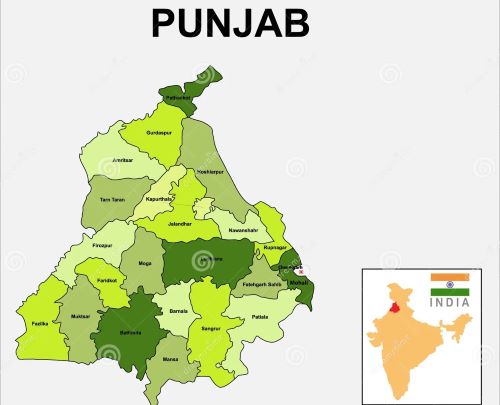
 Punjab has long held a reputation as one of India’s most progressive and dynamic states, achieving top positions in multiple sectors despite its small geographical size. Historically known as the “Granary of India,” Punjab’s contribution to the nation’s agricultural security, military strength, diaspora-led development, sports achievements, and cultural leadership places it at a unique position compared to other states. While economic challenges and policy issues have affected progress in recent years, Punjab still ranks number one or among the very top in several fields, proving its importance in India’s social and national framework.
Punjab is number one in agricultural productivity per acre, a remarkable achievement that originates from the Green Revolution of the 1960s and 1970s. Even today, when many states have expanded agricultural output, Punjab retains the highest per-acre yield of staples such as wheat and paddy. Despite having only about 1.5% of India’s total land area, Punjab has often contributed 35–40% of wheat and 25–30% of rice procured for the central food grain pool. No other Indian state matches this ratio of land size vs. contribution. In terms of irrigation, Punjab also ranks at the top, with over 98% agricultural land irrigated, giving it the highest irrigation coverage among all states. This makes Punjab India’s most dependable agricultural backbone even today.
Punjab is also number one in the Indian Armed Forces representation per capita. Although Punjab’s population is much smaller compared to Uttar Pradesh, Bihar or Maharashtra, the percentage of youth joining the Army, Navy and Air Force is the highest. Historically, Punjabis—especially Sikhs—have received some of the highest gallantry awards, including Param Vir Chakras, reflecting unmatched bravery. Punjab’s districts such as Gurdaspur, Amritsar, Hoshiarpur and Moga are among the biggest contributors to the armed forces, making Punjab India’s number one “soldier-producing state” when measured per thousand population.
Punjab is number one in NRI strength and global presence relative to population. Among all Indian states, Punjab has the strongest per-capita overseas diaspora, with an estimated 12–15% of its population living abroad. Punjabis are highly successful in Canada, the UK, Italy, the US, Australia and New Zealand. This global presence has made Punjab the leading state in foreign remittances per household, significantly boosting rural income and international investment. Punjab’s villages often reflect the highest standard of living due to NRI contributions, setting Punjab apart from other states in terms of global connectivity.
Punjab also ranks number one in milk availability per capita, thanks to its strong dairy culture. Punjab’s per-capita milk availability is consistently above the national average and among the highest in the country, making dairy a major support system for rural families. In several years, Punjab has stood at the top or near the top in dairy productivity, especially in cattle yield, due to scientific breeding and efficient dairy farming practices.
Punjab is also a number one state in sports achievements, especially in hockey, wrestling, kabaddi, athletics, weightlifting and boxing. Many Arjuna Awardees, Olympians and Asian Games medalists come from Punjab. The state dominates the national kabaddi scene and has produced world champions repeatedly. Punjab Police, Railways athletes, and rural akharas have created a sports culture unparalleled in most other states except Haryana. Punjab’s sporting academies and the energetic youth population continue to give the state a top position in medal tallies for many national competitions.
Culturally, Punjab is number one in cultural impact across India and globally. Punjabi music, Bhangra, Punjabi cinema, Sikh heritage and Punjabi language influence global entertainment. Punjabi songs dominate India’s music charts, most weddings across states include Punjabi beats, and Punjabi’s global influence—from Canada to California—is unmatched by any other regional culture of India. Punjab’s cuisine, festivals and folk traditions are also among the most popular worldwide. The state is culturally one of India’s strongest and most influential.
Punjab also ranks among the top states in literacy among rural Sikh women, reflecting progressive social trends in specific communities. In addition, Punjab has historically ranked among the best in school infrastructure, rural road connectivity and electricity availability. Though economic challenges exist, Punjab remains one of the fastest states in providing 24×7 power to rural households earlier than many others.
Even in fields like manufacturing of bicycles (Ludhiana), sports goods (Jalandhar), hosiery and garments, and agricultural machinery, Punjab stands among the top producers in India. Ludhiana is called the “Manchester of India” for its garment industry, and Jalandhar is one of the largest sports goods exporters in the world, supplying equipment for global tournaments.
Overall, Punjab’s leadership in agriculture, military service, NRI influence, dairy production, sports, culture, and industrial specialities shows that the state has repeatedly achieved number-one positions in key sectors. While modern economic reforms and diversification are necessary for the future, Punjab’s comparative strengths continue to set it apart from other Indian states, making it one of the most influential regions in India despite its size.