
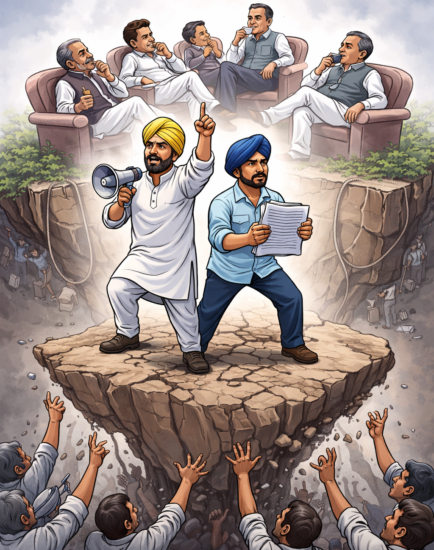
 In recent years, a growing concern within the Indian National Congress particularly in Punjab has been the visible lack of unity and active collaboration among its leaders. While a few prominent figures like Sukhpal Singh Khaira and Pargat Singh continue to engage actively with the public and raise issues consistently, a large section of the party leadership appears either inactive or disconnected from grassroots efforts. This imbalance raises a fundamental question: why aren’t more Congress leaders supporting those who are working tirelessly on the ground?
One of the primary reasons lies in internal factionalism. The Congress party, especially in Punjab, has long been plagued by groupism, where leaders align themselves with specific factions rather than working collectively for the party’s broader goals. This internal rivalry often leads to a lack of cooperation, where leaders hesitate to support others out of fear that it might strengthen a competing faction. As a result, even genuine efforts by active leaders fail to receive the backing they deserve.
Another critical factor is the absence of strong central leadership at the state level. After the tenure of leaders like Amarinder Singh, the party has struggled to maintain a unified command structure in Punjab. Without a clear and authoritative leadership figure to coordinate activities and enforce discipline, many leaders operate independently, often prioritising personal political survival over collective responsibility. This vacuum of leadership weakens organizational cohesion and discourages teamwork.
Electoral insecurity also plays a significant role. Many Congress leaders are focused primarily on safeguarding their own constituencies and political futures. In such an environment, supporting another leader—even within the same party can be seen as politically risky. Instead of building a united front, leaders often limit their engagement to their own areas, avoiding broader party initiatives led by others.
Additionally, there is a noticeable decline in ideological commitment. Historically, the Congress party was driven by a strong ideological framework and a sense of collective mission. Today, however, politics has become increasingly personality-driven. Leaders often prioritize individual recognition over party ideology, which reduces their willingness to collaborate or support colleagues who are actively raising issues or mobilizing the public.
Communication gaps within the party structure further worsen the situation. There appears to be a lack of effective coordination mechanisms that can bring leaders together on common platforms. Without regular dialogue, strategic planning, and shared campaigns, even well-intentioned leaders like Khaira and Pargat Singh find themselves working in relative isolation.
It is also important to consider the impact of repeated electoral setbacks. Continuous losses can demoralize party workers and leaders alike, leading to reduced enthusiasm and engagement. Some leaders may adopt a passive approach, waiting for political conditions to improve rather than actively working to change them. In contrast, leaders like Khaira and Pargat Singh stand out precisely because they continue to remain vocal and active despite these challenges.
The role of the central leadership cannot be ignored either. The high command of the Congress party has often been criticized for delayed decision-making and inconsistent strategies. This has created uncertainty at the state level, leaving leaders without clear direction or motivation to work cohesively. When leadership from the top appears indecisive, it trickles down and affects the entire organizational structure.
In conclusion, the lack of active support among Congress leaders in Punjab is not due to a single reason but a combination of factional politics, leadership vacuum, personal ambitions, weak coordination, and declining ideological unity. While a few leaders like Sukhpal Singh Khaira and Pargat Singh continue to demonstrate commitment and seriousness, their efforts alone are not enough to revive the party’s strength. For the Congress to regain its footing, it must address these internal challenges, foster unity, and encourage a culture where active leaders are supported rather than sidelined. Only then can the party rebuild trust among its workers and reconnect with the people.