
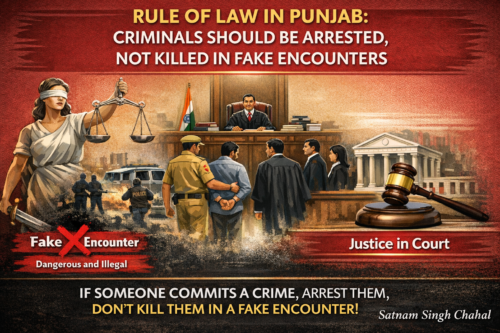
 In any democratic society, justice is not delivered through the barrel of a gun but through the strength of the legal system. Punjab, with its deep history of constitutional values and sacrifice, stands at a crucial point today where the debate over police encounters—especially those alleged to be fake has become intensely important. When any individual commits a crime, the law already provides a clear path: the person must be arrested, investigated properly, and presented before a court. This is the only legitimate method to determine guilt or innocence. Anything outside this framework directly challenges the foundations of justice.
Fake encounters create a dangerous shortcut, one that may temporarily satisfy the thirst for quick action but permanently damages the credibility of the police and the justice system. When a suspect is killed without a trial, society loses its right to know the truth. Was the person actually guilty? Was there a deeper conspiracy? Were powerful individuals trying to silence someone? Only a fair court trial can answer these questions. Skipping the judicial process not only violates human rights but also undermines public confidence in law enforcement.
Punjab has experienced many difficult decades, and history itself teaches that misuse of state power always leads to long-term harm. When the police choose revenge or convenience over procedure, citizens, especially the poor and powerless, become vulnerable. Fake encounters do not strengthen law and order; instead, they weaken it by normalising unlawful killings. Every such incident brings fear among ordinary people and raises suspicion about those responsible for maintaining peace.
The true identity of a robust democracy lies in its ability to protect even the accused. Presenting an arrested person before a court is not a favour; it is a constitutional duty. Punjab must ensure that police officers focus on investigation, evidence collection, and due process. Courts must be empowered to deliver justice swiftly, transparently, and independently. This respect for the rule of law is what separates justice from mere force.
Ultimately, the message is simple and powerful: If someone commits a crime in Punjab, they must be arrested—not killed. The courtroom, not the encounter site, is where justice must be served. Only then can Punjab move forward as a society that values fairness, accountability, and human dignity.