
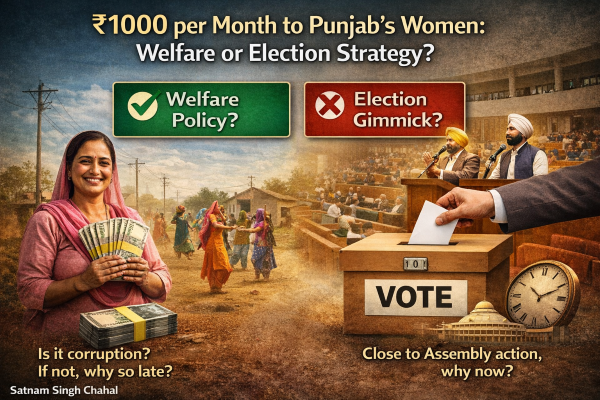
 The promise of providing ₹1000 per month to women in Punjab has remained a major topic of political discussion since it was first announced during the election campaign. At the time, the proposal was presented as a significant step toward empowering women financially and recognizing their role in managing household responsibilities. However, as the government now moves closer to implementing the scheme, questions are being raised about the timing and intent behind the decision.
Supporters of the initiative argue that the scheme should be viewed as a social welfare measure designed to provide economic relief to women, especially those managing households with limited financial resources. In many families across Punjab, women play a central role in budgeting and managing day-to-day expenses. Even a modest financial contribution such as ₹1000 per month could help ease household pressures and provide women with a degree of financial independence.
However, critics and opposition leaders have raised concerns about why the scheme was not implemented earlier if it was truly a priority. The promise was made during the election campaign, yet a considerable amount of time has passed since then without the program being fully launched. As a result, some observers believe the recent push to introduce the scheme may be influenced by political considerations rather than purely social objectives.
Another dimension of the debate centres around the broader discussion of welfare policies, often labelled by critics as “freebies.” While some argue that such schemes place a financial burden on the state treasury, others counter that welfare initiatives aimed at supporting vulnerable sections of society are a legitimate responsibility of any government. Several states in India have introduced financial support programs for women with the aim of improving economic stability at the household level.
The real issue, therefore, may not simply be whether the ₹1000 scheme is justified, but whether it can be implemented transparently and sustainably. For the policy to succeed, the government must ensure that it is supported by a clear financial plan and that the benefits reach the intended recipients without delays or administrative complications.
Ultimately, public trust depends on how effectively promises made to voters are fulfilled. If implemented honestly and consistently, the scheme could become an important step toward strengthening the economic role of women in Punjab. But if it is perceived as a short-term political gesture, it risks losing the credibility and purpose that such a welfare program is meant to serve.