
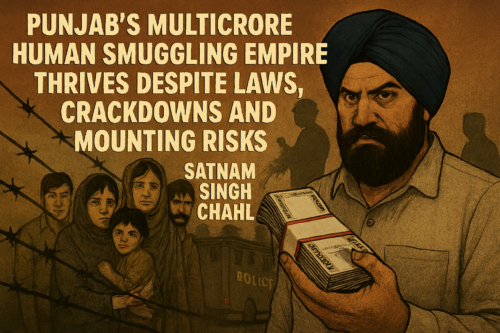
 Punjab has emerged as a major hub of illegal human smuggling, where a business worth crores of rupees is running openly under the nose of the system. From small villages to big towns, unlicensed “travel agents,” document forgers, and international handlers are operating networks that promise to send Punjabi youth abroad mostly to the United States, Canada, and Europe through illegal means. This industry feeds on the desperation of families, the unemployment of educated youth, and the social prestige attached to settling overseas. As a result, a giant underground economy has developed where one individual journey may cost between ₹25 lakh and ₹50 lakh, turning illegal migration into a multi-thousand crore rupee trade each year.
Punjab did try to attack the problem legally. In 2010, the Punjab Assembly passed the Punjab Prevention of Human Smuggling Bill, aimed at regulating travel agents and stopping fraudulent migration. The law sought mandatory licensing, accountability, and criminal penalties for illegal operators. In 2012, the bill was converted into a full Act and amended, widening the definition of a “travel agent” to include document creators, job-promise agents, and those arranging illegal travel routes. Yet, even after this legal framework, the situation hardly improved. Reports from the Ministry of External Affairs state that more than 90% of Punjab’s travel agents still operate without licences, which means the law exists on paper but enforcement remains weak. Thousands of FIRs have been lodged, but the parallel economy of illegal facilitators continues to flourish.
One of the main reasons the business thrives is high demand from the ground level. Punjab’s job crisis and falling agricultural incomes push thousands to dream of foreign shores. Families often sell land or borrow heavily to finance illegal migration. The cultural pressure of “settling abroad” is so strong that even stories of deportations, deaths on foreign routes, and financial ruin do not deter others. Local agents exploit this hope and advertise themselves through personal contacts, WhatsApp promotion, and village-level networks. On the other side, weak monitoring and political interference allow many unregistered operators to escape action. Even when agents are arrested, their networks revive under different names, keeping the machinery alive.
The most dangerous part of this underground industry is the international chain of handlers, especially those who run the notorious “Donkey” or “Dunki” route. Migrants are sent from Punjab to Dubai, Moscow, Central America, or the Caribbean, then pushed slowly toward Mexico and the U.S. border. This journey takes weeks or months, requiring illegal border crossings, jungle treks, boat rides, and secret shelters. The smuggler must coordinate transport, forged documents, bribes, and safe houses across multiple countries. Each link in the chain demands money, increasing the financial risk not only for the traveler but also the smuggler who must bribe foreign security forces, cartel groups, and border brokers.
The risk is not just financial—it is deeply physical and life-threatening. Migrants often walk long distances without food and shelter. Many travel through dense forests, face extreme weather, and pass territories controlled by gangs. Some are robbed, exploited, or sexually abused. Others are abandoned mid-journey when their Indian handlers fail to send funds. Deaths due to exposure, drowning, or dehydration have been reported in several countries. Even when migrants make it to a destination, they can end up detained in immigration prisons, deported back to India, and blacklisted forever.
For smugglers themselves, the business is not without hurdles. They must constantly dodge law enforcement in India, where FIRs, raids, and arrests are increasing. Their networks depend on secrecy and corruption; any broken link can collapse an entire operation. They risk the seizure of money, criminal prosecution, and long jail terms. At the international level, smugglers face the danger of foreign security agencies, mafia groups who control border routes, and rival operators who can kidnap or murder them.
Despite all these dangers legal, financial, and physical the trade continues. It continues because the push factor in Punjab is stronger than the fear. The dream of foreign citizenship, fast earnings, and family prestige outweighs caution. The legal system is slow, enforcement is under-resourced, and corrupt intermediaries infiltrate the machinery. As long as unemployment dominates the state, and as long as foreign dreams overshadow local opportunity, illegal human smuggling in Punjab will remain an empire of crores operating openly, despite laws, arrests, and international scandals.