
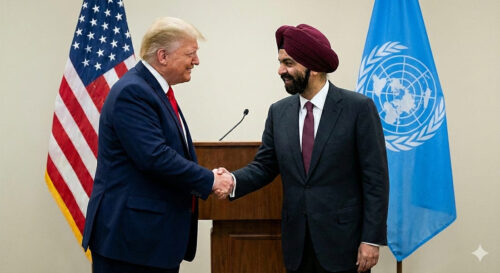
 President Donald Trump’s announcement (late 16 January 2026, Washington time) of a seven-member “Board of Peace” to oversee post-war Gaza is the boldest—and most contested—step yet in his 20-point “Comprehensive Plan to End the Gaza Conflict”. Endorsed by UN Security Council Resolution 2803 (17 November 2025), the Board is framed as a transitional administration with international legal personality, meant to steer reconstruction and governance until a reformed Palestinian Authority can “securely and effectively” assume control.
A Board born of war—and a Security Council mandate
Resolution 2803 adopted the US-backed plan by 13–0, with China and Russia abstaining, and explicitly welcomed the establishment of the Board of Peace as the central transitional mechanism.
Alongside it, the resolution authorised a temporary International Stabilization Force (ISF)—mandated to help stabilise Gaza, support demilitarisation, protect civilians (including humanitarian operations), and assist in training and supporting vetted Palestinian policing capacity.
Crucially, the resolution sets a defined outer limit: the Board and the international civil/security presences are authorised until 31 December 2027, subject to further Security Council action.
What the Board is supposed to do
In essence, the Board’s job is to sit above Gaza’s transitional machinery and make the whole architecture cohere:
Governance framework: set rules, approve key appointments, and supervise the technocratic Palestinian committee tasked with day-to-day administration.
Reconstruction finance: coordinate donors and funding vehicles, and work with international financial institutions; the resolution calls on the World Bank to help facilitate resources, including via a dedicated trust fund.
Stabilisation/demilitarisation: provide strategic guidance to the ISF’s mission set and reassure neighbours that Gaza will not revert to being an armed launchpad.
Notably, leading legal commentary has underlined that the Board is not a UN body—it is a sui generis entity operating under Security Council authority but outside UN administrative control, which is precisely why supporters see it as potent and critics see it as dangerous.
The seven membes— tight sketches
US reporting describes a US-led, high-profile roster—powerful, experienced, and politically freighted.
Marco Rubio (US Secretary of State): Confirmed 99–0 and sworn in as the 72nd Secretary of State on 21 January 2025. A former Florida senator with deep exposure to foreign policy and intelligence work, Rubio is a hard-edged, institutional presence on the Board—expected to drive the diplomatic track with Israel, Arab states, and the UN system, while shaping the security and governance end-state the US wants for Gaza.
Jared Kushner (Trump’s son-in-law; former Senior Adviser): A central architect of Trump’s first-term Middle East diplomacy, best known for the Abraham Accords and for cultivating close relationships with Gulf leaders. He returns without a formal White House title, but with outsized influence as an informal strategist and connector—especially on the investment-heavy parts of the plan, a role that also invites scrutiny because of his private business interests in the region.
Steve Witkoff (US Special Envoy; Trump confidant): A New York real-estate dealmaker and long-time Trump associate brought into the diplomacy lane as a results-driven negotiator rather than a traditional diplomat. Witkoff’s utility to the Board is his “transactional” skill set: brokering arrangements, keeping parties talking, and selling reconstruction as an investible proposition—bridging ceasefire mechanics, access arrangements, and the commercial architecture of rebuilding.
Tony Blair (former UK Prime Minister): UK Prime Minister from 1997 to 2007 and later the Quartet’s Middle East envoy, Blair brings experience in post-conflict statecraft and donor-facing institution-building. He also carries a heavy political burden: in much of the Arab world his name remains inseparable from the 2003 Iraq War, raising fears that Gaza’s transition could look like externally designed “economic peace” that skirts the core questions of sovereignty and rights.
Marc Rowan (CEO, Apollo Global Management): A Wall Street heavyweight leading one of the world’s largest alternative-asset managers, Rowan represents the “private capital” arm of the project—tasked with mobilising investment beyond grants and traditional aid. His likely contribution is financial engineering: blended-finance structures, risk-sharing vehicles, infrastructure financing and investor outreach, aimed at turning reconstruction into bankable projects rather than an open-ended donor appeal.
Robert Gabriel Jr. (Deputy National Security Adviser–level role): A younger Trump loyalist positioned inside the national security apparatus, functioning as the Board’s operational hinge to Washington. His value is bureaucratic power: aligning the NSC, State, Defence, intelligence and the Board secretariat so decisions translate into coherent execution—appointments, sequencing, messaging, and inter-agency discipline—rather than siloed competing lines.
Ajay Banga (President, World Bank Group): World Bank President since 2 June 2023, and the most consequential multilateral figure in an otherwise US-heavy design. Banga brings credibility with donors and development agencies, along with the Bank’s technical standards and financing machinery—critical for needs assessment, safeguards, procurement integrity, and long-horizon rebuilding.
Ajay Banga: a turbaned Sikh at the heart of reconstruction
Ajaypal Singh “Ajay” Banga (65) has led the World Bank Group as its 14th President since 2 June 2023, becoming the first person of South Asian ancestry to hold the post after being nominated by President Joe Biden. A former Mastercard CEO (2010–2020), he is best known for bringing a strong private-sector, public–private partnership mindset to development—and for pushing financial inclusion as a core strategy.
At the World Bank, Banga’s five-year term focuses on ending extreme poverty and boosting shared prosperity “on a liveable planet”, with climate mitigation and adaptation at the centre. His seat on the Gaza “Board of Peace” is significant because it effectively brings World Bank analytical capacity, safeguards, and multilateral financing architecture into the reconstruction effort. The Bank’s February 2025 Interim Rapid Damage and Needs Assessment estimated roughly $30 billion in physical damage and $53 billion in overall recovery and reconstruction needs, making it a central technical reference point for rebuilding.
Born in Maharashtra into a Punjabi Sikh family, educated at St Stephen’s (Delhi) and IIM Ahmedabad, and naturalised as a US citizen in 2007, Banga’s career has spanned emerging and developed markets—credentials that strengthen his claim to design an inclusive recovery model. Even so, his role also highlights a built-in tension: the World Bank’s poverty-and-development mandate must operate inside a post-war plan shaped heavily by security imperatives.
Reactions: scepticism, criticism—and a thin strand of hope
Criticism has arrived fast and in familiar language: a trusteeship by another name. Analysts argue that Resolution 2803 re-engineers governance in a way that risks displacing Palestinian self-determination behind externally imposed “reform” conditionalities.
From a sharper angle, some policy voices have described the framework as effectively “repackaged colonial rule”, particularly because it concentrates authority in a Board chaired by a US President while leaving the Palestinian role largely technocratic and subordinated.
And yet, there is a cautious counter-argument: because the structure is embedded in a Security Council resolution, it carries a baseline of international legal recognition—and the involvement of the World Bank could, at least in theory, tether recovery to needs-based planning and durable institutional rebuilding rather than a purely ad hoc donor scramble.
For now, the “Board of Peace” captures the era’s core contradiction: an ambitious international experiment in rebuilding Gaza that may unlock resources and coordination—while simultaneously deepening the argument over whether Gaza is being rebuilt for Palestinians, or merely managed around them.