
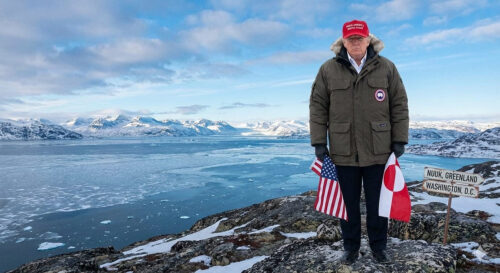
Trump’s framing flips that logic. By casting allied military activity connected to Greenland as a “dangerous situation”—and by threatening tariffs in response to European cooperation—he effectively treats allied territory as contested and allied coordination as provocation. That is unprecedented in modern NATO practice. It is one thing for allies to argue about burden-sharing or procurement. It is another for the alliance’s most powerful member to apply economic pressure on allies in a dispute that touches territorial sovereignty.
If such pressure were to intensify, the alliance confronts a question it was never designed to answer: what happens when the potential coercer is also the alliance’s principal guarantor? NATO’s deterrent architecture assumes internal trust. Once trust erodes, deterrence becomes selective—reliable in some theatres, doubtful in others.
Europe’s reaction: from managing unpredictability to resisting coercion
Europe’s response has been notable for its speed and coherence. The eight targeted states issued a joint warning that tariff threats undermine transatlantic relations and risk a downward spiral. Denmark’s leadership has spoken with unusual bluntness, rejecting the premise that sovereignty can be traded away under pressure. The coordination has also cut across institutional lines: EU and non-EU states have aligned, and the UK has found itself marching in step with continental capitals on a core sovereignty issue.
That unity is not merely symbolic. It reflects an emerging European judgement that the problem is not a single dispute over Greenland, but a method of diplomacy that weaponises trade to extract political concessions from allies. Even if the immediate crisis is defused, the episode will likely deepen Europe’s impulse to create “insurance” mechanisms—economic and strategic—against future coercion.
The EU now possesses instruments designed for precisely this kind of confrontation: responses to economic intimidation that target sectors where the aggressor is vulnerable. In theory, Europe can retaliate not only through reciprocal goods tariffs but through measures affecting services and procurement—areas where the US has substantial interests in European markets.
Yet deterrence is never free. A tariff conflict between the US and Europe would be economically painful and politically corrosive. It would disrupt supply chains, chill investment expectations, and intensify inflationary pressures in sensitive sectors. Even if Europe has the tools, deploying them risks escalation.
But Europe’s dilemma is straightforward: if coercion succeeds once, it becomes a template. If the precedent is established that tariffs can be used to force territorial or political concessions from allies, the method will spread—not only across the Atlantic alliance but into global practice. The long-term casualty would be the idea that rules and treaties restrain power. The world would move further towards an order in which leverage determines legitimacy.

Why Greenland matters strategically—without imperial choreography
It is important to separate motive from method. American interest in Greenland is not irrational. The island’s geography matters for early warning, Arctic surveillance, and North Atlantic security architecture. It also sits near emerging Arctic routes and contains mineral potential that grows more accessible as climate change reshapes the polar environment. A serious US strategy would seek strong cooperation with Denmark and Greenland to enhance defence infrastructure and resilience in the Arctic.
The problem is the language and posture of acquisition. Allies can negotiate enhanced basing rights, improved radar and early warning capability, logistics corridors, and joint exercises. What they cannot do—at least not without detonating alliance legitimacy—is accept a frame in which sovereignty is a bargaining chip, and tariffs are the enforcement mechanism. That turns strategic necessity into something closer to imperial choreography: “pay, yield, or suffer”.
Ironically, a coercive approach is also strategically self-defeating. NATO’s Arctic security depends on trust and coordination among Denmark, Norway, Iceland, Canada, the United States, and increasingly other European partners. Unilateral pressure fractures the very coalition required to secure the Arctic as the region becomes more contested.
Ice Station Zebra, Bond-era intrigue—and today’s plot twist
A journalist occasionally needs a cultural shorthand for strategic mood. The Greenland drama has the atmosphere of a Cold War thriller: a vast ice-scape, secret installations, high-stakes technology, and the sense that the real struggle is as much about control of information as control of territory. It evokes the era that gave popular culture both James Bond’s glamour and the grittier genre of polar espionage—captured memorably in Ice Station Zebra, where the Arctic becomes a theatre for deception, sabotage, and great-power brinkmanship.
But today’s plot twist is darker than fiction. In classic Cold War narratives, the Western alliance holds together and the suspense comes from an external adversary. In this episode, the destabilising pressure originates within the alliance itself. The threat is not an infiltrator in parkas; it is the proposition that treaties are subordinate to deals, and that the alliance is ultimately a conditional contract.
Scenarios: escalation, compromise, or permanent hedging
Three broad pathways present themselves.
First, escalation and fracture. Tariffs are implemented and raised; Europe retaliates; the dispute spills into defence cooperation, intelligence sharing, and political trust. NATO survives formally, but functionally weakens as allies hedge against unpredictability.
Second, managed de-escalation. Washington accepts a face-saving arrangement—enhanced access, upgraded facilities, or a new framework of Arctic cooperation—without any sovereignty transfer. The crisis cools, but the precedent remains: allies have seen that coercion was attempted, and they will plan accordingly.
Third, structural European hedging. Even if this episode is resolved, Europe accelerates defence integration and economic resilience against future coercion. The transatlantic relationship becomes more transactional on both sides—less a comprehensive alliance of assumed solidarity, more an issue-by-issue partnership.
Conclusion: when protection begins to look like conditionality
The Greenland episode is not merely about a territory, or even about tariffs. It is about the meaning of alliance. For decades, Europe has lived under a strategic assumption: that the American security guarantee—however imperfect—was a stabilising constant. Trump’s tariff-for-territory approach turns that guarantee into something else: a protection contract that can be re-priced, revised, or reneged upon when it suits the guarantor.
Europe’s unusually unified reaction suggests it understands the stakes. Sovereignty cannot be priced without corroding the international order that made sovereignty meaningful. Alliances cannot survive if the strongest member treats the weaker members as customers rather than partners. NATO may endure, but the ice beneath it has begun to crack—not because of Russian pressure on the eastern flank, but because the logic of the alliance is being tested from within.
And that is why the Shakespearean twist, however humorous, carries a serious warning: when “rot” becomes the language of politics, it is rarely confined to a single character’s ambition. It spreads—quietly, insistently—through the very institutions meant to hold the state, or the alliance, together.
India Implications?
For us in India, the temptation is to watch all this as distant theatre—Greenland today, Gaza tomorrow; Venezuela one week, Iran the next—comforting ourselves that the tremors in other people’s alliances need not shake our own ground. Officially, we issue the familiar diplomatic lullaby about “restraint”, “dialogue”, and a “peaceful and equitable resolution”, and move on. Meanwhile, ordinary citizens do what they always do when great powers play rough on faraway maps: they look up from their daily lives, scan the headlines, and keep their fingers crossed—hoping that someone else’s brinkmanship does not end up arriving, quietly and expensively, at our own doorstep.