
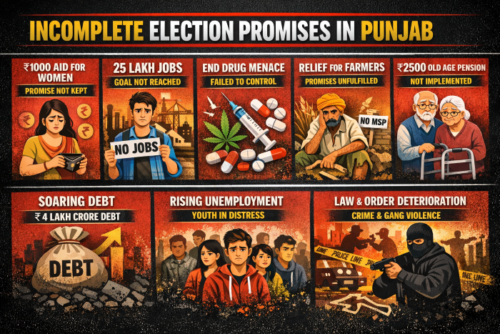
 When the Aam Aadmi Party came to power in Punjab, it did so on a wave of public trust. People believed that a new political force would finally break old patterns and deliver the change they had been promised for decades. The campaign was built on bold commitments—financial support for women, jobs for youth, a corruption‑free administration, improved public services, and justice in long‑pending cases. Today, however, many of those promises remain incomplete, raising serious concerns about governance and accountability.
One of the most widely promoted commitments was the promise of ₹1,000 per month to every woman above 18 years of age. This pledge generated enormous hope among women across the state, especially those from economically vulnerable backgrounds. Yet the scheme has never been implemented. No rollout plan, no budget allocation, and no timeline have been provided, leaving millions of women feeling misled and forgotten.
Employment was another major pillar of the campaign. AAP promised 16 lakh jobs, including one lakh government jobs in the first year alone. While a few recruitments have taken place, the overall picture remains bleak. Unemployment continues to trouble the youth, and many recruitment processes are delayed, inconsistent, or stuck in bureaucratic loops. The gap between the promise and the reality is difficult to ignore.
The government also vowed to eliminate corruption through a dedicated anti‑corruption helpline. Although the helpline exists, corruption complaints across departments continue to rise. Allegations of bribery, favoritism, and political interference persist, leaving citizens frustrated and disillusioned. Similarly, thousands of contractual employees—teachers, health workers, and other essential staff—were promised regularization. Most remain on temporary contracts, forced to protest repeatedly for job security and fair wages.
Law and order was another area where strong assurances were given. The government promised a safer Punjab, free from gang violence and criminal networks. Instead, incidents of extortion, targeted killings, and gangster activity have increased. Both NRIs and local residents express growing concerns about safety, and police responses often appear slow or ineffective.
Financial stability was also promised, yet the state’s economic condition has worsened. Departments like PRTC and Punbus face massive unpaid dues, electricity subsidy arrears remain unresolved, and the overall debt burden continues to rise. Despite repeated assurances, there is still no clear roadmap for financial recovery.
The much‑touted “Delhi‑model” improvements in schools and hospitals have also fallen short. While some renovations have taken place, the large‑scale transformation promised to the public has not materialized. Many schools still lack adequate staff, and hospitals continue to struggle with shortages of specialists, equipment, and essential medicines. The promise of world‑class public services remains distant.
Justice in sacrilege cases and a decisive crackdown on the drug network were also central commitments. However, investigations remain slow, incomplete, or politically influenced. Drug availability continues to plague communities, and major suppliers remain untouched. Families affected by addiction still wait for meaningful action.
Adding to these concerns is a growing sentiment among many Punjabis that the AAP leadership in Delhi is exerting excessive control over Punjab’s governance, sidelining local voices and weakening the state’s autonomy. Critics argue that decisions affecting Punjab are increasingly shaped by political priorities outside the state, creating the perception that the Delhi team is undermining Punjab’s interests rather than strengthening them. This feeling of external interference has deepened frustration among citizens who expected a government focused solely on Punjab’s welfare.
Punjab did not demand miracles—it demanded sincerity, transparency, and delivery. Instead, many of the most important promises remain unfulfilled, leaving citizens questioning why commitments were made so confidently but not implemented with equal conviction. A government is ultimately judged by its actions, not its slogans. And today, the gap between AAP’s promises and Punjab’s reality is wider than eve