
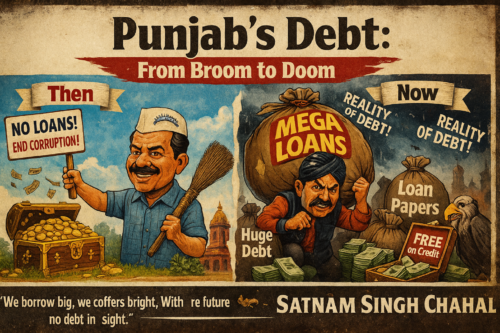
 Punjab is currently facing a severe fiscal crisis under the Aam Aadmi Party (AAP) government led by Chief Minister Bhagwant Mann. The state is now the second-most debt-ridden in India, with total liabilities estimated at Rs 3,78,453 crore by the end of March 2025, and a debt-to-GDP ratio of 46.6%. The debt situation has worsened significantly since AAP came to power in March 2022. In the past three years under AAP rule, Rs 95,000 crore has been added to the state’s debt The Tribune. The state’s debt is projected to cross Rs 4 lakh crore by 2025-26
Alarming Debt Servicing Burden: A significant portion of new borrowing goes directly to servicing old debt. This year alone, 86% of the fresh loans that Punjab will raise will go only towards repayment of old loans and servicing of legacy debt. The state earned Rs 70,000 crore in own revenue but paid nearly Rs 24,000 crore as interest on debt, meaning 34% of its revenue goes to interest payments.
A revenue deficit implies that the government needs to borrow to finance those expenses that do not increase its assets or reduce its liabilities. Revenue deficit of Rs 23,198 crore (2.9% of the GSDP) is estimated in 2024-25. The state has been running a revenue deficit consistently since 2019-20. Adding to the woes, the Punjab government fell short of its revenue target by about 10% in the 2024-25 financial year, garnering ₹93,236 crore from tax and non-tax revenues as well as grants-in-aid against its revenue receipts budget estimate of ₹103,937 crore.
The fiscal crisis has become so severe that the government is struggling to pay salaries on time. Since early June 2025, the Finance Department has cautioned that routine liabilities, especially salaries, may not be met on time, with a monthly pay bill of roughly ₹ 2,916 crore and annual pension outgo of nearly ₹ 19,800 crore Brandfetch. A fresh controversy has erupted over the government’s decision to paint schools in colours matching the AAP’s party flag. Nearly 19,000 government schools in Punjab are being painted in blue and yellow shades, which are similar to colours used by the ruling AAP in its party flags, posters and banners.
Opposition parties have strongly criticised this move. Former Education Minister Pargat Singh alleged that the colour shades were chosen as part of the ruling party’s political agenda, saying, “public money is being used for partisan propaganda in schools, which is unacceptable” However, Education Minister Harjot Bains dismissed the opposition charge as baseless, saying the shades were selected based on feedback from teachers and experts. released Rs 17.44 crore for renovating 852 government schools. The controversy has intensified public anger, as many believe taxpayer money is being used for party branding at a time when the state faces severe fiscal constraints and mounting debt obligations.
One of the biggest drains on Punjab’s finances is the free electricity scheme. Currently, 79.90 lakh domestic consumers are availing 300 units of free electricity per month, with the domestic power subsidy projected to reach Rs 8,785 crore by the end of the current fiscal year Zameen. This marks a significant rise from Rs 5,739 crore in 2022-23. The state’s annual farm subsidy burden has surged nearly 17 times from Rs 604.57 crore in 1997-98 to Rs 10,000 crore in 2025-26. The total estimated subsidy is around Rs 20,500 crore if other categories are included Barnala.
In Punjab, the freebies promised by AAP led to an additional expenditure of about Rs 20,000 crore per annum. Unable to foot the bill from its budget, Chief Minister Bhagwant Mann had to approach the Central government to help it raise around Rs 50,000 crore .The power subsidy alone is creating massive problems for the Punjab State Power Corporation Limited (PSPCL). Reeling under a financial burden of nearly Rs 8,000 crores due to non-clearance of subsidy by the state government, the new announcement by Chief Minister Bhagwant Mann put an additional financial load of over Rs 2,000 crore on the PSPCL Observer Research Foundation.
Despite the crippling debt, the AAP government continues to announce new development projects and welfare schemes, financed largely through additional borrowing. Critics argue that instead of cutting wasteful expenditure and rationalizing subsidies, the government is taking on more loans to fund politically popular but fiscally unsustainable programs. In contrast to states with larger economies, Punjab, with a debt of ₹3.78 lakh crore in 2025, has a high debt-to-GSDP ratio (46.6%), highlighting structural fiscal stress, which is not due to shocks such as Covid-19, but because of lower revenue generation year-on-year X.
The combination of mounting debt, alleged misuse of public funds for party promotion, and continuing freebies has created widespread anger among Punjab’s citizens. Many feel betrayed that while the state struggles to pay salaries and basic expenses, resources are being diverted to paint schools in party colors and fund politically motivated schemes. The controversy over school painting has become symbolic of what critics see as the AAP government’s priorities using public money for political branding while the state sinks deeper into debt. As one opposition leader noted, it reflects a government more interested in self-promotion than fiscal responsibility or genuine development.